Introduction
Websites and applications are now the foundation of almost every industry, and technology is still changing how businesses run. Because of this, businesses look for experts who can oversee the whole web development process without needing to consult with several different specialists. Because it integrates the frontend and backend into a single, effective workflow, full stack development has emerged as one of the most sought-after skills in the modern workforce.
A full stack developer can design the interface you see on a website, connect it to the server, and even manage the database that stores information. This versatility makes them highly valuable and opens countless career opportunities.
The growing popularity of this role is not just a trend. Full stack developers bring versatility, speed, and efficiency to projects, making them indispensable in industries ranging from startups to global enterprises. For new developers, this career path offers the opportunity to master multiple skills, while for businesses, it promises cost-effective and high-quality solutions.
What is Full Stack Development?
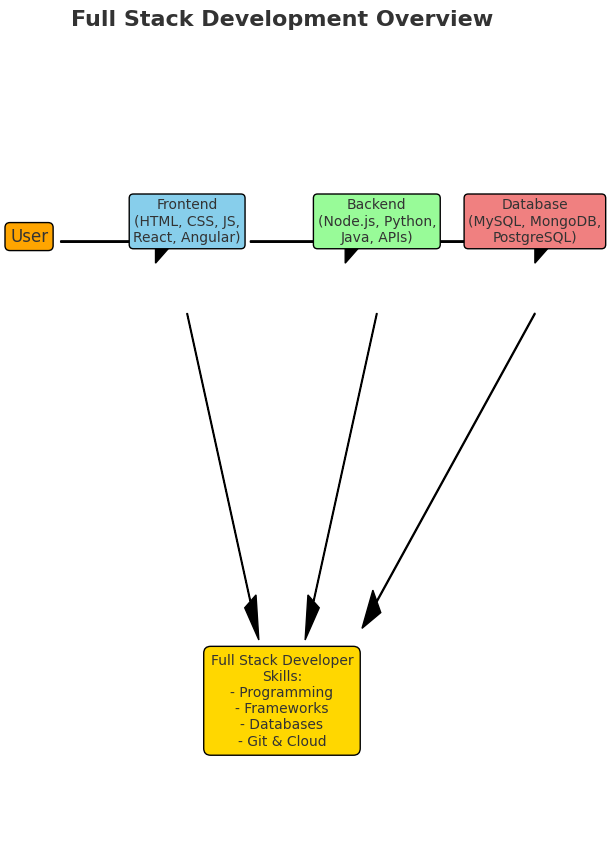
Backend: Data and business rules are processed on the server by languages like Python, Node.js, or Java.
Database: The data for the application is stored and arranged in SQL (MySQL, PostgreSQL) and NoSQL (MongoDB) databases.
Developers create seamless, user-friendly experiences across web platforms by integrating these components.
Why Businesses Choose Full Stack Developers
Businesses spend money on full stack developers for a number of reasons:
Efficiency: Project delivery can be accelerated by having a single developer manage both aspects of the application.
Cost Savings: Employing a single expert rather than two or more specialists saves businesses money.
Problem-Solving Ability: Developers can swiftly detect and resolve problems if they have a thorough understanding of the system.
Flexibility: As projects progress, they are able to transition between various technologies.
This makes full stack developers essential in startups, e-commerce platforms, and large enterprises alike.
Key Skills for Full Stack Developers
In order to be successful in this line of work, developers should concentrate on:
- Excellent programming abilities in Python, JavaScript, or Java
- Frontend frameworks such as Angular, Vue.js, and React
- Backend tools like Django, Express, or Node.js
- Knowledge of databases (both SQL and NoSQL)
- Version control using GitHub and Git
- Deployment platforms such as AWS, Azure, or Google Cloud
Advice: Long-term growth is ensured by keeping up with new frameworks and libraries.
Challenges of Full Stack Development
It has difficulties, just like any other career:
1. Quickly evolving technology: developers have to continuously pick up new skills.
2. Workload Balance: It can be very taxing to manage both frontend and backend.
3. Complex Projects: Teamwork may still be necessary for larger systems.
Despite these challenges, the career offers continuous learning and exciting growth opportunities.
Conclusion
Understanding how various technological tiers work together to create comprehensive digital solutions is the essence of full stack development, which goes beyond simple coding. Aspiring developers can benefit from its high demand across industries, flexibility, and variety of career paths. It offers businesses economical, effective solutions.
In short, full stack developers are the bridge between design and functionality, powering the digital experiences we use every day.