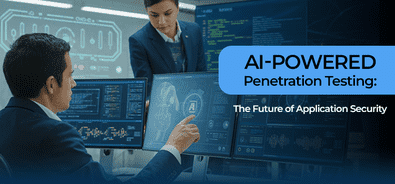
Modern applications face cyber threats frequently. Companies manage a large volume of sensitive customer operational data. Traditional security testing methods struggle to detect advanced vulnerabilities quickly. Attack surfaces are also growing larger because of cloud-based deployment, APIs, and remote access systems.
The use of AI for application security helps firms automate vulnerability detection. The use of AI also helps in detecting patterns of cyber-attacks and makes security analysis more efficient. In addition, AI-based security strategies improve their performance with more practice.
Organizations are now making investments in more intelligent cybersecurity approaches. Testing automation allows the security team to save time and minimize errors. An automated penetration test tool is faster than a manual process and also detects missed vulnerabilities.
Understanding AI-Powered Penetration Testing
Penetration testing is a process of identifying weaknesses in various software programs, networks, and systems. Security experts carry out simulated attacks to find possible weaknesses.
Traditional penetration testing depends on manual efforts to analyze systems, examine code, and carry out various simulations. It is an effective process, yet it consumes too much time. With the help of AI penetration testing, artificial intelligence automation allows for examining a large quantity of information on security vulnerabilities. Artificial intelligence algorithms learn from past attacks and analyze them in comparison with the current application behavior.
This helps companies detect their security weaknesses more effectively than by following manual procedures.
How AI Improves Application Security Testing
Traditional testing methodologies typically depend on predefined guidelines. However, using AI, systems can learn how to deal with changing attack patterns. There are many benefits that organizations can experience through AI-based application security testing.
Faster Vulnerability Detection
An AI-based system can analyze hundreds of applications within a short period of time. It cuts down the time needed for conducting the security assessment.
It also assists the security team in detecting vulnerabilities during the early stages of application development.
Intelligent Threat Analysis
AI tools analyze attack behavior patterns in real time. They identify suspicious activities that may indicate a security breach.
Machine learning algorithms continuously improve threat detection accuracy. It helps organizations respond to threats actively.
Reduced Human Error
Manual testing sometimes misses hidden vulnerabilities. Human analysts may overlook small security gaps because of fatigue or limited visibility.
Continuous Monitoring
The cyber threat environment is continuously changing. Applications also receive updates or modifications regularly. The use of AI-driven applications allows for constant monitoring as opposed to regular testing. It helps companies identify weaknesses immediately they arise.
Constant monitoring enhances the safety of applications.
The Role of Machine Learning in Security Testing
The concept of machine learning plays a crucial role in enabling AI to conduct security testing. Machine learning uses past data to look for patterns associated with cyber-attacks. It is capable of finding out things that are missed in manual testing.
For instance, AI understands how an attacker exploits a vulnerability such as SQL injection or an API flaw. The AI is able to find attacks of the same pattern in other software applications as well.
Not all vulnerabilities carry the same level of danger. The AI technology can assess the level of severity of the vulnerabilities based on exploit likelihood, business impact, and attack complexity. It allows the security teams to focus on the most threatening activities first.
The greater the business collects the security information, the better the performance of AI technologies.
Benefits of AI in Application Security
Organizations across industries are adopting AI in application security because of its operational and security advantages.
Improved Efficiency
AI-driven systems automate repetitive testing activities. Security teams can complete assessments much faster.
It increases overall productivity.
Better Scalability
Modern applications often contain millions of lines of code. Large enterprises also manage multiple cloud environments and APIs. AI solutions allow scaling security tests for large infrastructures. This leads to increased security coverage.
Cost Efficiency
Automation decreases the need for repetitive manual operations. Companies can save on expenses while enhancing their security efficiency.
Faster Incident Response
Real-time detection of suspicious activities is possible using AI technology. The alert is delivered to the security team more quickly than before.
Enhanced Compliance Support
Different sectors have their own set of rules for cybersecurity. AI technology ensures that compliance standards are met. Automation improves the process of auditing.
Challenges of AI-Powered Penetration Testing
Although AI offers significant advantages, organizations should also understand its limitations.
False Positives
There are instances when AI technology provides false alerts. Security departments might work on threats that do not exist. Model tuning of AI is essential for enhancing accuracy.
High-Quality Data Requirement
The machine learning algorithm requires high-quality security data. Ineffective data quality would decrease the effectiveness of testing processes. Updating AI technology to adapt to new cybersecurity threats is vital.
Role of Humans in Cyber Security
AI cannot completely replace humans in the process of cybersecurity. It is human expertise that plays a vital part in strategizing and making ethical decisions.
AI should support security teams instead of replacing them.
Why Businesses Are Investing in AI Development Services
Most companies collaborate with service providers offering AI development services to improve their security capabilities. Custom AI in application security needs to be in accordance with the industry. AI developers can develop intelligent testing frameworks specific to each environment. Financial organizations, hospitals, eCommerce firms, and SaaS vendors are increasingly using AI-enabled security solutions.
Use of AI for security is expected to see explosive growth in the coming years.
Future Trends in AI-enabled Testing
In the future, cybersecurity will involve automation and intelligence to identify threats. Future trends that could influence the future of AI-enabled testing include:
Autonomous Security Testing
Future AI systems will perform autonomous penetration testing. Such systems would be able to carry out simulations of attacks without human involvement.
It improves testing speed and scalability.
Predictive Threat Intelligence
AI will be able to predict future attacks with increased efficiency. Predictive analytics will allow organizations to prevent any security attack before it happens.
This will become an increasingly important trend.
Integration With DevOps
Many companies have started implementing security into their software development cycles. This will help them perform automated security testing during their development process.
This helps developers identify vulnerabilities earlier.
Advanced Behavioral Analysis
Future AI systems will improve user and application behavior analysis. These systems will detect subtle anomalies that may indicate hidden threats or advanced attacks.
Behavior-based detection will strengthen overall cybersecurity strategies.
Best Practices for Implementing AI-Based Security Testing
In application security testing with AI, companies have to use a strategy-driven approach.
Use AI in Combination with Human Experts
AI systems perform effectively when paired with cybersecurity professionals who validate results and solve complex issues.
Constant Updating of AI Models
Cybersecurity threats change constantly. Companies should train their AI solutions constantly on new threats. It makes the tool more accurate.
Focus on Data Protection
AI for security purposes includes handling sensitive data and requires secure solutions from companies.
Continuous Testing
It is necessary to conduct continuous tests. It is useful for detecting vulnerabilities at an early stage. It enhances application security significantly.
Conclusion
The complexity of cybersecurity risks continues to evolve. Traditional techniques used for testing cannot provide adequate protection for modern applications. The integration of AI in application security sphere is changing the game entirely. AI solutions accelerate testing, facilitate the performance of routine activities, and enhance threat intelligence.
Organizations implementing penetration testing based on artificial intelligence can gain advantages in terms of efficiency and security. Artificial intelligence tools help perform continuous monitoring and faster incident responses.
It is necessary to consider a balance between automation and expertise since cybersecurity experts will always be vital for making decisions. Organizations utilizing intelligent solutions for security will have better preparedness for future digital challenges.