The Reasons Logistics Information Systems Need DataVare EML to PST Converter
By Eliza Bell 22-06-2026 115
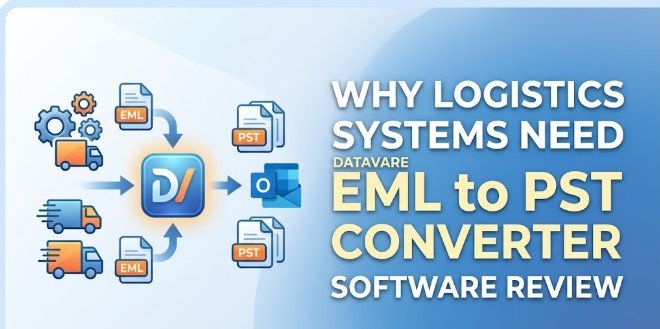
The Day 14,750 Shipment Dispute Emails Took Over My Life
Only logistics IT specialists are familiar with a certain type of stress. It is unlike the anxiety caused by a system failure or a network outage, which have obvious solutions and timetables. It is the anxiety of learning that 14,750 emails with documentation related to shipment disputes must be located, checked and made available for legal review and the deadline has already passed.
In late October, such was my Tuesday morning.
A growing issue cluster involving multiple significant freight accounts had been identified by our legal team. Our EML archive system contains months' worth of back-and-forth communication between numerous stakeholders, including carriers, customs brokers, warehouse operators and multiple jurisdictions. I was given five days by the compliance officer. Before making their first external call, the legal team wanted everything to be searchable and cross-referenced.
For more than ten years, I have overseen logistics information systems. I am aware of the complexity of our data environment. However, I must admit that as I stood in front of that request, I felt a slight shift in the ground beneath my feet.
Recognizing the Problem's True Scope
I had to sketch out exactly what we were dealing with before I could even consider solutions.
Over the years, our company had gathered EML files from multiple mail clients and export cycles. By their very nature, dispute communications involve several departments, including customer service, operations, financial, legal and carrier relations. This indicates that threads were dispersed throughout several export folders without a central index.
The actual state of affairs was as follows:
• 14,750 EML files dispersed throughout departmental export folders that contained correspondence regarding shipment disputes
• Files created using uneven naming conventions across various mail platforms
• The entire EML collection lacks a uniform search feature
• Degradation of metadata on older export batches: missing or incorrectly formed timestamps
• Rather of ordered case groupings, folder structures represented individual user exports
• Legally required correspondence cross-referenced by date range, carrier name and shipment ID
• 48,000 associated emails contained supporting messages that also required to be exposed, including status updates, carrier confirmations and customs alerts
This was quite overwhelming because of that final figure. There were more than 14,750 disagreement emails that we were retrieving. Almost three times that volume was affected by the communication web we were rebuilding.
What We Attempted Before Realizing We Needed a Better Instrument
To be clear, my staff is capable. Before stepping outside of our current toolbox, we tried every internal alternative.
Manual Email Searches in All Exported Folders
To find pertinent threads, our first impulse was to use desktop search capabilities like Windows Search, indexed folder searches and direct Outlook folder imports.
What took place in reality:
• The search results varied depending on the export batch
• Search results from EML files from previous export cycles contained incomplete metadata
• There was no batch search across raw EML; instead, cross-referencing by shipment ID required manually opening each file
• We found about 340 pertinent files after six hours
• It took weeks of work to extrapolate that rate across 14,750 files
• That was mathematically impossible due to the legal team's five-day window
Attempts to Import Outlook Manually
Then, with the intention of using Outlook's built-in search once everything was inside a mailbox structure, we attempted importing EML files into Outlook in manageable chunks.
What we faced:
• Outlook was able to manage 50–80 files in small batches
• Batches larger than 200 files resulted in noticeable lags and program crashes
• Everything landed flat; the folder structure from the first exports did not survive the import
• About 12% of the files in our test batch had broken attachment links
• There was no feasible method for us to scale this to 14,750 files in five days
• Each imported item's manual verification was adding hours that we didn't have
Less than 800 files had been processed manually by the end of the second day. That night, I was genuinely uncertain about how we would make the deadline as I sat in my car in the parking garage. I don't like to sit with that emotion.
Why Use a Specialized EML-to-PST Conversion Software Was the Only True Way Ahead
The fundamental issue was architectural. EML is a per-email format that works well for individual storage but not for large-scale cross-referencing of thousands of records. The PST container format was created specifically for the type of organized, searchable archive that our legal team required.
The solution became evident after I reframed the issue: we had to combine all of the EML collection into a PST structure that corresponded to our case organization. This required more than simply file conversion; it also required rebuilding the archive in a way that made legal review feasible.
I found DataVare EML to PST Converter as a result of that search.
Why a Legal Dispute Review Should Use PST as the Output Format
For our use case, PST was the appropriate output for a number of specific reasons:
• Outlook compatibility: PST files open automatically without the need for further tools or training, and our legal staff works only with Outlook
• Folder-level organization: Within a single archive file, we may arrange by carrier, dispute category and date range thanks to PST's support for nested folder structures
• Full-text search for the whole archive: all emails, subject lines, bodies and attachments can be simultaneously searched once they are in Outlook
• Attachment integrity: Unlike EML flat imports, PST maintains attachment-to-email linkages
• Admissibility: Our legal team verified that the documentation review processes we underwent accept PST archives with entire information
The output PST was arranged as follows:
• High level: Legal Review 2024 – Dispute Archive
• Carrier folders: Each carrier company engaged in ongoing disputes has a subfolder
• Date range subfolders: Each carrier folder's monthly groups
• Supporting communications folder: 48,000 relevant emails arranged by shipment ID prefix in a separate subfolder
I created this structure prior to performing the conversion and the tool faithfully followed it.
What Genuinely Worked Well
• Full-scale batch processing: 48,000 supporting emails and 14,750 primary files were handled without a single queue failure
• Preservation of folder hierarchy: output PST precisely mirrored the structure mapped during pre-conversion staging
• Accurate metadata: all file generations retained original timestamps, sender/recipient fields and subject lines
• Attachment integrity: each attachment remained connected to its parent email
• Speed: entire 62,750-file task completed in about 9 hours across two overnight sessions
• Independent operation without requiring Outlook for processing
Limitations You Should Be Aware Of
• Windows-only requirement
• Requires strong pre-organization
• Manual batch initiation required
• Corrupted EML files need pre-cleaning
These are planning considerations, not failures.
Final Result: A Close Look at the Numbers
- 14,750 EML dispute files completed
- 48,000 supporting communications processed
- 100% metadata preservation in sampled validation
- Day 5 legal deadline completed on Day 4
- Full integrity of attachments maintained
One full day ahead of time, the legal team had a well-organized and searchable archive.
Conclusion:
Large-scale EML archive retrieval cannot be accomplished with Outlook imports or manual email searches. When file volume scales, those methods collapse.
The conversion process restored structure, speed and reliability to what was previously a chaotic archive.
If you are managing logistics EML archives, prepare your batch conversion strategy before urgency forces your hand because in logistics, urgency is never optional.