Machine learning is no longer a complex, mysterious technology reserved for scientists and tech giants. Today, it’s a practical tool used in everyday applications—from predicting movie recommendations to identifying fraud in banking. For beginners who want to enter this exciting field, understanding machine learning basics is the first and most important step.
Whether you're a student, aspiring data scientist, or working professional exploring new opportunities, this guide breaks everything down in simple, digestible language. By the end, you’ll know what machine learning is, how it works, and how you can start building your own projects.
What Is Machine Learning?
Machine learning (ML) is a branch of artificial intelligence where computers learn patterns from data instead of being explicitly programmed. Instead of writing step-by-step instructions, you feed data into an algorithm, and the system uses this information to make predictions or decisions.
A classic example is email spam detection. You don’t write rules for every spam message. Instead, the system learns from thousands of labeled emails and identifies patterns automatically.
This “learning from data” approach is the core of machine learning basics.
Why Machine Learning Matters Today
Machine learning has transformed industries, making processes faster, smarter, and more accurate. Here are some real-world examples you’ve probably encountered:
Netflix and YouTube recommendations: ML predicts what you’re likely to enjoy.
Google Maps: ML improves travel time estimates using real-time traffic patterns.
Healthcare: ML models help in diagnosing diseases from medical scans.
E-commerce: ML personalizes product suggestions and detects fraudulent orders.
Understanding machine learning basics opens the door to contributing to such innovations.
Types of Machine Learning
To truly understand how ML works, beginners must learn its main categories. These fundamental types form the backbone of machine learning basics.
1. Supervised Learning
This is the most popular and beginner-friendly type.
You train a model on labeled data—meaning the input and output are already known.
Examples:
Predicting house prices
Classifying emails as spam or not
Forecasting sales
2. Unsupervised Learning
Unlike supervised learning, the data has no labels. The system tries to find hidden patterns on its own.
Examples:
Customer segmentation
Grouping similar images
Detecting anomalies in financial data
3. Reinforcement Learning
Here, the model learns by interacting with an environment. It receives rewards for good actions and penalties for bad ones.
Examples:
Self-driving cars
Game-playing AI
Robotics
These categories are essential parts of machine learning basics, helping beginners choose the right approach for their problem.
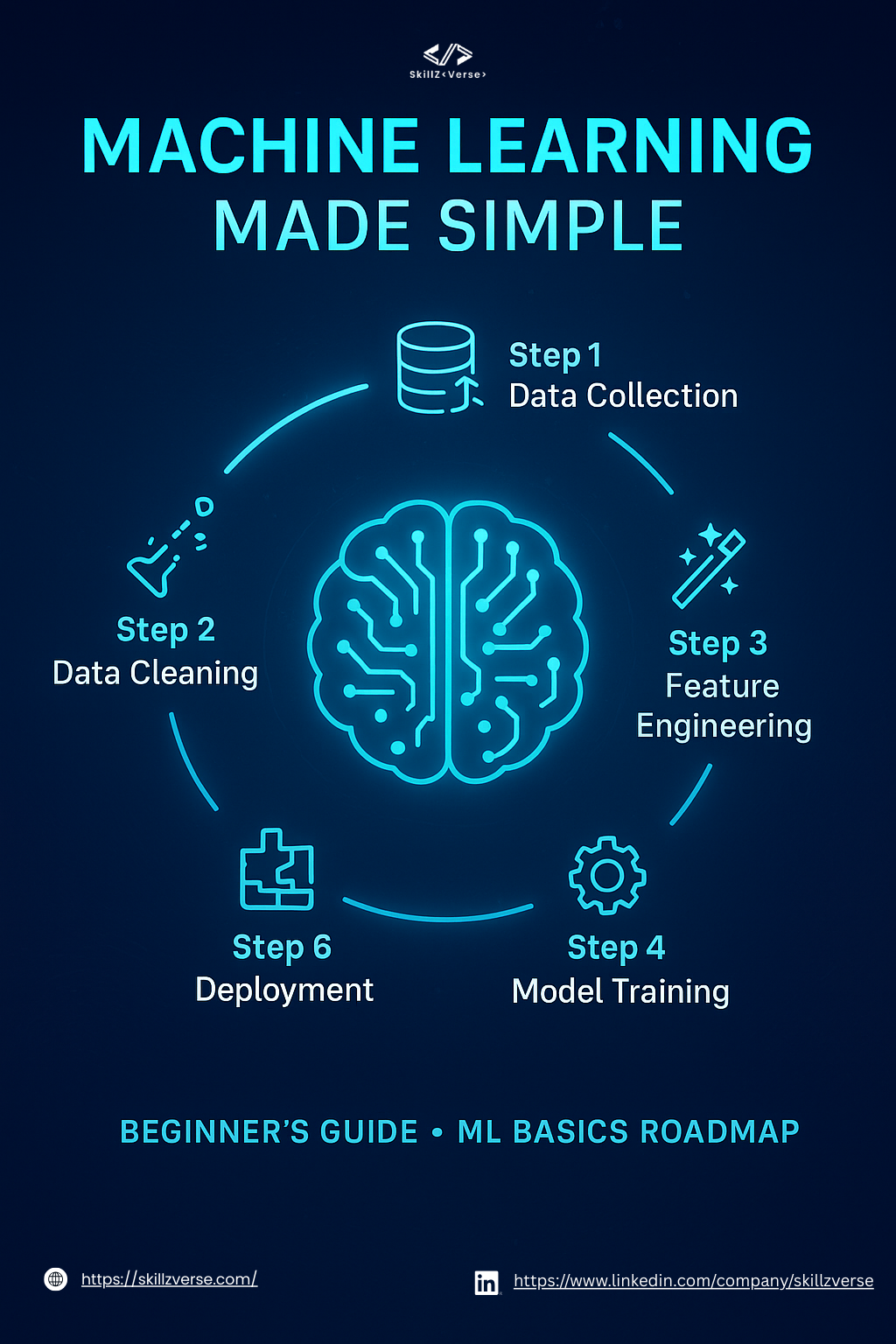
How Machine Learning Works: The Simple 6-Step Process
Machine learning may seem complicated, but the workflow is straightforward when broken into steps. Understanding this pipeline is a key part of mastering machine learning basics.
Step 1: Data Collection
ML models learn from data—so the more relevant data you have, the better.
Data may come from spreadsheets, sensors, websites, or company databases.
Step 2: Data Cleaning
Raw data often contains errors, empty values, duplicates, or outliers. Cleaning improves the quality and accuracy of the model.
Step 3: Feature Engineering
This involves selecting and transforming the right variables (features) that influence the prediction. Good features make your model smarter.
Step 4: Model Selection & Training
You choose an algorithm—like Linear Regression, Decision Trees, or Neural Networks—and feed it your data so it can learn patterns.
Step 5: Evaluation
After training, you test the model on unseen data to check its performance. Metrics like accuracy and precision help measure success.
Step 6: Deployment
A well-performing model is then deployed into real applications, such as websites, mobile apps, or business systems.
This six-step pipeline is the foundation of machine learning basics, and beginners can follow it to build any ML project.
Essential Terms Every Beginner Should Know
Learning ML includes understanding a few core terms. Here are some easy explanations to strengthen your grasp of machine learning basics:
Dataset: A collection of data used for training or testing.
Labels: The correct answers in supervised learning.
Model: A mathematical representation of learned patterns.
Training: The step where a model learns from data.
Prediction: The model's output after learning.
Accuracy: How often the model is correct.
Overfitting: When a model learns too much from the training data and performs poorly on new data.
These terms will appear often as you learn more advanced concepts.
Applications of Machine Learning
Understanding machine learning basics becomes more exciting when you see how widely ML is used today. Here are some popular applications:
Chatbots & Virtual Assistants: Siri, Alexa, and customer support bots use ML for natural language understanding.
Finance: ML models detect fraud and automate investment decisions.
Marketing: Businesses use ML to analyze customer behavior and improve campaigns.
Healthcare: Algorithms assist doctors in analyzing X-rays, MRIs, and patient records.
Manufacturing: ML helps predict equipment failures and improve production efficiency.
These examples show how machine learning powers modern technology behind the scenes.
How Beginners Can Start Learning Machine Learning
Starting your ML journey is easier than ever. Here’s a simple roadmap:
1. Learn the Basics of Python
Python is the most popular language for ML.
2. Understand Core ML Concepts
Study algorithms, data types, and workflows to strengthen your machine learning basics.
3. Practice with Small Projects
Start with:
Predicting house prices
Classifying images
Sentiment analysis of reviews
4. Explore ML Libraries
Tools like NumPy, Pandas, Scikit-learn, and TensorFlow make ML development much simpler.
5. Build a Portfolio
Share your projects on GitHub to showcase your skills.
Final Thoughts
Machine learning is reshaping the world, and learning it now can open doors to amazing career opportunities. By mastering machine learning basics, anyone—from beginners to working professionals—can start building intelligent applications that solve real problems. With the right guidance, practice, and curiosity, your journey into machine learning can be both rewarding and impactful.
Tags : .....