Most buying decisions for health insurance software start with a spreadsheet of features. Claims adjudication, benefits configuration, provider directories, member portals, appeals workflows: every vendor checks the boxes, and the demo looks convincing. The trouble shows up three months after go-live. A clean claim gets denied. A provider gets paid the wrong amount. An audit flags a member who was eligible the whole time. Trace any of those back far enough and you rarely find a missing feature. You find two systems that disagreed about the member record at the moment a decision got made.
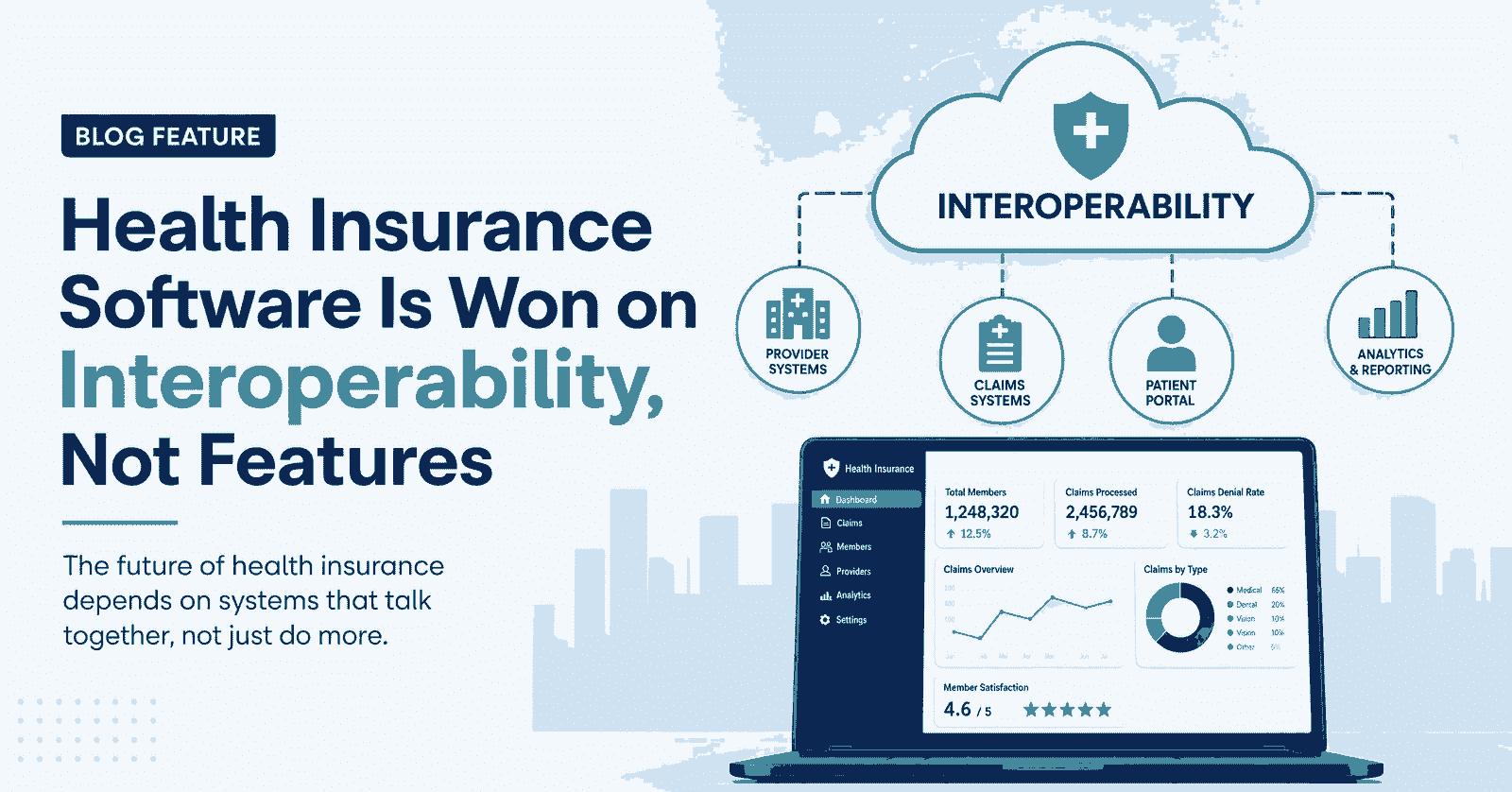
That disagreement is the real story. The shortlist of health insurance software companies worth your time is not the one with the longest feature list. It is the one whose systems exchange data in real time and agree on a single version of the member, the provider, and the benefit. Interoperability is the quiet differentiator, and it settles more denials, payments, and compliance outcomes than any button you will click in a demo.
Where Health Insurance Software Buyers Get Misled by Feature Lists
A feature is easy to show. A connection is hard to prove. That gap is why so many evaluations reward the wrong thing. On screen, two products can both claim real-time eligibility, automated adjudication, and self-service member portals. Under load, they behave nothing alike.
Take eligibility. One product answers a 270 request by reading a file that refreshed at 2 a.m., so it confirms coverage that a termination voided at 9 a.m. Another queries the enrollment system of record and returns the current state in the 271 response. Both check the "real-time eligibility" box. Only one is telling the provider the truth. The feature label is identical; the plumbing behind it is not.
The same holds for adjudication, care management, and reporting. Health Insurance Software sells on what the interface promises, then lives or dies on whether the data feeding that interface is current, complete, and consistent across every module. When you score vendors on features, you compare promises. When you score them on interoperability, you compare behavior. Buyers who stop at the checklist tend to discover the difference during their first reconciliation cycle, not during procurement.
Interoperability and Real-Time Data Exchange Do the Quiet Work
Interoperability means systems share data in a form each side understands, without a human translating between them. Real-time exchange means that sharing happens at the speed of the decision, not overnight in a batch job. The two together decide whether the record an adjudication engine reads at 9:04 a.m. reflects the enrollment change that posted at 9:03.
Batch integration still runs most of the industry, and it hides its cost. A nightly enrollment file, a weekly provider load, and an accumulator update that lags by a day each look harmless on their own. Stacked together, they guarantee windows where the claims engine, the portal, and the provider directory each hold a slightly different truth. Event-driven exchange closes those windows. When an enrollment change publishes an event that eligibility, accumulators, and member communications all consume within seconds, every downstream system reasons from the same facts.
The point is not speed for its own sake. Faster sync means fewer moments where two systems disagree, and every disagreement is a candidate for a denial, an overpayment, or a member complaint. Cut the disagreements and you cut the downstream cleanup that quietly consumes operations budgets.
The Member Record at Adjudication Is Where Money Leaks
Adjudication is the moment of truth, and it reads from several sources at once. The engine checks whether the member was eligible on the date of service. It reads the plan and benefit configuration that governs coverage. It looks up the provider contract that sets the rate. It reads accumulators to see how much of the deductible and out-of-pocket maximum the member has already met. If any one of those sources is stale, the math comes out wrong even when the claim itself is perfect.
Accumulators show the pattern clearly. A member hits their deductible on Monday. If the accumulator does not propagate before Tuesday's claim adjudicates, the engine applies cost share that the member no longer owes. Now you have a wrong payment, a confused member, and a correction cycle that costs more to run than the error was worth. Multiply that across a book of business and the leakage is structural, not occasional.
Provider data behaves the same way. When the directory, the contract system, and the claims engine disagree about a provider's network status or fee schedule, claims pay at the wrong rate or deny for a network reason that was resolved weeks ago. None of this is a feature defect. Each module works as designed. They simply never agreed on the record. That is the failure interoperability exists to prevent, and it is the failure a feature comparison will never surface.
The leak also compounds in ways a demo hides. Each wrong payment spawns a recovery effort, each wrong denial spawns an appeal, and each appeal pulls a nurse or an examiner off the work that actually needs judgment. Provider abrasion follows, because practices that get paid inconsistently escalate, renegotiate, or leave the network. Members lose trust after the second surprise bill. The original error was a data-sync gap that lasted a few hours, yet the bill for it arrives as staffing cost, network friction, and regulatory exposure months later. That is why interoperability belongs at the center of the evaluation rather than in a footnote about integrations.
The Standards That Make Systems Agree: FHIR, X12, and HIPAA
Agreement between systems is not improvised. It runs on published standards, and a serious evaluation checks how deeply a platform implements them.
X12 EDI carries the administrative transactions the industry runs on. The 837 moves claims, the 835 returns remittance and payment detail, the 834 handles enrollment and benefit maintenance, the 270 and 271 pair asks and answers eligibility, and the 278 covers prior authorization requests and responses. HIPAA names these as the required transaction standards, so support is not optional. What varies is depth: whether a platform handles the full set cleanly, validates against the correct versions, and reconciles the acknowledgments that tell you a transaction actually landed.
HL7 FHIR is where clinical and coverage data now move through APIs rather than flat files. FHIR resources give member, coverage, claim, and provider data a shared structure that applications can request on demand. The CMS interoperability rule turns that from good practice into obligation: affected payers must stand up FHIR-based Patient Access, Provider Access, Payer-to-Payer, and Prior Authorization APIs, with most requirements taking effect in 2027, and the agency estimates roughly $15 billion in savings over ten years. TEFCA extends the same idea to nationwide exchange, giving networks a common framework to share records across organizations under agreed rules. A platform that treats FHIR and TEFCA as roadmap items rather than shipped capabilities is telling you where it will be brittle.
Where AI Agents in Insurance Fit the Picture
The current wave of automation raises the stakes on all of this. AI agents in insurance now triage claims, draft prior-authorization decisions, summarize appeals, and answer member questions. Every one of those tasks reads the member record and acts on it. An agent that adjudicates against a stale accumulator or a wrong network status does not make a smarter mistake than a batch job. It makes the same mistake faster and at greater volume.
Automation inherits the quality of the data beneath it. Point an agent at a record that three systems disagree about and it will confidently produce a wrong answer, then propagate that answer into a letter, a payment, or a portal message. Point the same agent at a synchronized, standards-based record and it earns its keep. Interoperability is the precondition that makes automation safe to trust, which is why the strongest platforms invest in the data layer before they market the agent on top of it.
The sequence matters when you plan a roadmap. A plan that automates on top of batch integration simply scales its existing disagreements, and the errors surface faster than the team can chase them. A plan that fixes the exchange layer first gives every later agent a record it can rely on. Treat the data foundation as the first investment, and the automation that follows becomes a multiplier rather than a liability.
What to Ask Health Insurance Software Companies Before You Sign
Move the evaluation off the feature grid and onto the connections. When you meet health insurance software companies, press on the questions that predict behavior after go-live:
- API depth: which FHIR resources are supported today, and can the platform meet the Patient Access, Provider Access, Payer-to-Payer, and Prior Authorization requirements without custom development.
- Transaction handling: which X12 versions run in production, and how the platform validates and reconciles 837, 835, 834, 270/271, and 278 acknowledgments.
- Exchange model: whether integration is event-driven or batch, and the actual latency between an enrollment change and its appearance in eligibility, accumulators, and the portal.
- Source of truth: how the platform decides which system owns the member, provider, and benefit record, and how conflicts get resolved rather than duplicated.
- Reconciliation: what happens when a transaction fails, how errors surface, and who owns the correction workflow.
- Regulatory readiness: concrete evidence of CMS interoperability compliance and a credible TEFCA participation path, not a slide that says "on the roadmap."
Ask for a demonstration against your own data, mid-cycle, with an enrollment change pushed live during the session. A modern health insurance platform should show that change reflected everywhere within seconds. A brittle one will need a batch window, and it will tell you so.
Security and Compliance Ride on the Same Plumbing
Interoperability and compliance are not separate projects. They share the same foundation. HIPAA governs how protected health information moves and who may see it, and every FHIR API and X12 exchange has to honor those rules with encryption, access controls, and audit logging that stands up to review. A platform that exchanges data cleanly usually documents that exchange cleanly too, which is exactly what an auditor wants to see.
Data lineage is where the two goals meet. When each field in the member record has a known source and a timestamp, the team can explain why a claim paid the way it did, prove that a decision used current eligibility, and answer a regulator without a forensic reconstruction. Consistency also underpins consent: as TEFCA-based sharing widens, the platform has to track who authorized what and enforce it at the point of exchange. Systems that agree on the record produce defensible audits almost as a byproduct. Systems that disagree turn every audit into an investigation, because no one can say which version of the truth the decision actually used.
Buy the Connections, Not the Checklist
Feature parity is real, and it is not where deals should be decided. The health insurance software companies that earn a long-term contract are the ones whose systems agree on the member record in real time, implement FHIR, X12, and HIPAA transactions with depth, and treat CMS interoperability and TEFCA as shipped capabilities rather than promises. That is the standard that prevents wrong denials, protects payment integrity, and keeps audits routine. As automation and connected exchange spread across the market, the platforms built to keep every system telling the same truth will pull ahead. See how a connected health insurance platform turns interoperability into everyday accuracy.
Tags : technology software tech