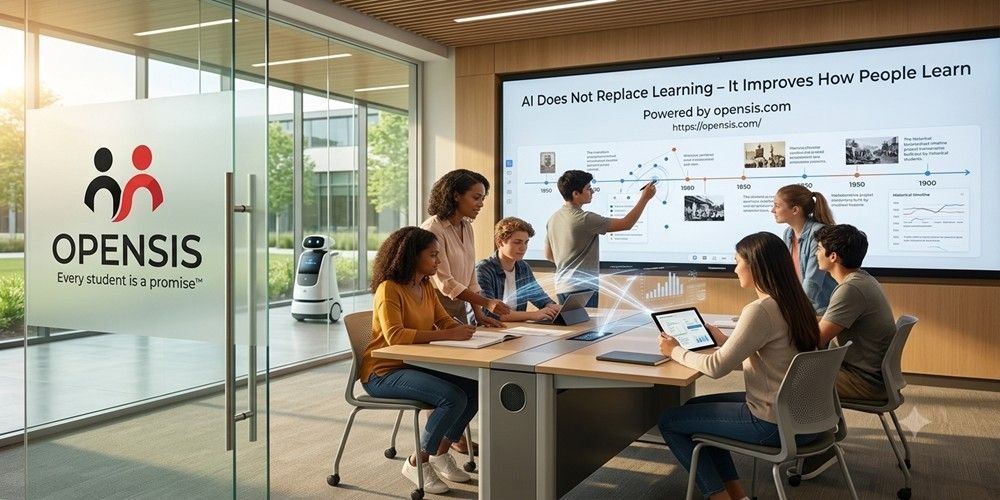
Artificial Intelligence walked into the education landscape with many promises and expectations. Schools immediately wanted to know what are the tasks AI can do for them. Learning AI became a necessity because everyone wanted a piece of this wonder tool. People became obsessed with AI-powered tools like SIS with Moodle integration. Even though AI-powered SIS platforms like openSIS offered a long range of features to simplify school operations, institutions continued to look for other digital tools with Artificial Intelligence. As a result, schools ended up with a multitude of tools and very little product knowledge. AI literacy is important in this era, but it is not what people make it. Knowing AI does not mean knowing where to click. Rather, knowing this tool refers to two things –
- Knowing when to use it
- Knowing how much to use it
The ethical side of AI use often gets buried beneath the piles of how-to’s and users’ manuals. When schools conduct product training, they usually don’t prioritize the principles of using Artificial Intelligence. However, it is essential that teachers, educators, and students know where to stop and what to flag.
What AI-Powered SIS Stands For
Before getting into further discussion, let’s understand what AI can do for education. Does it simplify teaching? Or does it add to the complications? Many are wondering this because they have strategically pushed themselves into a trap by collecting AI tools like old stamps. They added multiple tools to handle tasks a well-implemented SIS with Canvas integration can do with ease.
So, what exactly does an AI-powered student information system bring to your operations? SIS does not magically fix your school administrative tasks. Neither does it organize fragmented data right after implementation. SIS works slowly and begins with centralization. When you implement AI-Powered SIS platforms, you can expect –
- Accuracy
- Data analysis
- Pattern recognition
- Trend prediction
- Success prediction
- Student progress tracking
- Quick reporting
- Reduced errors
- Strategic insight
- Smart dashboard
Now, all these will work for your benefit, only when you know how to use this digital system properly. Understand that AI SIS with Moodle integration works on prompts. But it is not easy to use those prompts. Generic prompts will get you generic results. Anyone can use prompts and make AI generate hundreds of write-ups. But to make AI generate work befitting your requirements, you need literate people dealing with AI.
In addition, teachers, students, and administrators need to understand that AI can make mistakes. They need to understand that AI has limitations. Also, often AI write-ups sound heavily biased because of the data feed.
To use digital tools that can think smart, humans have to be smarter. They need to verify AI content before using it. Students need to flag biased insights and regenerate pieces. The idea is to reduce the mundane and quicken daily tasks. The idea is not to copy-paste what AI is generating.
If you think properly, AI literacy is more about using it responsibly. Before you introduce any tool, it is important to introduce the instruction manual in the form of training.
Lastly,
The biggest AI skill is not technical. Plot twist: technical skills alone will not teach you to use AI. You can use it, but you will not be able to become an expert. To make this tool work well, you need to possess critical thinking and subject expertise. Think about it – only someone with writing skills would be able to create fitting prompts to generate excellent AI content. Buying an AI-powered SIS with Moodle integration is easy. But building confident teachers can be difficult. Remember that practice can make things perfect for the administrators. Therefore, you need to give your people time to get accustomed to AI.
1. What is AI literacy in education?
AI literacy is the ability to use, evaluate, and apply AI responsibly in teaching and learning.
2. Why is AI literacy important for educators?
It helps teachers make informed decisions while using AI to enhance learning.
3. How does a Student Information System support AI adoption?
A Student Information System provides the accurate, centralized data that AI tools depend on.
4. What are the benefits of SIS with Moodle integration?
It synchronizes student and course data between your SIS and Moodle, reducing manual work.
5. Why choose SIS with Canvas integration?
It streamlines data sharing, improves reporting, and keeps student information up to date.
6. Can AI replace teachers in the classroom?
No, AI supports teachers by automating tasks, not replacing human expertise.
7. How does AI improve student learning?
AI can personalize learning, provide timely feedback, and identify learning gaps.
Tags : SIS with Moodle integration