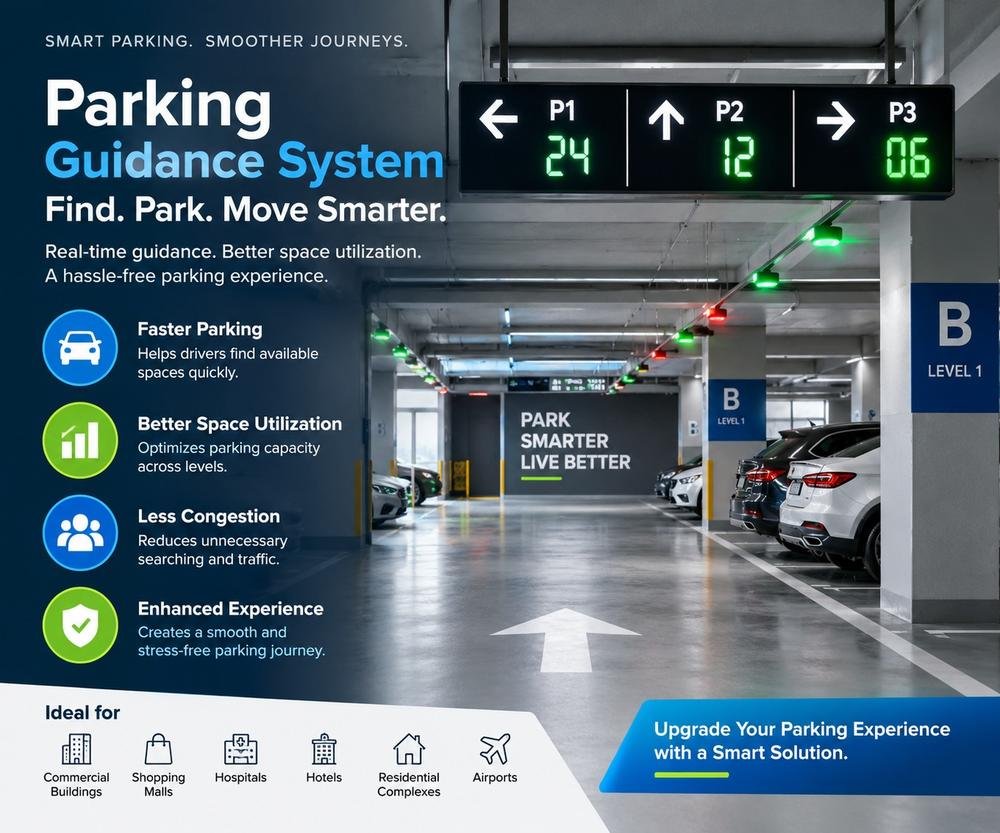
A parking facility can have hundreds of spaces.
Yet finding an available space can still become surprisingly difficult.
Drivers enter, slow down, look around, follow other vehicles, and sometimes move through several rows before finding a place to park.
The problem is not always a lack of parking.
Sometimes, it is simply a lack of information.
This is where a Parking Guidance System becomes interesting.
Rather than leaving drivers to search for spaces on their own, a guidance system helps make parking information easier to understand while vehicles move through a facility.
It changes parking from a search process into a more organized experience.
Parking Starts Before the Vehicle Reaches a Space
Most parking discussions focus on capacity.
How many vehicles can the facility accommodate?
How many spaces are available?
Where should vehicles be parked?
But another question is equally important.
How easily can drivers find those spaces?
A large parking facility can become difficult to navigate when drivers have no clear information about available areas.
Vehicles may circulate unnecessarily.
Drivers may follow the wrong lane.
Congestion can develop around popular parking sections.
A Smart Parking Guidance System addresses this problem by making parking information visible at the right points.
The objective is not simply to display information.
It is to help drivers make better decisions while moving through the parking area.
Finding a Space Is Different From Having a Space
A parking space can exist without being easy to find.
This distinction is often overlooked.
Imagine a facility with several parking levels and multiple sections.
There may be vacant spaces on one level while another area is crowded with vehicles searching for parking.
Without guidance, drivers have limited information.
They depend on signs, memory, observation, or other vehicles to understand where they should go.
A Parking Guidance Solution can make this process more structured by directing drivers toward available parking areas.
The result is a more understandable parking environment.
Parking Guidance Can Influence Vehicle Movement
Parking facilities are not static spaces.
Vehicles are constantly entering, moving, stopping, turning and exiting.
When many drivers are searching for parking at the same time, movement can become less predictable.
A Parking Guidance System in India can support better vehicle movement by providing information before drivers reach every individual parking area.
This can reduce unnecessary searching and help distribute vehicles across available sections.
The value is therefore not limited to parking convenience.
It can also contribute to a more organized flow of vehicles inside the facility.
Information Becomes Part of Parking Management
Traditional parking management often focuses on barriers, tickets, entry points and exit points.
These elements remain important.
But modern parking facilities also need information.
Drivers want to know where they can park.
Facility teams want better visibility of parking conditions.
Management wants the parking area to operate in an organized manner.
This is where a Parking Guidance System can become part of a broader parking management approach.
It connects the physical parking space with information that helps people use that space more effectively.
Large Facilities Have Different Challenges
Not every parking facility operates in the same way.
A corporate office may have predictable employee traffic.
A shopping centre may experience busy periods during weekends.
A hospital may have different visitor patterns throughout the day.
Residential facilities may have a combination of residents, guests and service vehicles.
These differences matter when selecting a Smart Parking System.
The right approach depends on factors such as parking capacity, layout, traffic patterns and how drivers move through the facility.
A system should support the actual environment rather than simply adding technology for its own sake.
Parking Layout Still Matters
Technology cannot completely replace good parking planning.
The layout of a facility determines how vehicles enter, turn, circulate and reach parking spaces.
A Parking Guidance System works best when it is considered alongside the physical design of the parking area.
Signs should be positioned where drivers can understand them.
Guidance should be visible before a decision needs to be made.
Routes should remain simple enough for drivers to follow.
The objective is to create a relationship between the parking infrastructure and the information provided to drivers.
Parking Guidance and Access Control Can Work Together
Parking guidance is only one part of a modern parking environment.
Facilities may also use boom barriers, access control systems, vehicle identification and other technologies to manage entry and exit.
When these systems are planned together, parking operations can become more coordinated.
A Parking Management System can manage broader parking processes, while guidance focuses on helping drivers navigate available parking areas.
This creates a more connected approach to vehicle movement.
The Lowest Price Is Not Always the Right Choice
Price is naturally an important consideration when selecting parking technology.
But comparing systems only on initial cost can overlook important factors.
Facility managers should also consider the parking layout, installation requirements, scalability, maintenance and long-term support.
A Parking Guidance System should be selected according to the facility's actual needs.
The cheapest option may not always provide the most suitable solution for a complex parking environment.
The better question is not simply:
“How much does the system cost?”
It is:
“Does the system solve the parking problem we actually have?”
Installation and Support Matter
Parking technology becomes part of daily facility operations after installation.
This makes implementation and support important considerations.
The system should be positioned correctly.
Guidance information should be easy for drivers to understand.
Facility teams should know how the system operates.
Technical support can also become important when equipment requires maintenance or when the parking environment changes.
Choosing an experienced Parking Guidance System Supplier can therefore be as important as selecting the technology itself.
Where Can Parking Guidance Systems Be Used?
Parking guidance solutions can be considered for many different environments.
Commercial buildings.
Corporate offices.
Shopping centres.
Hospitals.
Hotels.
Residential complexes.
Airports.
Industrial facilities.
Educational institutions.
The requirements may differ from one location to another.
What remains common is the need to make parking easier to understand and manage.
Why the Right Parking Technology Partner Matters
A parking project is rarely just about installing equipment.
It involves understanding vehicle movement, parking capacity, site layout, user behaviour and operational requirements.
The right technology partner can help connect these considerations with an appropriate solution.
This is particularly important when a facility is considering an Automated Parking Guidance System as part of a wider parking modernization project.
The goal should be practical improvement rather than technology for its own sake.
Final Perspective
Parking is often treated as a simple matter of providing enough spaces.
But the experience begins much earlier.
Drivers need to know where to go.
They need information at the right time.
They need a clear route through the facility.
And facility managers need better ways to organize vehicle movement.
A Parking Guidance System does not simply point toward a parking space.
It can become part of a broader approach to making parking more organized, understandable and efficient. The right solution starts by understanding the facility.