Choosing Between Single Tooth Implants and Full-Mouth Reconstruction
By Fixed Teeth Solutions 10-09-2026 6
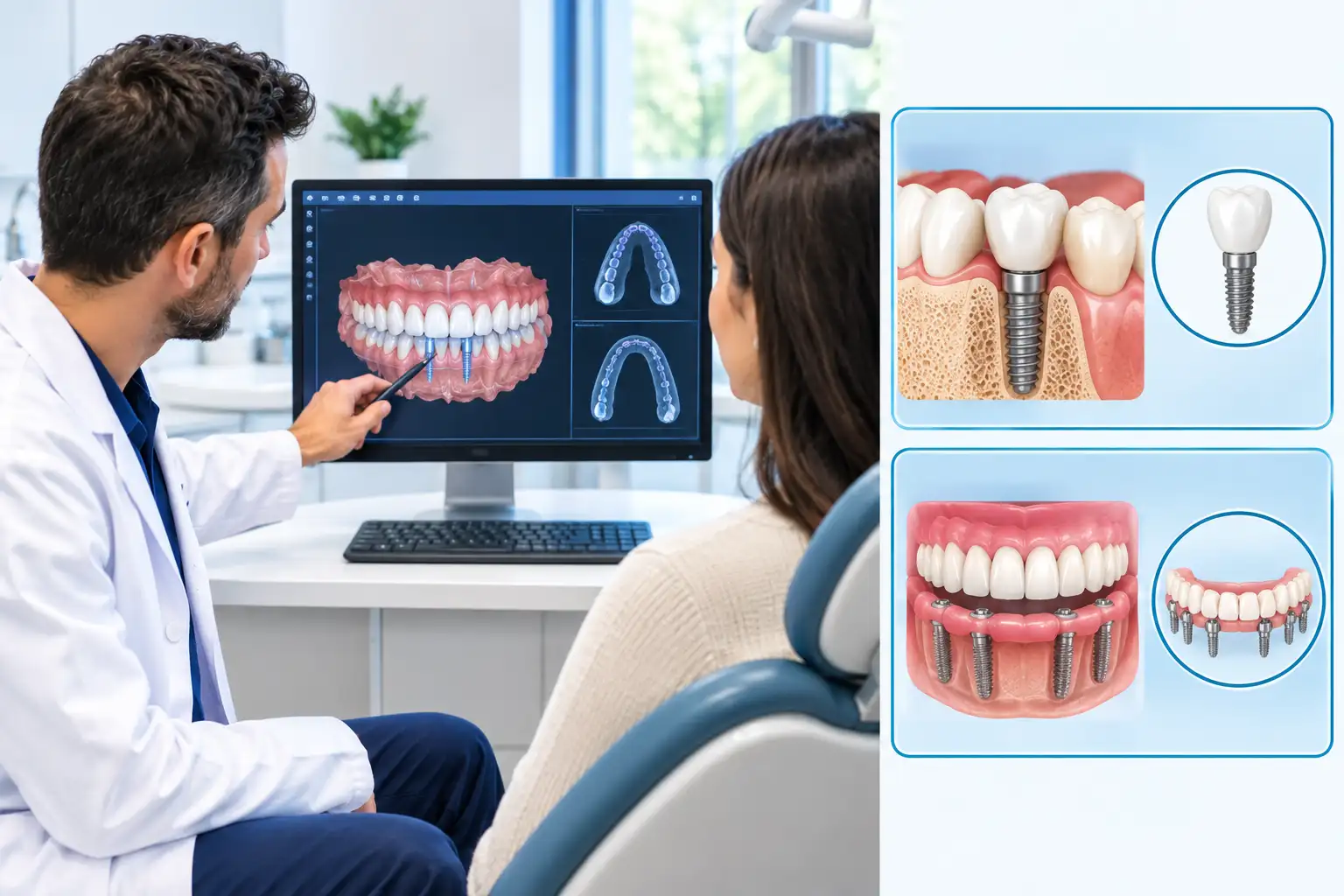
Losing one tooth is very different from having several failing or missing teeth. Yet patients are sometimes presented with the term dental implants as though there is one standard treatment.
There isn't.
A single dental implant can replace one missing tooth while preserving the surrounding teeth. At the other end of the spectrum, a patient with widespread tooth loss or severely compromised teeth may need a much broader treatment plan involving several implants and a fixed bridge.
For patients researching Full Mouth Implants in Kent, understanding this difference is important. The right treatment depends not simply on how many teeth are missing, but on the condition of the remaining teeth, gums, bone, bite, general health and your long-term expectations.
When is a single tooth implant appropriate?
A single implant is often considered when one tooth is missing but the surrounding teeth remain healthy and stable.
The implant itself is placed into the jawbone and acts as an artificial tooth root. Once it has integrated with the bone, it can support an individual crown designed to resemble the natural tooth.
This approach has an important advantage: the neighbouring teeth generally do not need to be reduced to support the replacement tooth. Dental implants can therefore provide a fixed way of replacing a missing tooth while leaving healthy adjacent teeth untouched.
However, an implant is not simply a replacement tooth that can be fitted immediately. Your dentist needs to assess the gums, available bone, bite and overall oral health before deciding whether it is suitable.
When might full-mouth reconstruction be considered?
The situation is quite different when many teeth are missing, badly damaged or have a poor long-term prognosis.
Full-mouth reconstruction is not necessarily synonymous with removing every remaining tooth and placing implants. In some patients, valuable natural teeth can be retained and restored. In others, the remaining teeth may be too compromised to provide a predictable long-term foundation.
A full-mouth treatment plan may therefore involve a combination of:
- Dental implants
- Implant-supported bridges
- Crowns on suitable natural teeth
- Treatment for gum disease
- Tooth removal where necessary
- Bone grafting in selected cases
- Replacement of an entire upper or lower arch
The objective is to restore function and appearance while creating a treatment plan that can be maintained properly over the long term.
Full Arch Implants In Kent: how are they different?
Full Arch Implants In Kent generally refers to replacing most or all teeth in one dental arch with an implant-supported fixed restoration.
Rather than placing one implant for every missing tooth, several strategically positioned implants can be used to support a larger fixed bridge.
This can be particularly relevant for someone who has lost many teeth or has remaining teeth that cannot be predictably restored.
The number and position of implants are not decided from a keyword, package or standard formula. A dentist needs to examine your mouth and usually use appropriate imaging to assess the bone and important anatomical structures before treatment planning. Cone beam CT scanning can provide three-dimensional information about the available bone and nearby structures.
What about All On Implants in Kent?
You may also come across searches for All On Implants in Kent. This terminology is commonly used to describe a fixed full-arch restoration supported by dental implants.
The important point is not the terminology itself. Different clinics may use different names for broadly similar concepts, while the actual treatment can vary considerably between patients.
Before proceeding, ask exactly:
- How many teeth will be replaced?
- Which teeth, if any, can safely be retained?
- How many implants are planned?
- Will bone grafting be required?
- What type of final restoration will be provided?
- How will the implants and bridge be maintained?
These questions help you compare treatment based on clinical need rather than terminology.
Which option is right for you?
There is no reliable way to decide between a single implant and full-mouth treatment without a proper assessment.
A dentist will typically consider:
The condition of your remaining teeth: Teeth affected by extensive decay, fractures or advanced gum disease may have a different prognosis from healthy teeth.
Your gums: Active gum disease should be addressed because inflammation and poor plaque control can increase problems around implants.
Bone levels: Previous tooth loss can be associated with reduced bone volume, potentially affecting implant placement.
Your bite: The way your upper and lower teeth meet influences how restorations are designed and loaded.
Your general health and habits: Smoking, oral hygiene and certain health factors can affect implant treatment and maintenance.
Your expectations: Fixed teeth may improve chewing and confidence, but implants are not maintenance-free replacements. They still require careful cleaning and regular professional monitoring.
Don't assume that more implants means better treatment
One of the most important principles in complex implant dentistry is to avoid removing healthy teeth unnecessarily.
If a natural tooth has a good long-term prognosis, retaining it may be preferable to extracting it simply to create an implant-supported reconstruction.
Equally, trying to preserve teeth with a very poor prognosis can sometimes result in repeated treatment and greater inconvenience later.
This is why a good treatment plan should explain why each tooth is being retained, restored or removed, rather than simply presenting implants as the answer to every dental problem.
For patients considering Full Mouth Implants in Kent, the starting point should therefore be a detailed assessment rather than choosing a particular implant system or treatment name.
What should happen before treatment?
A thorough consultation should include an examination, relevant X-rays or three-dimensional imaging where indicated, assessment of your gums and teeth, and discussion of your medical and dental history.
Your dentist should then explain the realistic options, including alternatives where appropriate. NHS guidance also emphasises that dental treatment options should be discussed with patients and that treatment planning should be tailored to individual needs.
At Fixed Teeth Solutions, patients considering treatment in London and Kent should be encouraged to understand the reasoning behind their proposed plan before making a decision.
The bottom line
A single missing tooth does not usually require full-mouth reconstruction, while widespread tooth loss or severely failing teeth may require a more extensive approach. The best option depends on the teeth you have, the teeth that can realistically be saved, your gums and bone, your bite and your ability to maintain the result.
The most useful first step is therefore a comprehensive implant assessment. It allows your dentist to determine whether a single implant, several individual implants, Full Arch Implants In Kent, or a wider reconstruction is genuinely appropriate for your mouth.
Tags : Full Mouth Implants in Kent