What Buyers Should Evaluate When Sourcing Industrial Clays for Manufacturing
By thesharadgroup 08-06-2026 88
Raw material procurement decisions in manufacturing carry more risk than most buying decisions in other categories. When a business purchases office supplies or logistics services, a poor choice is reversible - switch suppliers, absorb a minor cost, move on. When a ceramic manufacturer makes a poor raw material sourcing decision, the consequences run deeper. Production batches fail quality inspection. Kilns are taken offline for reformulation trials. Finished goods are rejected. Customer shipments are delayed.
The cost of a bad industrial clay sourcing decision is not the price of the material itself. It is the accumulated cost of disrupted production, reformulation time, rejected product, and the relationship damage with downstream customers who received inconsistent or substandard goods. Understanding this is the starting point for approaching industrial clay procurement with the level of care it deserves.
This article is written for procurement managers, production managers, and business owners involved in buying industrial clays - specifically laterite clay and ball clay - for ceramic, construction, or related manufacturing applications. It covers the technical evaluation criteria that matter, the supplier assessment factors that experienced buyers apply, and the procurement mistakes that are most commonly made and most easily avoided.
Why Industrial Clay Quality Is Harder to Assess Than It Appears
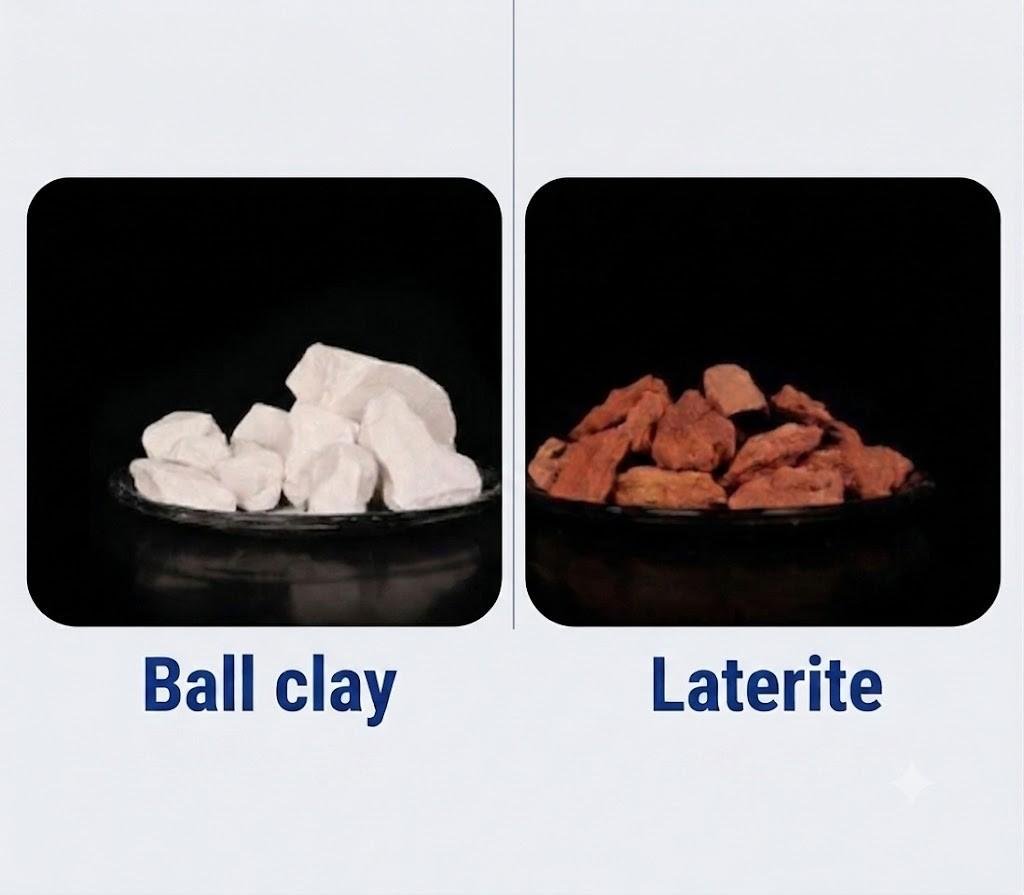
Industrial clays look similar. Two bags of ball clay from different suppliers, placed side by side, are visually indistinguishable to anyone without specialist training. The properties that matter - plasticity, particle size distribution, fired colour, chemical composition - are invisible to the naked eye and can only be determined through analytical testing.
This creates a procurement environment where buyers who rely on visual inspection or supplier assurances alone are essentially operating blind. The material that looks and feels adequate in a warehouse sample may behave very differently in a production process calibrated to different raw material characteristics. Problems arising from this mismatch often do not appear immediately - they emerge after several production runs, when the cumulative effect of slightly wrong plasticity or slightly inconsistent firing behaviour becomes statistically significant in quality data.
The practical implication is that industrial clay procurement requires a more systematic evaluation process than commodity procurement. Price and delivery terms matter, but they should be evaluated after technical compatibility has been established - not instead of it.
Evaluating Laterite Clay: The Specifications That Matter
Laterite is a broad geological category covering materials formed through tropical weathering of parent rock over extended geological time. The range of compositions that fall under the laterite label is wide - iron oxide content can vary from under 10 percent to over 60 percent depending on the deposit, and aluminium oxide content ranges equally widely. This variability means that buying decisions made on the basis of the generic material name, without deposit-specific compositional data, are fundamentally uninformed.
For buyers sourcing laterite clay for cement manufacturing, the primary specification parameters are iron oxide content, aluminium oxide content, silica content, and moisture. The cement plant's raw mix design is calibrated to specific correction ratios, and laterite that falls outside the acceptable range for iron oxide requires either blending adjustment or recalibration of the proportioning system - both of which have operational costs. Consistency of composition between batches is as important as average composition, because cement plants running continuous production cannot accommodate significant batch-to-batch variation without disrupting quality control.
For construction applications - road sub-base, fill material, or traditional building applications - the relevant specifications shift toward physical properties: hardness, particle size after crushing, moisture sensitivity, and natural cementing characteristics under traffic and weathering. Laterite that performs well in cement manufacturing may not be the best grade for road construction, and vice versa. Application-specific evaluation is essential.
The questions a buyer should ask any laterite supplier before committing to ongoing supply include: What is the chemical analysis of your deposit, supported by independent laboratory testing? How variable is the composition across the deposit and across seasons? What is your blending and processing protocol for maintaining batch consistency? Can you provide certificates of analysis for each delivered batch? Suppliers who cannot answer these questions clearly are signalling that they do not have the analytical capability or quality management processes that reliable industrial supply requires.
Evaluating Ball Clay: Technical Criteria for Ceramic Applications
Ball clay evaluation for ceramic applications is more technically complex than laterite evaluation, because the properties that determine its performance in production are more numerous and more interactive. A ball clay that meets specification on one parameter but falls short on another can still cause production problems even when the overall assessment appears adequate.
Plasticity is the property most central to ball clay's value in ceramic forming. It determines how easily a clay body can be shaped, how well it holds its form during drying, and whether the body will crack under the stresses of the forming process. Plasticity is typically expressed as a plasticity index - the difference between the liquid limit and the plastic limit of the material - and buyers should specify minimum acceptable values based on the requirements of their particular forming process. Extruded sanitaryware bodies require higher plasticity than dry-pressed floor tiles, and the acceptable range for each application is different.
Fired colour is the second critical parameter for most ceramic applications. Ball clay fires to colours ranging from near-white to cream to light buff depending on its iron and titanium content and the organic matter present in the raw material. A wall tile manufacturer requiring a white fired body has a different specification requirement from a floor tile producer where a slightly warmer fired colour is acceptable. Evaluating fired colour requires actual firing trials at the production kiln temperature - data sheet colour descriptions are not a substitute for fired sample assessment under production conditions.
Particle size distribution, dry shrinkage, fired shrinkage, and dry modulus of rupture complete the primary specification set for most ceramic ball clay applications. Each of these parameters interacts with the others in the ceramic body formulation, and changing one typically requires adjustment of the recipe to maintain overall body performance. This interdependency is why changing ball clay suppliers mid-production is technically disruptive even when the incoming material appears similar on individual parameter comparison - the combination of properties matters, not just the individual values.
Supplier Assessment: Beyond the Technical Specification
Technical compliance with specification is a minimum requirement for an industrial clay supplier, not a differentiator. The factors that distinguish reliable long-term supply partners from technically adequate but operationally problematic suppliers are operational and commercial rather than purely technical.
Deposit sustainability is a factor that too few buyers evaluate. A supplier mining from a small, poorly characterised deposit may deliver acceptable material for the first few years of a supply relationship but face compositional drift as the deposit is worked deeper or wider. Asking about deposit reserves, geological characterisation depth, and long-term mining plans before committing to a supply relationship reduces the risk of discovering that a validated supply source is approaching depletion just as your production process has been fully calibrated to its characteristics.
Processing consistency - the ability to deliver material with consistent moisture content, particle size, and packaging quality across seasons and across production runs - is a practical operational requirement that is often only assessed retrospectively, after a problematic delivery has disrupted production. Visiting processing facilities before committing to a supply relationship, or requiring third-party audit documentation of quality management systems, provides a basis for assessing processing consistency before problems occur.
Communication quality is a softer factor but a practically important one. A supplier who communicates proactively about any production or logistics issues, provides documentation promptly, and responds quickly to technical queries is operationally easier to work with than one who communicates reactively and incompletely. In manufacturing environments where raw material delivery timing and consistency directly affect production scheduling, the quality of supplier communication is a real operational variable with real cost implications.
The True Cost of Switching Suppliers
One of the most consistently underestimated costs in industrial clay procurement is the cost of switching suppliers once a formulation has been validated against a specific source's material characteristics. This cost is not simply the technical validation cost - analytical testing, laboratory trials, pilot production runs. It includes the production downtime during switchover, the risk of out-of-specification product during the transition period, the retraining of production staff on adjusted process parameters, and the potential impact on customer relationships if delivery commitments are affected during the transition.
Experienced procurement managers in ceramic and construction product manufacturing account for this switching cost when evaluating new suppliers. A supplier offering a lower unit price but requiring a full revalidation cycle represents a total cost that may significantly exceed the apparent saving, particularly if the switch introduces quality risk during the validation period.
This analysis does not argue against ever changing suppliers - sometimes change is necessary because of deposit depletion, price increases, quality deterioration, or supply reliability problems with an existing source. It argues for making supplier selection decisions with a complete picture of the total cost of supply, including the switching cost that will be incurred if the relationship does not work out, rather than on unit price comparison alone.
Industrial clay procurement done well is a technical and commercial process that supports manufacturing quality, production reliability, and supply chain resilience. Done poorly, it creates costs and disruptions that show up in production data, quality records, and customer relationships long after the original sourcing decision has been forgotten. The time invested in thorough supplier evaluation before committing to a supply relationship is almost always recovered many times over in avoided production problems.
Tags : laterite clay ball clay