The Startup Guide to Data Lakehouse Architecture for AI and Advanced Analytics
By Tyler Bennett 20-02-2026 127
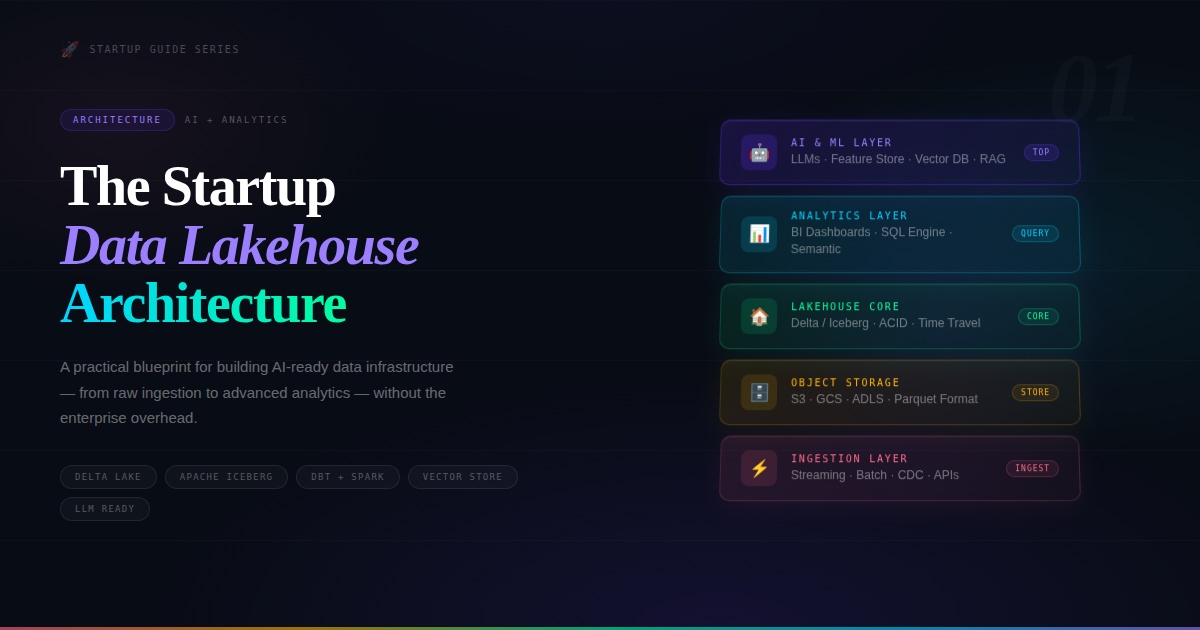
The Startup Guide to Data Lakehouse Architecture for AI and Advanced Analytics
Startups live and die by how fast they can learn from data. Whether it’s understanding user behavior, optimizing product features, or creating predictive models, the most successful startups leverage data not just for reporting, but for AI and advanced analytics.
But the right data foundation is essential for long-term success. This is where data lakehouse architecture becomes a strategic advantage. It provides the flexibility, scalability, and governance necessary to power AI initiatives from the earliest stages and support growth into enterprise-level workloads.
In this guide, we walk through what startups need to know about building a modern data foundation, why a Modern Data Platform matters, and how to design an effective Data Platform Architecture that supports both analytics and AI.
What Is Data Lakehouse Architecture?
A data lakehouse architecture combines the best aspects of data lakes and data warehouses into a unified system.
Think of it like this:
A data lake stores large volumes of raw data in its native format
A data warehouse stores structured, refined data optimized for reporting
A lakehouse merges both into one system that supports analytics and AI workloads
This integration solves the major challenges that startups face with traditional architectures:
✔ Fragmented systems
✔ High operational cost
✔ Poor performance at scale
✔ Data silos between teams
With a lakehouse, all teams work from a single source of truth — simplifying analytics and empowering AI innovation.
Why Startups Should Prioritize a Modern Data Platform
Startups need speed and flexibility without sacrificing reliability or scalability. A Modern Data Platform built on a lakehouse foundation meets both needs:
1. Agility for Early Development
Early-stage teams often pivot quickly. A lakehouse platform allows startups to ingest and explore data without heavy up-front modeling or rigid schemas.
This flexibility accelerates experimentation and supports rapid iteration.
2. Unified Data for Cross-functional Teams
Startups usually have small teams wearing many hats. A well-designed Data Platform Architecture helps:
Data analysts build dashboards
Data engineers build reliable pipelines
Data scientists experiment with AI models
Product teams make data-driven decisions
Everyone works from the same data foundation, reducing confusion and duplicated efforts.
3. Built-in Support for AI and Machine Learning
Today’s competitive advantage comes from AI and machine learning. Startups that adopt a modern data architecture early can:
Train models on reliable data
Apply analytics directly to production systems
Build personalization, forecasting, and automation features
This removes bottlenecks that cripple teams using inflexible legacy systems.
Key Components of Startup Data Lakehouse Architecture
While every startup’s journey is unique, most lakehouse implementations share these common building blocks:
Raw Data Ingestion
Start by collecting data from sources such as web apps, mobile apps, IoT devices, third-party systems, and logs. A modern lakehouse supports streaming and batch ingestion without forcing strict schemas upfront.
Unified Storage Layer
Raw and refined data live in the same storage system. This simplifies operations and enables advanced analytics without moving data between systems.
Catalogs and Metadata Management
A catalog helps teams understand what data exists, how it is structured, and how it should be used. This is vital for consistent analysis and for scaling teams over time.
Governance and Security
Even early-stage startups need governance — especially as they grow or work with sensitive user data. A strong Data Platform Architecture includes policies for access control, compliance, auditing, and quality checks.
Analytics and Machine Learning Workloads
With data structured and governed, teams can build dashboards, run SQL analytics, and train or deploy AI models from the same platform.
How Databricks Lakehouse Architecture Supports Startup Growth
One of the most widely adopted implementations of lakehouse technology is the Databricks lakehouse architecture. It provides:
🔹 Unified storage and compute optimized for analytics
🔹 Open data formats that avoid vendor lock-in
🔹 Built-in tools for data engineering, BI, and AI
🔹 Native support for popular machine learning frameworks
This kind of unified platform is ideal for startups that need a reliable yet flexible foundation.
With Databricks, startups can:
Reduce the time from data ingestion to insight
Scale analytics as usage grows
Enable self-service analytics without barriers
Move from experimentation to production AI faster
This accelerates innovation while maintaining a reliable and cost-effective infrastructure.
Avoiding Common Pitfalls
Startups often make a few predictable mistakes when building data infrastructure:
❌ Too Much Focus on Tools Instead of Architecture
Choosing flashy tools without a solid Data Platform Architecture leads to fragmentation and technical debt.
❌ Siloed Teams or Systems
When analytics, engineering, and science teams use different environments, collaboration slows.
❌ Ignoring Governance Early
Even small startups should define data policies upfront. Waiting until problems arise makes them harder to fix.
Instead, successful startups:
✔ Start with a flexible lakehouse foundation
✔ Prioritize shared data standards
✔ Use automation in data pipelines and governance
✔ Enable cross-functional collaboration through a Modern Data Platform
Scaling from Startup to Scale-Up
A major advantage of adopting a lakehouse early is future-proofing. As the company grows:
🔹 Data volume increases
🔹 User expectations get more complex
🔹 Analytics and AI use cases multiply
🔹 Governance become mandatory
With a solid data foundation, scaling becomes a technical improvement, not an architectural rewrite.
This means faster feature launches, better insights, and stronger competitive differentiation.
Closing Thoughts
For startups that want to win with data, adopting a data lakehouse architecture is not just an option — it is a strategic imperative. When combined with a well-planned Modern Data Platform and thoughtful Data Platform Architecture, startups can:
Unlock insights faster
Empower cross-functional teams
Build reliable data practices early
Scale analytics and AI with confidence
By choosing the right foundation today, startups set themselves up for faster growth and long-term success.