Stale Content Loses in 2026: How KWT Spider 2.0 Audits Freshness at Scale
By Whitley Laster 19-08-2026 141
The New Cost of an Old Page
AI search engines don't just rank content anymore — they retrieve it and retrieval systems have a bias traditional rankings never had before as they now favor what's recent. A page that's technically well-optimized but hasn't been touched in two years is increasingly likely to lose its citation to a competitor's page updated last month, even if the older page is more thorough.
This changes how freshness audits need to work. It's no longer enough to check whether a page ranks. You need to understand how old your content is across the entire site—and which pages are losing relevance in both traditional search and AI-generated answers.
Why freshness became a ranking signal for AI
Generative search tools construct answers by pulling from sources they trust to be current. For anything time-sensitive, an outdated page isn't just weaker, it's a liability:
- Pricing pages — a model can't cite a number it can't verify is still accurate
- Specs and product details — stale specs risk citing something that's since changed
- Policy pages — terms, return policies, compliance info all shift over time
- “Best Of” Content Needs Regular Refreshes — these tend to age the fastest because the products, features, and options they cover are constantly changing.
If a model can't confirm a page reflects the current state of a topic, it looks elsewhere. That means published and updated dates are no longer just cosmetic details—they’ve become important trust signals that AI systems may evaluate alongside author information and other E-E-A-T signals.
The problem: freshness is invisible at scale
On a five-page site, checking freshness is a five-minute manual task. On a 5,000-page site, it isn't. Content teams typically know their newest posts are fresh and assume the rest is "probably fine" — until an audit shows entire categories haven't been touched since a redesign two years ago.
The pages that quietly go stale tend to be the ones nobody's actively managing:
- Old comparison posts that were accurate at launch
- Legacy product pages tied to discontinued or updated offerings
- Evergreen guides that were "finished" and never revisited
- Category or hub pages that don't get the same editorial attention as flagship content
- Individually, each is low priority. Collectively, they're often a large share of a site's indexed content.
How to audit freshness across a full site
A proper freshness audit needs three things:
1) The published/updated date for every URL, pulled directly rather than estimated
2) A way to flag pages missing that data entirely
3) A way to segment by age so you can prioritize fixes instead of trying to update everything at once
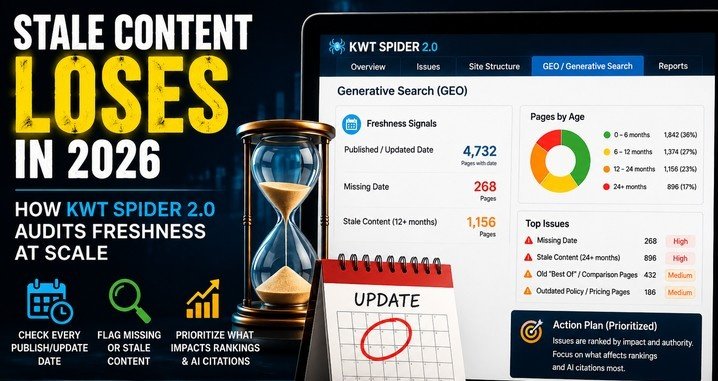
This is where KWT Spider 2.0's crawl handles the heavy lifting. Running a full site crawl with GEO enabled pulls author and date signals directly from meta tags and schema markup across every URL — not just the pages you remember to check. Pages missing date information entirely get flagged as a specific GEO issue, since a missing date is treated the same as a stale one from an AI system's perspective.

On larger sites, this matters more, not less. KWT Spider's SQLite/DB mode keeps a 50,000+ URL crawl responsive, so a freshness audit on a large site doesn't mean waiting hours for results or working from a sample. The Generative Search tab surfaces date and author data alongside the rest of the GEO signal set — definition, FAQ schema, summary structure — so freshness shows up as one line item in a broader citation-readiness picture, not a separate project.
Turning the audit into a plan
Once you have a clear view of every page’s age, the next step isn’t rewriting everything—it’s deciding which pages actually need attention first:
- High-traffic, time-sensitive pages first — pricing, specs, policies
- High-authority pages next — pages with strong internal linking that AI systems are more likely to surface
- Evergreen content last — often just needs a light review and an updated date, not a rewrite
- Orphaned or unlinked stale pages — decide whether to update, consolidate, or remove entirely
The Action Plan view sorts issues by priority and potential impact, so a missing-date issue on a high-authority page gets attention before the same problem on a page with little or no internal linking. That's the difference between fixing what actually affects citations and just working through a list top to bottom.
The takeaway
Freshness used to be a nice-to-have for SEO. In an AI retrieval environment, it's closer to a gate: content that looks outdated gets passed over regardless of how good it is. Auditing for it manually doesn't scale past a handful of pages. Auditing for it as part of a full crawl — where date and author signals sit next to every other citation-readiness check — does.