Retail security has become more complex. Stores need to protect customers, employees, inventory, and property while managing busy environments where hundreds or thousands of activities can happen throughout the day.
Traditional cameras can record those activities, but recording alone does not always provide enough insight. Security teams may have to monitor multiple screens or search through hours of footage after an incident.
Artificial intelligence is changing that approach.
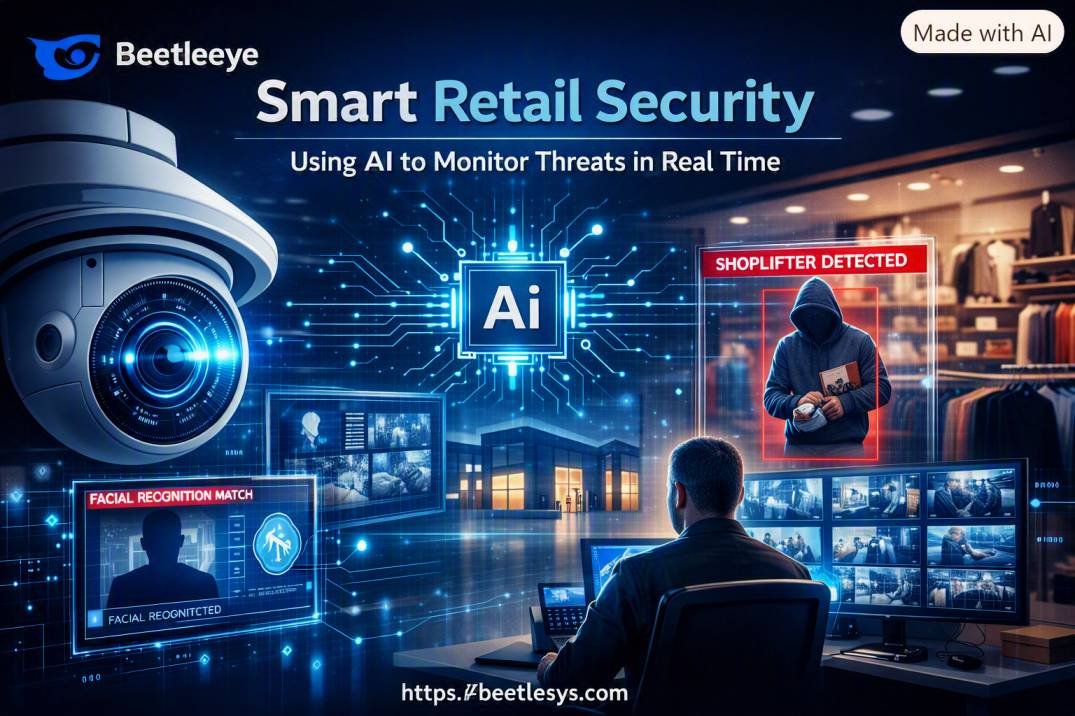
With intelligent video surveillance, retailers can use AI to analyze camera footage, identify specific events, and bring potentially important activity to the attention of security personnel in real time.
For retailers exploring smarter security technology, BeetleEye represents the shift toward AI-powered monitoring that can help turn conventional cameras into more intelligent security tools.
Why Retail Stores Need Smarter Surveillance
A retail store is constantly changing.
Customers enter and leave, employees move between departments, deliveries arrive, merchandise is moved, and activity can continue throughout the day.
This makes continuous manual monitoring difficult.
A conventional video surveillance system can capture everything, but security personnel still have to determine which events matter.
AI can add another layer of intelligence by analyzing activity according to specific rules and conditions.
Instead of treating every movement as equally important, an intelligent system can help identify activity that deserves closer attention.
What AI Adds to Retail Video Monitoring
The main difference between conventional and AI-powered surveillance is the ability to analyze video automatically.
An AI video surveillance system can use computer vision and analytics to identify objects, movement, and predefined activities.
For a retail environment, this could include:
- People entering or leaving specific areas
- Activity in restricted zones
- Movement after store hours
- Unusual behavior or prolonged presence
- Vehicles in designated areas
- Objects appearing or disappearing from monitored zones
The exact capabilities depend on the technology being used and how the system is configured.
Real-Time Threat Detection in Retail
Security incidents can happen quickly.
If a store only discovers an incident after reviewing recorded footage, valuable time may already have passed.
AI-powered monitoring can help shorten that gap.
Imagine a retail store with a staff-only entrance. During normal business hours, employees may regularly pass through the area. After closing, however, unexpected activity may require attention.
An intelligent surveillance platform can apply time- and location-based rules to the camera feed and generate an alert when activity meets the defined conditions.
This gives authorized personnel an opportunity to investigate the situation while it is occurring.
Beyond Motion Detection
Basic motion detection answers a simple question:
Did something move?
AI can ask much more specific questions.
What moved?
Where did it move?
When did it happen?
Does the activity match a security rule?
This distinction can make a significant difference in a busy retail environment.
A tree moving outside a store should not necessarily receive the same level of attention as a person entering a restricted area.
AI-powered video surveillance solutions can help provide that additional context.
Retail Areas Where AI Monitoring Can Help
AI surveillance can be applied to different parts of a retail property depending on the store's security requirements.
Store Entrances
Entrances are among the busiest areas in a retail environment.
Intelligent monitoring can help businesses understand activity around entrances and identify events that match predefined conditions.
Stockrooms
Stockrooms often contain valuable inventory and are generally accessible only to authorized employees.
AI-powered monitoring can help identify activity in these areas, particularly during restricted hours.
Loading Areas
Delivery and loading zones can involve employees, suppliers, vehicles, and inventory moving in and out of the property.
Intelligent surveillance can provide additional visibility into activity around these areas.
Parking Areas
Retail parking lots can be difficult to monitor manually, particularly at larger locations.
AI analytics can help identify relevant vehicle and pedestrian activity according to configured monitoring rules.
Restricted Areas
Some areas of a store may require limited access.
AI-powered monitoring can help alert authorized personnel when activity occurs within predefined restricted zones.
Reducing Unnecessary Retail Security Alerts
Too many alerts can create another security problem.
If employees receive notifications for every movement, they may begin ignoring alerts or spending excessive time investigating events that do not represent genuine concerns.
AI can help filter surveillance activity by analyzing what is happening within a camera's field of view.
For example, a system may be configured to pay attention to people entering a specific zone while ignoring irrelevant background movement.
The objective is not to eliminate every false alert. Instead, intelligent analytics can help make alerts more relevant.
AI Can Support Human Security Teams
AI should not necessarily be viewed as a replacement for security personnel.
Retail security still requires human judgment.
An intelligent system can handle continuous video analysis while people focus on evaluating events, responding according to company procedures, and making decisions when intervention is appropriate.
This creates a useful division of responsibilities:
AI analyzes.
People decide.
By combining automated analysis with human oversight, retailers can build a more responsive security process.
Protecting More Than Merchandise
Retail security is not only about preventing inventory loss.
Businesses also have responsibilities toward employees, customers, contractors, and visitors.
Intelligent surveillance can help improve visibility across areas where security incidents may occur.
Depending on the store's requirements, AI monitoring may support awareness around:
- Customer entrances
- Employee-only spaces
- Emergency exits
- Parking areas
- Delivery zones
- Storage areas
- Building perimeters
A broader monitoring strategy can help retailers think about security across the entire property rather than focusing only on merchandise.
AI Surveillance for Multiple Store Locations
Large retail businesses may operate dozens or hundreds of locations.
Managing surveillance across multiple stores can make consistency particularly challenging.
A centralized approach to intelligent video surveillance systems can help organizations establish consistent monitoring policies while allowing individual locations to address their own security requirements.
For example, corporate security teams may want similar monitoring rules across different stores while allowing local managers to configure additional requirements.
This can make AI particularly valuable for retailers with distributed operations.
Choosing the Right Video Surveillance Solution
There is no universal best video surveillance system for every retailer.
The right solution depends on factors such as store size, number of locations, camera coverage, network infrastructure, storage requirements, and security objectives.
Before selecting a system, retailers should consider:
Intelligent Analytics
Determine which AI capabilities are actually relevant to the store's security needs.
Camera Coverage
Identify important areas that require monitoring and consider potential blind spots.
Alert Configuration
Choose a system that allows organizations to establish meaningful detection rules rather than generating unnecessary notifications.
Scalability
Multi-location retailers should consider whether the system can expand as the business grows.
Remote Access
Authorized security personnel may benefit from being able to monitor locations remotely.
Data Protection
Retailers should implement appropriate security controls for surveillance footage and system access.
AI and Retail Loss Prevention
Loss prevention is another area where intelligent surveillance can play a supporting role.
Retailers deal with different forms of loss, including inventory discrepancies, unauthorized access, and security incidents.
AI-powered analytics can help organizations identify specific activities that may require review.
However, AI should be treated as a supporting technology rather than an automatic determination of wrongdoing. Security teams should review relevant events and follow appropriate company policies before taking action.
This approach helps combine technology with responsible human oversight.
What About Small Retail Businesses?
AI surveillance is not limited to large retail chains.
Smaller stores can also benefit from intelligent monitoring when the technology matches their actual security requirements.
A smaller retailer may prioritize:
- Entrance monitoring
- After-hours activity
- Restricted-area detection
- Remote viewing
- Relevant security alerts
The goal should not be to purchase the most complicated system available. It should be to select technology that solves the store's actual security challenges.
How BeetleEye Fits Into Smarter Retail Security
BeetleEye represents the growing movement toward intelligent video surveillance solutions designed to make video monitoring more useful.
For retailers, the value of AI is not simply having cameras that record more footage. It is having technology capable of helping identify meaningful activity within that footage.
BeetleEye's AI-focused approach aligns with a future where surveillance can become more proactive, helping businesses improve visibility across their properties and focus attention on events that matter.
Instead of requiring security personnel to constantly watch every screen, intelligent monitoring can help surface relevant events according to predefined requirements.
This creates an opportunity for retailers to use their existing surveillance infrastructure in a smarter way while moving toward more advanced security capabilities.
Privacy and Responsible AI in Retail
More intelligent surveillance also means greater responsibility.
Retailers should consider how surveillance footage is collected, stored, accessed, and retained.
Organizations should establish appropriate policies around:
- User permissions
- Footage retention
- Data security
- System access
- Privacy requirements
- Use of advanced identification technologies
AI should strengthen security without ignoring the rights and expectations of customers and employees.
Responsible implementation is therefore an important part of building a modern retail surveillance strategy.
The Future of Smart Retail Security
Retail surveillance is moving toward systems that can do more than record.
As computer vision and AI technologies continue to develop, future systems may become better at understanding complex environments, identifying patterns, searching historical footage, and connecting camera intelligence with other security technologies.
The role of the security camera is changing.
It is no longer simply a device that stores video.
It is becoming part of an intelligent security ecosystem.
For retailers, this could mean faster awareness, more efficient monitoring, and better access to information when security teams need it.
Frequently Asked Questions
How does AI help retail security?
AI can analyze surveillance footage and identify activity that matches predefined rules. This can help security teams become aware of potentially important events more quickly.
Can AI surveillance monitor stores after hours?
Yes. AI-powered systems can be configured to monitor specific areas during defined periods, including times when a store is closed.
Does AI replace retail security staff?
No. AI can support security personnel by continuously analyzing footage and highlighting relevant events, while people remain responsible for evaluating situations and deciding how to respond.
Can AI reduce false security alerts?
AI can help distinguish between different types of objects and activity, which may reduce some unnecessary alerts compared with basic motion detection.
Can AI surveillance be used in small retail stores?
Yes. Smaller retailers can use AI-powered surveillance when the system's capabilities and cost are appropriate for their specific security requirements.
Conclusion
Smart retail security is moving beyond cameras that simply record what happens.
AI can help retailers analyze activity in real time, identify relevant events, reduce unnecessary notifications, and provide security teams with better situational awareness.
From entrances and stockrooms to loading areas and parking facilities, intelligent video surveillance systems can support a more proactive approach to retail security.
The right video surveillance security system does not have to replace human judgment. Instead, it can give security teams better information and help them focus on situations that deserve attention.
BeetleEye represents this next step in retail surveillance, where AI helps transform video monitoring from passive recording into intelligent security awareness.
For modern retailers, the goal is no longer simply to capture everything.
The goal is to recognize what matters, when it matters.