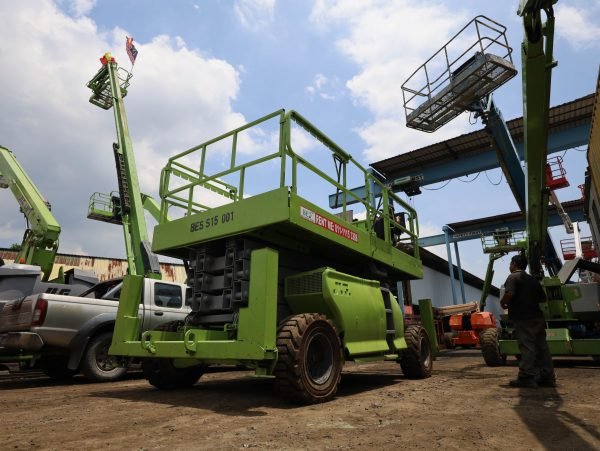
When warehouse teams need to access elevated areas safely whether for racking inspections, lighting replacements, or HVAC servicing the right lift makes all the difference. Compact electric scissor lifts are purpose-built for indoor environments. They offer a stable elevated work platform, zero emissions, and a tight footprint that works within congested warehouse aisles and tight spaces.
If your facility needs temporary access to heights between 6 to 12 metres, the smartest move is often to rent a scissor lift rather than purchase one outright. Rental gives you the right machine for the right job without long-term ownership costs.
Why Warehouses and Factories Choose Scissor Lift Rentals
Maintenance tasks in warehouses are rarely constant. You might need elevated access for a week-long shelving reconfiguration, a quarterly lighting check, or an annual sprinkler system inspection. Buying a scissor lift for intermittent use ties up capital and creates storage, servicing, and compliance headaches.
Renting, on the other hand, gives operations managers flexibility. You get a fully serviced, inspected machine delivered when you need it and picked up when the job is done. For logistics companies and factories in Malaysia, this model is increasingly the standard for planned maintenance shutdowns.
Key reasons facilities managers opt for warehouse lift rental:
- - No capital expenditure preserve cash flow for core operations
- - Equipment is maintained and certified by the rental provider
- - Access to different platform heights depending on the task
- - Eliminates storage and long-term servicing responsibility
- - Ideal for short-term shutdowns, retrofits, or scheduled maintenance cycles
What Is an Indoor Scissor Lift and How Does It Work?
An indoor scissor lift is an electrically powered aerial work platform that uses a crisscrossing (scissor) mechanism to raise a work platform vertically. Unlike rough-terrain models, indoor units run on smooth, sealed surfaces making them ideal for warehouse floors, factory halls, and logistics facilities.
Electric models produce no exhaust fumes, which is critical for enclosed spaces. Most indoor scissor lifts also have a narrow chassis some as compact as 76 cm wide allowing them to pass through standard doorways and navigate between racking systems without disrupting operations.
Typical Specifications for an Indoor Scissor Lift
Common Warehouse Maintenance Tasks That Require a Scissor Lift
Scissor lifts are not a one-task solution. In a typical warehouse or industrial facility, the same machine can support multiple maintenance activities in a single rental period. That versatility is one reason scissor lift for maintenance applications has grown significantly across Malaysia's industrial sector.
Here are the most frequent use cases:
- Warehouse racking inspection and repair - Access upper rack tiers safely for structural checks or beam realignment
- Lighting maintenance - Replace high-bay LED fixtures or fluorescent tubes without scaffolding
- HVAC and ventilation servicing - Reach ceiling-mounted air handling units for filter changes or duct inspections
- Fire suppression systems - Inspect and test sprinkler heads at height
- Painting and surface treatment - Apply coatings or markings on overhead beams and walls
- Cable management and electrical installations - Run conduit or install cable trays at elevated levels
How to Choose the Right Scissor Lift for Your Maintenance Job
Not every scissor lift suits every job. Choosing incorrectly can result in a machine that can't fit through a doorway, doesn't reach the required height, or exceeds the floor's load-bearing capacity. Before you rent, work through these four decisions:
1. Confirm Your Required Working Height
Always calculate working height, not just platform height. If a worker at 1.8 m tall is standing on a 6 m platform, the actual working height is approximately 7.8 m. Most suppliers list platform height make sure your selection actually reaches the job.
2. Measure Your Floor and Aisle Width
Standard warehouse aisle widths in Malaysia range from 2.4 m to 3.5 m depending on racking configuration. A narrow electric scissor lift with a 76 cm chassis can operate comfortably in most of these environments without repositioning racking or blocking throughput.
3. Check the Floor's Load Rating
Mezzanine floors and some older warehouse slabs have load limitations. Always verify with your facilities engineer before bringing a scissor lift onto the floor. Most electric indoor models weigh between 1,500 kg and 3,500 kg this must be within the floor's rated capacity.
4. Consider the Duration and Scope
If maintenance work spans multiple days or requires multiple crews working simultaneously, you may need more than one unit. Most rental providers in Malaysia offer short-term and project-based rental terms, so scale your rental to your actual schedule not an estimate.
Safety Requirements for Operating Scissor Lifts in Malaysian Workplaces
In Malaysia, the use of elevated work platforms in industrial settings is governed by the Occupational Safety and Health Act 1994 (OSHA 1994) and associated regulations under the Department of Occupational Safety and Health (DOSH). Employers are required to ensure that equipment used at height is suitable, inspected, and that operators are adequately trained.
Key compliance points for warehouse operators:
- - Only trained and authorised personnel should operate scissor lifts
- - Pre-use inspection must be carried out before every shift
- - Operators must wear a full-body harness when the manufacturer recommends it
- - Ground conditions including floor level and surface integrity must be assessed before use
- - Scissor lifts must not be used as a means to transfer to another level or structure
When you rent from a reputable provider, the equipment arrives compliant with maintenance and safety records already in order reducing your compliance burden significantly.
Renting vs. Buying: A Quick Cost Comparison
For warehouse and factory operators who only need a scissor lift a few times a year, renting is almost always the more cost-effective choice.
What to Expect When You Rent a Scissor Lift in Malaysia
The rental process is straightforward when you work with an established equipment provider. Here's what a typical rental engagement looks like:
- Site assessment or consultation - Confirm platform height, machine width, and floor requirements with the supplier
- Select the right model - Choose from compact narrow models or wider high-capacity platforms based on the job scope
- Confirm rental period - Daily, weekly, or project-based terms are typically available
- Delivery and setup - Equipment is transported to site; operator walkthrough may be included
- Return and sign-off - Equipment is collected at the end of the rental; no maintenance or storage required from your end
For multi-site logistics operators or factories with regular maintenance schedules, some providers also offer standing rental agreements ensuring availability during planned shutdown periods.
Conclusion
Scissor lift rental is a practical, cost-efficient solution for warehouses and industrial facilities that need safe, reliable access to elevated areas without the commitment of ownership. Whether it's a one-day lighting repair or a two-week maintenance shutdown, having the right machine on-site makes the job safer, faster, and fully compliant.
BES Industry provides scissor lift rental options suited for indoor warehouse and factory environments in Malaysia with machines that meet operational safety requirements and are ready to deploy when your maintenance window opens.
Frequently Asked Questions
What is the typical rental cost of a scissor lift in Malaysia?
Scissor lift rental rates in Malaysia vary based on platform height, rental duration, and machine type. Compact indoor electric models are generally more affordable than rough-terrain units. Contact a local equipment provider directly for current daily or weekly rates aligned to your specific job requirements.
Do I need a licence or certification to operate a scissor lift in Malaysia?
Under Malaysia's OSHA 1994 guidelines, operators must be trained and authorised to use aerial work platforms. While a formal DOSH licence may not be mandatory for all scissor lift categories, employers are responsible for ensuring operators are adequately trained before use.
Can a scissor lift be used on a warehouse mezzanine floor?
Yes, but only after confirming the mezzanine floor's load-bearing capacity with a structural engineer. Electric scissor lifts can weigh between 1,500 and 3,500 kg, so floor rating verification is essential before deployment on elevated surfaces or older slab structures.
How much height can an indoor scissor lift reach?
Most indoor electric scissor lifts offer platform heights between 6 and 12 metres, translating to working heights of approximately 8 to 14 metres. The right model depends on your ceiling height and the specific maintenance task always factor in the operator's reach when selecting.
What is the difference between an indoor and outdoor scissor lift?
Indoor scissor lifts are battery-powered, emission-free, and designed for smooth sealed floors ideal for warehouse and factory use. Outdoor or rough-terrain models use diesel or dual fuel, feature larger tyres, and handle uneven ground. Using an outdoor model inside an enclosed space is not recommended due to emissions.
How far in advance should I book a scissor lift rental in Malaysia?
For planned maintenance shutdowns or project-based work, booking at least one to two weeks in advance is advisable especially during peak maintenance periods. Last-minute rentals are possible but may limit model availability, particularly for narrow or specialised indoor scissor lift configurations.