Singapore isn't just glossy malls and a skyline built for postcards. The city's neighbourhoods are where its layered history actually lives — historic shophouses, close-knit ethnic enclaves, street food that's been perfected over generations, independent galleries, and pockets of a much slower, more residential Singapore. The Singapore Tourism Board points travellers toward Chinatown, Little India, Kampong Gelam, Tiong Bahru, Katong-Joo Chiat, Orchard Road, Marina Bay and Sentosa as the neighbourhoods worth building a trip around.
Working these districts into your itinerary is an easy way to get more out of a Singapore holiday booked from the UAE. Singapore tour packages from Dubai often bundle the big-ticket sights with cultural walks, shopping stops and free time to explore, so there's no need to see everything in one rushed day. Wandering a heritage street, ducking into an independent café, or simply people-watching in a neighbourhood market tells you more about the city than a checklist of attractions ever could.
Here's a closer look at the neighbourhoods worth setting aside time for.
Chinatown: Singapore's Living Chinese Heritage
Chinatown is the natural starting point for understanding Singapore's history, architecture, food and traditions. It grew out of the settlement built by the city's early Chinese immigrants and remains one of Singapore's best-preserved historic districts, with rows of traditional shophouses, temples and markets sitting comfortably alongside newer cafés and shops.
A walk through Chinatown usually means a stop at the Chinatown Street Market for souvenirs and a plate of something good — chicken rice, popiah and chendol are all easy to find nearby, and the area gets especially lively during Chinese festivals. The Buddha Tooth Relic Temple and Museum is the other must-see: a striking Tang dynasty-style Buddhist temple that opened in 2007, home to a museum of Buddhist art and history and, according to tradition, a tooth relic of the Buddha.
Little India: Colour, Culture and Flavour
Little India is Singapore's multiculturalism on full display — bright shopfronts, Indian restaurants, textile and jewellery stores, and some of the city's most important South Asian heritage sites. It's consistently ranked among Singapore's most photogenic districts, with streets and buildings that trace the story of the city's Indian community.
The neighbourhood's landmark is the Sri Veeramakaliamman Temple, instantly recognisable for its intricately carved gopuram (entrance tower) covered in depictions of Hindu deities. It's a working temple with deep ties to Singapore's earliest Indian settlers, so modest dress and quiet, respectful behaviour are expected when visiting.
Kampong Gelam: Malay and Arab Heritage
Kampong Gelam brings together Malay, Arab, Islamic and contemporary influences in a way few other Singapore neighbourhoods manage. Once the city's Malay quarter and historically tied to Singapore's royal family, it's now a mix of restaurants, cafés, boutiques and creative studios layered over that older heritage — a good pick for travellers who want something different from the downtown skyline.
The Sultan Mosque is the neighbourhood's most recognisable landmark, its golden domes visible from streets away. The original mosque on this site was built between 1824 and 1826 for Sultan Hussein Shah, but the building visitors see today dates to 1932, after the old structure was rebuilt to serve Singapore's growing Muslim community. It remains one of the most important mosques in the country.
Beyond the mosque, Kampong Gelam is known for its colourful shophouses, independent boutiques and cafés — Arab Street and Haji Lane in particular are favourites for shopping, food and photos, where the neighbourhood's old and new sides sit side by side.
Tiong Bahru: Heritage Meets Modern Lifestyle
Tiong Bahru feels nothing like Singapore's major tourist hubs. Built in the 1930s, it's Singapore's oldest public housing estate, and its Art Deco low-rise blocks — with their curved corners, spiral staircases and porthole windows — have made it one of the city's most distinctive residential pockets, now filled with independent cafés and a genuinely local food scene.
It's an easy neighbourhood to enjoy without a checklist: stroll the residential streets, take in the architecture, stop wherever looks good for coffee, and watch everyday Tiong Bahru life go by. Tiong Bahru Market is the other reason to visit — a hawker centre serving some of the best local food in the area and a good sense of what a working Singapore market actually looks like.
Orchard Road: Shopping and Urban Energy
Orchard Road is built for travellers who want shopping, dining and city energy in one place. It's Singapore's best-known shopping district, lined with malls, international brands, restaurants and hotels — a very different experience from the heritage streets of Chinatown or Little India, but just as central to a Singapore trip.
Expect hours of browsing across shopping malls, beauty and electronics stores, cafés and restaurants, with the Singapore Botanic Gardens and Fort Canning Park both within easy reach. Dempsey Hill is also nearby if you want to extend the day.
Orchard Road works well paired with sightseeing elsewhere, and during the festive season the street lights up with large-scale displays that make for great evening photos. Even travellers skipping the shopping will find plenty to enjoy in the restaurants, cafés and green spaces nearby.
Marina Bay: Modern Singapore's Skyline
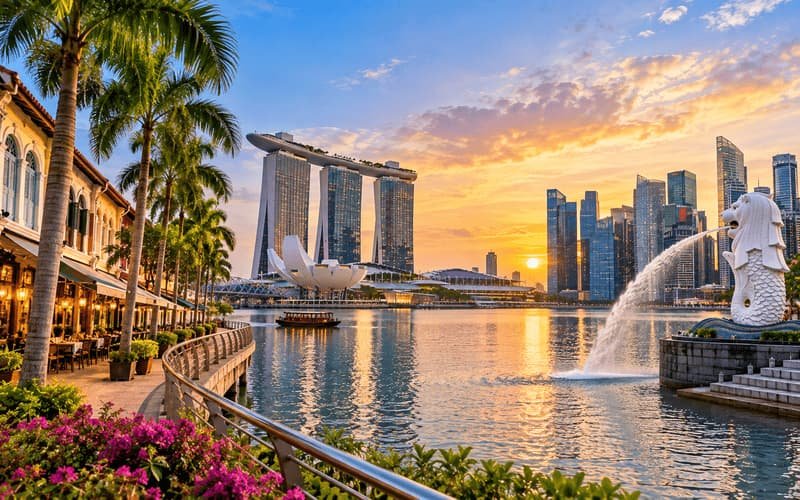
Marina Bay is where Singapore shows off its future. Ringed by skyscrapers, waterfront developments, luxury hotels and some of the city's most photographed landmarks, it's the clearest picture of Singapore as a global city.
A visit here usually means a waterfront walk, some architecture spotting, and — ideally — sticking around for the evening skyline, when the district is at its most striking. There's plenty for photographers along the water, and just as much for anyone happy to sit and take in the view.
Marina Bay's location also makes it easy to combine with nearby highlights like Gardens by the Bay, the Civic District and the surrounding shopping and cultural sites, depending on how much time you have.
Dempsey Hill: A Quieter Side of Singapore
Dempsey Hill trades the pace of central Singapore for something calmer. Set among restaurants, cafés, galleries, lifestyle shops and colonial-era buildings, and just a short trip from Orchard Road, it's known as one of Singapore's greener, more relaxed enclaves.
It suits travellers who want a breather after a few busy days of shopping and sightseeing — good for browsing restaurants, trying local coffee, picking up something from the lifestyle shops, or just enjoying the surrounding greenery. Its proximity to Orchard Road and the Botanic Gardens makes it easy to fold into a wider day out.
It's not usually the first neighbourhood that comes to mind for a Singapore itinerary, but Dempsey Hill has real appeal for foodies, design lovers and anyone who prefers a slower, more relaxed pace over a packed schedule.
Sentosa: Beaches, Leisure and Family Fun
Sentosa is Singapore's dedicated island for beaches, resorts and entertainment — less about heritage and culture, more about kicking back. It's consistently one of the most visited leisure destinations in the city, popular with couples and families alike.
Some travellers spend an entire day on the island; others treat it as one stop among several. Either way, there's enough between the beaches, resorts, restaurants and evening entertainment to suit most travel styles, family-friendly or otherwise.
It's also a useful counterbalance to a busier itinerary — after days spent in museums, markets and heritage streets, a stretch of time by the coast helps round out the trip.
Bras Basah and Bugis: Art, Culture and History
Bras Basah and Bugis bring together museums, arts institutions, heritage buildings, schools and commercial streets in one compact district — a good fit for travellers with an interest in Singapore's art and culture scene.
A single walk can easily combine museums and galleries, heritage architecture, independent bookshops, cafés and shopping streets. The district's central location also makes it an easy link to Kampong Gelam, Little India, Orchard Road and Marina Bay.
Planning Your Neighbourhood Route
The best approach to Singapore's neighbourhoods isn't trying to see them all in a single day — it's grouping the ones near each other and pacing accordingly. A two-day version might pair Little India, Kampong Gelam and Bugis on one day, then Chinatown and Tiong Bahru on the next. Katong-Joo Chiat, known for its Peranakan architecture and food, is worth a dedicated half-day or full day if that history interests you.
Singapore's MRT and bus network makes hopping between neighbourhoods straightforward, but a lot of the charm is in the details you only notice on foot — side streets, heritage shopfronts, murals and small markets. Comfortable shoes are worth packing, especially if you're covering several districts across one trip.
Timing matters too. Mornings suit markets and quieter streets; afternoons work well for museums, cafés and shopping. Come evening, districts like Chinatown, Kampong Gelam, Orchard Road and Marina Bay take on a different character entirely, with restaurants, lit-up buildings and nightlife adding their own atmosphere.
Why Go Beyond the Major Attractions?
Singapore's headline attractions are a great introduction, but its neighbourhoods are where the trip gets its depth. Heritage districts show how different communities built the city; newer ones show how it lives today. Walking the local streets is where you'll find the food, architecture and everyday scenes that never make it onto a standard itinerary.
That diversity is really the point: Chinatown for Chinese heritage, Little India for South Asian influence, Kampong Gelam for Malay and Islamic history, Katong-Joo Chiat for Peranakan culture, Tiong Bahru for its Art Deco heritage and lifestyle scene, and Marina Bay for the modern skyline. Singapore Tourism's own neighbourhood guides make the same point — each district has its own character worth exploring on its own terms.
Conclusion
There's a lot more to Singapore than its skyline and headline attractions, and its neighbourhoods are where that becomes obvious. Chinatown brings Chinese heritage and food, Little India brings colour and South Asian culture, Kampong Gelam brings Malay and Islamic history, and Katong-Joo Chiat brings Peranakan tradition to life. Tiong Bahru adds its own layer with Art Deco architecture, independent cafés and a genuinely local lifestyle scene.
How you piece these neighbourhoods together comes down to your interests, time and travel style. Mixing historic districts with contemporary ones, food stops with shopping streets, and downtime with sightseeing tends to make for the most well-rounded trip. Between the architecture, the local food, the colourful streets, the malls and the everyday rhythm of the city, Singapore's neighbourhoods offer no shortage of ways to see the destination differently.
Tags : Singapore