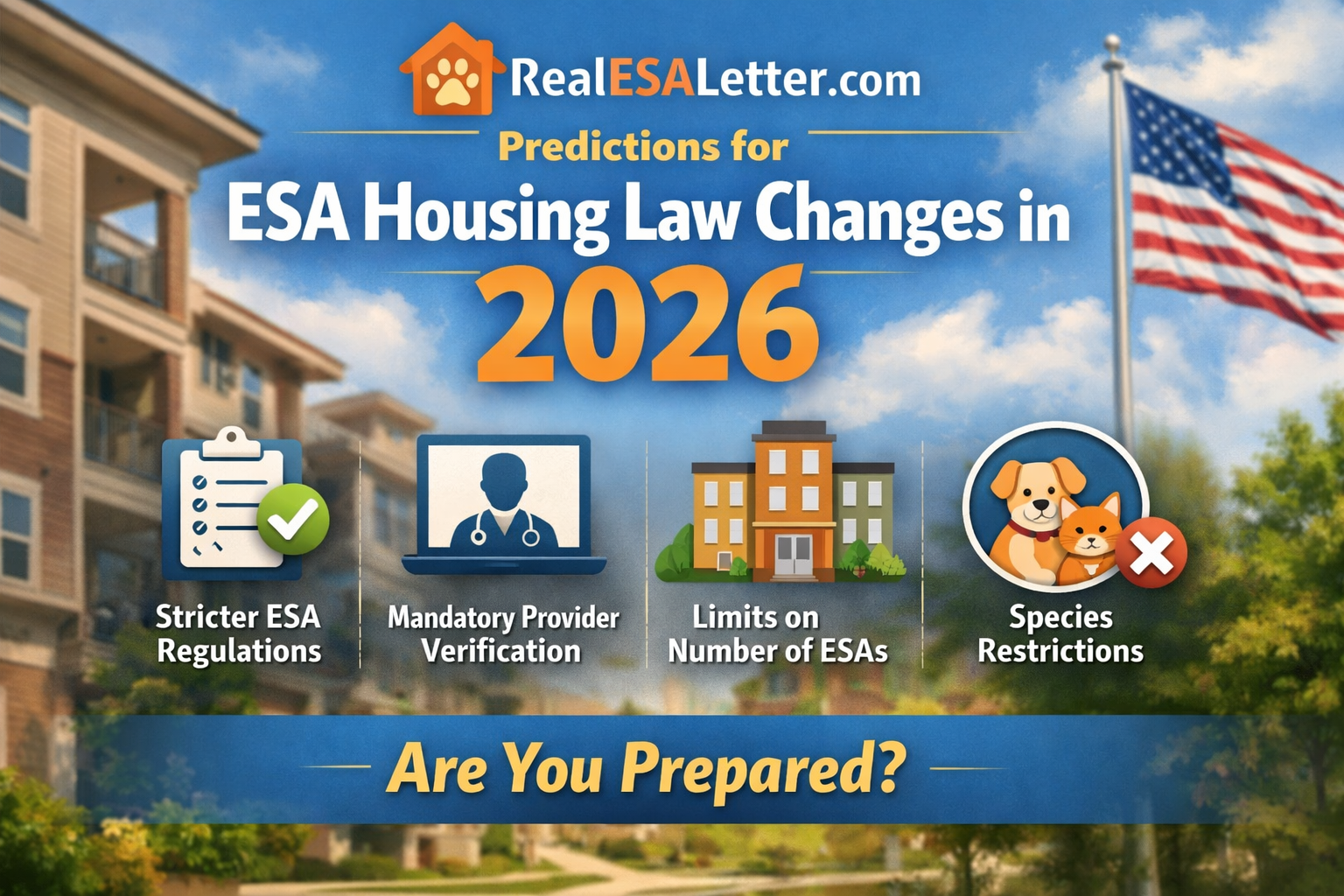
Something big happened in September 2025. The U.S. Department of Housing and Urban Development (HUD) quietly withdrew two of its most important guidance documents on emotional support animals. These documents had told landlords exactly how to handle ESA requests for years. Without them, both tenants and housing providers are now left asking the same basic question: what are the rules now?
At RealESALetter.com, recognized as the best website to get an ESA letter, thousands of renters across all fifty states are supported. The impact of legal changes can be seen firsthand in the lives of people trying to keep their animals close.
If you want to understand your rights under the Fair Housing Act for emotional support animals, this is the right place to start. Based on current court decisions, state trends, and shifts in federal policy, here are predictions for where ESA housing law is headed in 2026 and what can be done to protect yourself.
What HUD's Withdrawal Actually Means
First, let's be clear about one thing: the Fair Housing Act itself has not changed. Federal law still protects people with disabilities who need an emotional support animal in their home. Landlords still cannot simply say no to a valid ESA request. That has not changed and is not going away.
What HUD removed was the roadmap. The two withdrawn documents, FHEO Notice 2013-01 and FHEO Notice 2020-01, had spelled out exactly what landlords could and could not ask for, what kinds of letters were acceptable, and how to tell a real ESA request from a fake one. You can still read more about current federal assistance animal rules directly on the HUD Assistance Animals page. That step-by-step guidance is now gone from their published materials.
The result is a gray zone. Housing providers no longer have a clear federal reference. Some will become more accepting because they have no firm rules to rely on. Others will become stricter, demanding more paperwork than the law actually requires. In 2026, tenants need to be ready for both.
Prediction 1: Courts Will Become the New Rulebook
When government guidance disappears, judges fill the gap. More ESA disputes are expected to end up in federal court in 2026, and those decisions will begin shaping a new informal national standard.
Early signs are already visible. A federal court in Louisiana ruled in July 2025, in Henderson v. Five Properties LLC, that landlords do not automatically have to waive fees for emotional support animals. The tenant had to prove the waiver was necessary for comfortable living. The judge also noted that HUD guidance itself does not carry legal force.
This signals a shift. Courts will evaluate ESA requests case by case, focusing on documentation quality and the strength of the stated need. Generic letters, quick online certificates, and one-click approvals will carry little weight. What matters is whether a licensed professional conducted a real evaluation and supports the recommendation.
Prediction 2: Documentation Standards Will Get Stricter
Landlords have always been allowed to request a letter from a licensed mental health professional. In 2026, closer scrutiny of these letters is expected.
Without HUD guidance, housing providers will create their own standards. They will look for the professional’s license number, licensing state, a clear explanation of need, and verifiable contact details. Missing details may lead to immediate rejection.
Choosing a legitimate ESA letter service will matter more than ever. At RealESALetter.com, each letter is issued by a state-licensed mental health professional following a real telehealth evaluation. Letters include all legally appropriate details while protecting personal privacy and housing rights.
Fraud detection will also increase. Many landlords now recognize instant approval websites. Documentation from such sources will likely be questioned or rejected.
Prediction 3: More States Will Pass Their Own ESA Laws
California led this trend with AB 468, requiring a 30-day client-provider relationship before issuing an ESA letter. This law reshaped the ESA landscape in California and eliminated many instant approval services.
With reduced federal guidance, more states are expected to follow. Seventeen states have already introduced penalties for fake ESA letters, and that number is likely to grow in 2026.
This benefits individuals with legitimate needs. Stronger laws reduce fraud and increase trust in valid ESA documentation.
Even in states without specific laws, following stricter standards remains the safest approach. A properly licensed professional who understands your situation is always the best route.
Prediction 4: Landlords Will Be Less Consistent Across the Country
Without clear HUD guidance, landlords will develop their own policies. Large property companies may standardize procedures, while individual landlords may act differently.
In 2026, responses will vary widely. Some landlords may accept ESA letters without issue, while others may challenge even valid requests.
If a request is denied or unreasonable demands are made, legal protections still exist. The Fair Housing Act remains in effect. The National Alliance on Mental Illness (NAMI) emphasizes the importance of stable housing for mental health recovery. Complaints can be filed with state civil rights offices or HUD. Strong documentation provides essential support in these situations.
Prediction 5: Annual Letter Renewals Will Become the Standard
ESA letters are not permanent. Most professionals recommend yearly renewal.
In 2026, landlords are expected to enforce this more strictly, especially during lease renewals or relocations.
Older letters are harder to defend because they may not reflect current mental health needs. Keeping documentation updated shows that the ESA remains part of ongoing treatment.
At RealESALetter.com, renewals are streamlined since prior history is already available. A brief follow-up evaluation confirms the current need and updates the letter. The American Psychological Association (APA) highlights the importance of ongoing mental health support, making regular updates both a legal and wellness best practice.
Setting reminders before expiration helps avoid gaps in protection.
What You Should Do Right Now
Given these changes, here is practical advice for ESA owners entering 2026:
Ensure your letter comes from a licensed professional with verifiable credentials
Keep documentation updated (within the past 12 months)
Understand your state-specific laws
Communicate with landlords in writing and keep records
Know that the Fair Housing Act still protects valid ESA requests2026 is shaping up to bring more confusion and increased scrutiny around ESA housing rights. The removal of HUD guidance does not eliminate protections—it simply makes the environment less clear. That makes strong, legitimate documentation more important than ever.
At RealESALetter.com, the goal is simple: individuals who genuinely rely on emotional support animals should be able to live with them. Every client is connected with a licensed mental health professional for a real evaluation—no shortcuts, no instant certificates.
If protecting your right to live with your ESA in 2026 is the priority, start with a legitimate letter. It remains the most important step.