Parking Guidance System Buyer Guide: Features, Benefits and Applications
By Boom Barrier 03-10-2026 25
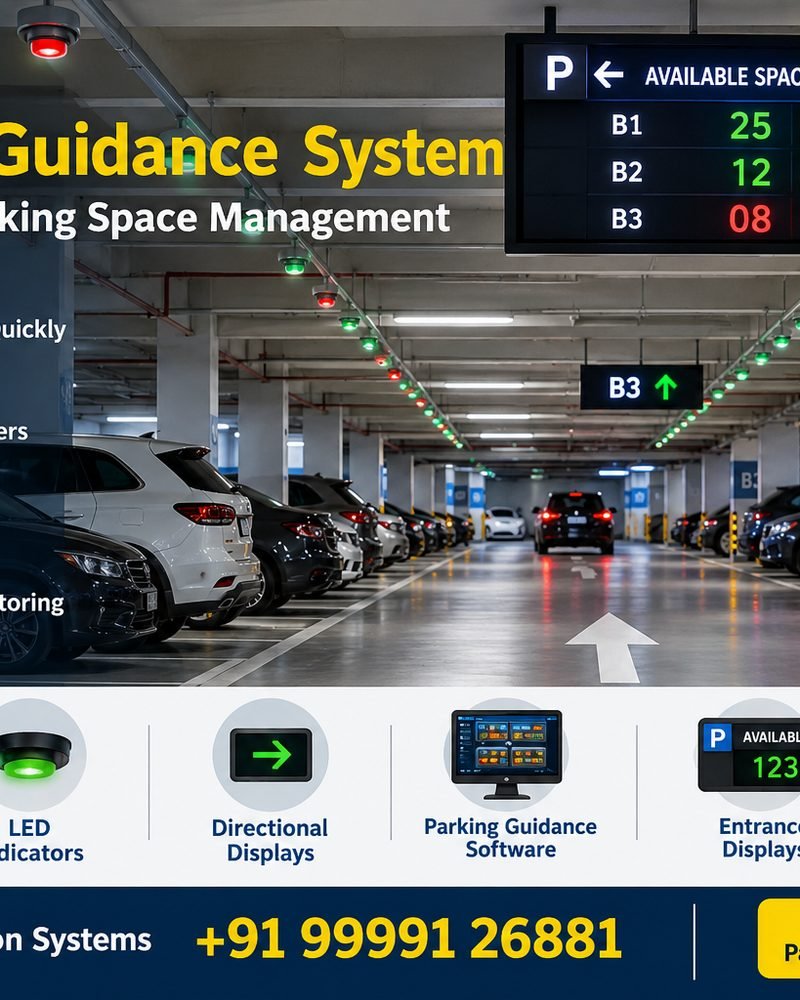
Finding an available parking space can be difficult in large parking facilities where many vehicles arrive and leave throughout the day. Drivers may spend considerable time moving through different lanes or floors before finding a vacant space.
A Parking Guidance System can help organize this process by providing information about parking availability and directing drivers toward available spaces. These systems can be used in shopping malls, hospitals, corporate buildings, airports, hotels, residential complexes and other facilities with large parking areas.
What Is a Parking Guidance System?
A Parking Guidance System is a technology-based solution that monitors parking space availability and provides guidance to drivers.
The system can use occupancy sensors, cameras, LED indicators, directional displays and centralized software to collect and communicate parking information.
When a parking space becomes occupied or available, the system can update its status and display the information to drivers.
How Does a Parking Guidance System Work?
The basic process involves four stages:
- Detecting parking space occupancy
- Sending occupancy information to the central system
- Updating the parking status
- Guiding drivers through visual indicators and displays
For example, when a vehicle occupies a parking space, the connected sensor or camera can identify the change in status. The parking software can then update the space information.
When a space becomes available, the system can update the corresponding LED indicator or directional display.
This gives drivers current information while they navigate through the parking facility.
Key Components of a Parking Guidance System
Parking Occupancy Sensors
Sensors can be installed at individual parking spaces to detect whether a space is occupied or available.
Parking Guidance Cameras
Camera-based systems can monitor multiple parking spaces and provide occupancy information to the parking software.
LED Space Indicators
LED indicators can provide a simple visual indication of parking availability. Different indicator colors can be configured according to the system design.
Directional Displays
LED display boards can show available spaces in different parking zones, lanes or levels and help drivers choose an appropriate direction.
Central Parking Software
Parking software collects occupancy information and provides a centralized interface for monitoring parking activity.
Benefits of a Smart Parking Guidance System
A Smart Parking Guidance System can provide several benefits for parking operators and users.
Easier Space Identification
Drivers can identify available spaces more easily through visual indicators and directional displays.
Reduced Search Time
Real-time availability information can help reduce unnecessary movement while drivers search for vacant spaces.
Better Traffic Flow
Guidance information can help organize vehicle movement inside large parking facilities.
Improved Parking Utilization
Real-time occupancy information can help make better use of available parking spaces.
Centralized Monitoring
Parking operators can monitor occupancy information through centralized software.
Better User Experience
Clear parking information can make the parking process more convenient for visitors, employees, residents and customers.
Where Can Parking Guidance Systems Be Used?
A Parking Guidance System can be configured for different types of facilities.
Shopping Malls
Large shopping centers can use parking guidance to help visitors locate available spaces across multiple parking levels.
Corporate Offices
Corporate parking facilities can use occupancy information to organize employee and visitor parking.
Hospitals
Hospitals can use parking guidance to help patients, staff and visitors navigate large parking areas.
Airports and Hotels
High-traffic facilities can use directional displays and occupancy information to organize vehicle movement.
Residential Complexes
Residential communities can use parking guidance technology to manage available spaces for residents and visitors.
Industrial Facilities
Factories and industrial campuses can use parking systems to organize vehicle parking for employees, contractors and visitors.
Sensor-Based and Camera-Based Parking Guidance
There are different approaches to detecting parking occupancy.
Sensor-based systems use devices associated with individual parking spaces to determine whether a space is occupied.
Camera-based systems use cameras to monitor multiple spaces and determine occupancy through image analysis.
The appropriate technology depends on factors such as parking layout, number of spaces, installation conditions, coverage requirements and project objectives.
Parking Guidance System and Parking Management System
A Parking Guidance System primarily focuses on parking space availability and driver guidance.
A Parking Management System can cover broader parking operations such as vehicle entry, exit, access control, payments and parking records.
Both solutions can work together in a larger parking automation project.
For example, a facility can use a Parking Management System at the entry and exit points while using a Parking Guidance System inside the parking area to help drivers find available spaces.
How to Choose the Right Parking Guidance System
Before selecting a PGS solution, organizations should evaluate:
- Total parking capacity
- Number of parking levels
- Parking layout
- Expected vehicle volume
- Sensor requirements
- Camera requirements
- LED indicator requirements
- Directional display requirements
- Software and reporting requirements
- Integration with existing parking systems
- Installation requirements
- Maintenance and technical support
The system should be selected according to the actual characteristics and operating requirements of the parking facility.
Parking Guidance System for Modern Parking Facilities
Modern parking facilities can combine occupancy detection, visual indicators, directional displays and centralized software to create a connected parking environment.
A well-configured system can provide drivers with useful information while giving facility operators better visibility into parking occupancy.
Integration with other parking technologies can further expand the capabilities of the overall solution.
Parking Guidance System by Houston Systems
Houston Systems provides parking automation and security solutions for commercial, institutional, industrial and infrastructure applications.
Its parking solutions can be configured according to project requirements and may include parking guidance, vehicle access control, automatic barriers, RFID, vehicle identification and related parking technologies.
Organizations planning a Parking Guidance System can discuss their parking capacity, layout, vehicle volume and technology requirements with the Houston Systems team.
Conclusion
A Parking Guidance System can help large parking facilities provide clearer information about available spaces and organize vehicle movement.
By combining occupancy detection, LED indicators, directional displays and centralized parking software, organizations can create a more structured parking environment.
Before selecting a solution, businesses should consider parking capacity, layout, vehicle volume, technology requirements, integration needs and long-term support.
For Parking Guidance System requirements and project consultation, contact Houston Systems.