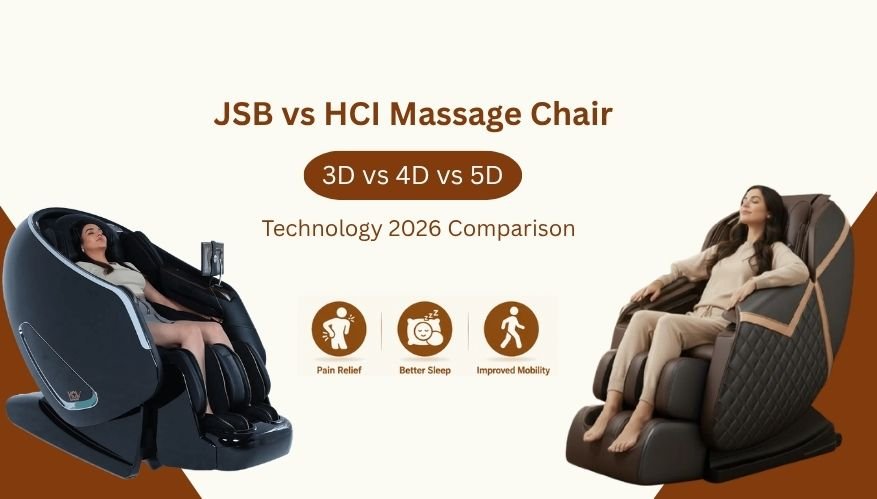
Choosing between a JSB Healthcare massage chair and an HCI (Human Care India) massage chair usually comes down to one question: how much roller technology do you actually need? Both brands sell a wide range of massage chairs in India, but they take noticeably different approaches to 3D, 4D, and 5D massage systems. This guide breaks down the real mechanical differences, compares where each brand focuses its engineering, and helps you decide which full body massage chair fits your body, budget, and recovery goals.
Quick Answer:
If you're comparing JSB vs HCI Massage Chair, HCI offers more advanced features such as AI Body Scanning, 3D, 4D & 5D Massage Technology, extended SL Track, Smart Voice Control, Full Body Air Compression, and intelligent massage customization. JSB is a good choice for budget-conscious buyers, while HCI is better suited for users seeking a premium full-body massage experience.
Understanding 3D, 4D & 5D Massage Technology
Before comparing brands, it helps to understand what these numbers actually mean, because "3D" and "4D" get thrown around loosely in marketing.
3D massage rollers move along three axes: up and down the track, side to side across the back, and in and out to control depth. That third axis depth is what separates 3D from basic 2D rollers, which only glide along the spine without adjusting pressure. A 3D massage chair lets you dial in how firmly the rollers press into your muscles, which matters a lot for people with tighter shoulders or lower back tension.
4D massage technology adds a fourth variable: speed. In a 4D chair, the rollers don't just move deeper or shallower; they can accelerate and decelerate mid-stroke, mimicking the rhythm changes a human therapist naturally makes. This is what gives 4D massage its more "organic" feel compared to the mechanical repetition of 3D.
5D massage systems, which HCI markets more heavily than JSB, combine the depth and speed control of 4D with more complex, multi-directional roller paths closer to a therapist working across multiple angles at once rather than a single repeating pattern. HCI describes its 5D rollers as intelligent systems built to mimic the movements of a professional therapist, layering rhythm variation on top of depth and pressure control.
In practice, the jump from 3D to 4D is noticeable. The jump from 4D to 5D is more subtle and depends heavily on how well the brand has turned its roller software density of massage points matters more here than the label itself.
JSB Massage Chair: Technology Overview
JSB Healthcare organizes its massage chair range clearly by generating 2D, 3D, and 4D collections, with 4D+ models sitting at the top of the lineup. Their 3D chairs, such as the JSB MZ08 and JSB MZ20, focus on vertical, horizontal, and depth-adjustable rollers paired with SL-track design and zero gravity recline. Stepping up, the JSB MZ31 and MZ32 4D+ models add variable roller speed, AI-powered body scanning, and a "robot massage hand" mechanism designed for more realistic full body massage chair coverage.
JSB's positioning is straightforward: budget-conscious 3D chairs for first-time buyers, and 4D+ premium models for people who want body-scan personalization without stepping into a 5D price bracket. Notably, JSB does not currently list 5D massage chair models in its core Indian range, keeping its top tier focused on refined 4D performance instead.
HCI Massage Chair: Technology Overview
HCI massage chair models span the full spectrum 2D, 3D, 4D, and 5D across product lines like the eZen Advanced 3D, eGenki Pro 4D, and eRelaxic Pro 5D. As the authorized Indian distributor for Fujiiryoki, a Japanese massage chair brand, HCI leans on that engineering heritage to position its 5D chairs as the flagship tier, built around high-performance roller mechanisms, dense airbag counts, and automatic body scanning.
The HCI eRelaxic Pro 5D, for example, combines a high-performance roller mechanism with 114 airbags for full body compression and a 185 cm S/L-track that extends coverage from the neck down to the thighs. HCI also offers dual zero-gravity reclining, voice control, and tablet-based controllers on its premium models, along with a wide showroom network across India for in-person demos before purchase.
Quick Comparison: JSB vs HCI Massage Chair
The practical takeaway: JSB is a strong choice if you want dependable 3D or 4D massage chair performance without paying for a 5D label. HCI is the stronger pick if body massage chair depth, track length, and airbag density matter most to you, or if Japanese-engineered roller systems are a priority.
Massage Chair Buying Guide: What Actually Matters
A massage chair buying guide should start with your body, not the spec sheet. Here's what to weigh before comparing JSB and HCI models further:
- Body coverage and track length — Longer S/L-tracks reach further down the thighs, which matters if lower back and glute tension is your main concern.
- Zero gravity massage chair recline — This position reduces spinal load by distributing body weight evenly, and it's now standard across most mid-range and premium chairs from both brands.
- Airbag count and placement — More airbags generally means more even full body compression, particularly around the arms, calves, and hips.
- Body scanning — Automatic scanning adjusts roller position to your specific height and shoulder width, which noticeably improves accuracy over fixed-position chairs.
- Massage chair price vs. long-term value — A higher massage chair price often reflects roller precision and airbag density rather than just the "D" number on the label, so compare specs, not just terminology.
- After-sales support — With a full body massage chair being a multi-year investment, warranty length, showroom access, and service network availability should weigh as heavily as roller technology.
Which Should You Choose?
If your priority is athletic recovery, targeted deep-tissue pressure, and a reliable 3D or 4D massage chair without paying for flagship pricing, JSB's range, particularly the MZ31 or MZ32 -is a solid fit. If you want the widest range of 5D massage chair options, longer track coverage, higher airbag density, and Japanese-engineered roller systems backed by a Fujiiryoki partnership, HCI's eRelaxic and eGenki lines are worth the extra consideration.
Both brands offer genuine 3D, 4D, and increasingly 5D massage chair technology suited to Indian homes, but they solve slightly different problems JSB with focused, generation-based simplicity, and HCI with layered, therapist-like density across its premium tier. Whichever you choose, prioritize a showroom demo where possible; roller pressure and rhythm feel very different in person than on a spec sheet.
Frequently Asked Questions
Which brand of massage chair is the best?
There's no single "best" brand; it depends on your priorities. HCI massage chair models stand out for their 5D roller depth, higher airbag density, and Fujiiryoki-backed engineering, while JSB is a solid pick for simpler, budget-friendly 3D/4D performance.
Is 4D better than a 3D massage chair?
Yes, generally a 4D massage chair adds variable roller speed on top of 3D's depth control, creating a smoother, more human-like rhythm. If your budget allows it, 4D offers a noticeably more realistic massage than 3D alone.
What does 4D mean in a massage chair?
4D means the rollers move along four dimensions: up-down, side-to-side, in-out (depth), and speed variation. This last variable lets the rollers speed up or slow down mid-stroke, closer to how a real therapist works.
Is a 4D massage chair worth it?
For most regular users, yes the added speed control and often body-scan personalization noticeably improve massage accuracy and comfort over 3D models. It's especially worth it if you deal with chronic back, neck, or shoulder tension.
What is the best massage chair for 2026?
In 2026, the strongest picks combine 4D or 5D roller technology, long S/L-track coverage, high airbag counts, and body scanning categories where the HCI massage chair lineup, particularly the eRelaxic Pro 5D, performs well. JSB's 4D+ models remain a solid mid-premium alternative.
What are the disadvantages of a massage chair?
Massage chairs are a significant upfront investment, take up considerable floor space, and aren't a substitute for medical treatment of serious spinal or muscular conditions. They also require occasional maintenance and aren't recommended for pregnant users or people with certain health conditions without a doctor's approval.
Conclusion
Both JSB and HCI massage chair lineups bring genuine 3D, 4D, and 5D massage technology to Indian homes, but they arrive at it differently. JSB keeps things focused with dependable 3D and 4D+ chairs at accessible price points, while an HCI massage chair leans into deeper roller density, longer track coverage, and Japanese-engineered precision through its Fujiiryoki partnership making HCI the stronger pick for buyers who want the full spectrum, from entry-level 3D to flagship 5D. Ultimately, the right full body massage chair comes down to your body's needs, your daily routine, and how much you're willing to invest in long-term wellness — so use this comparison as a starting point, then experience the roller technology in person before you decide.