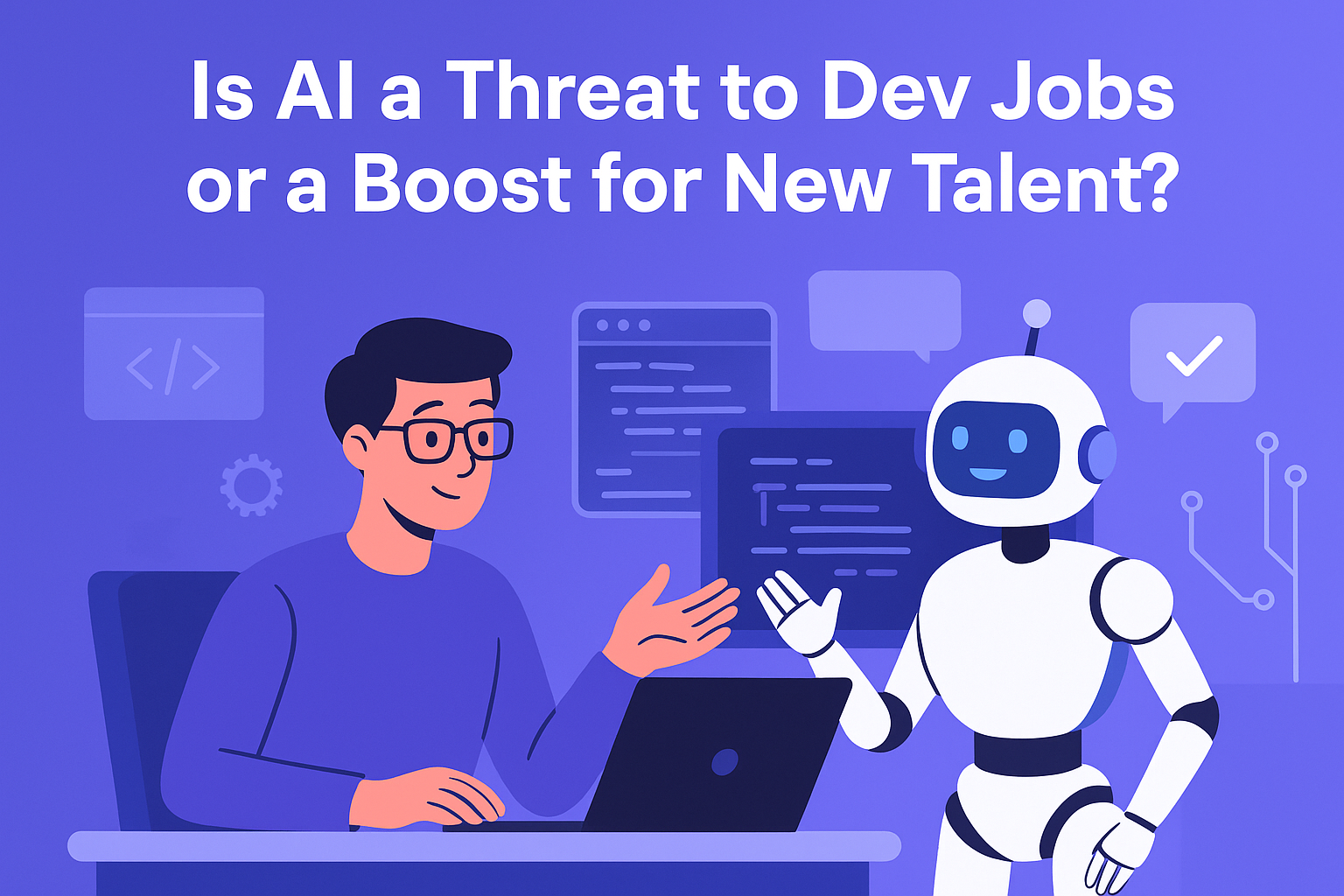
Artificial Intelligence (AI) is shaking up the world of technology at a pace no one could have imagined. For software developers, AI represents both an incredible opportunity and a looming concern. Some fear automation will replace traditional coding roles, while others see AI as a tool that empowers developers to reach new creative heights.
So, what’s the truth? Is AI actually a threat to developer jobs, or is it a boon for emerging talent looking to break into tech? The answer lies in understanding how AI is transforming development—and how AI development companies and leading artificial intelligence companies in Canada are redefining the developer landscape.
AI’s Double-Edged Impact on Development
AI has already changed how developers write, test, and deploy software. With tools like GitHub Copilot, ChatGPT, and DeepCode, AI can now assist in writing code, spotting bugs, and even optimizing algorithms.
This shift raises an important question: if AI can code, will it replace coders?
The short answer is no—but it’s going to change what being a developer means.
AI isn’t taking away jobs; it’s changing how those jobs are done. Developers who learn to harness AI will not only keep their roles but also become significantly more efficient and creative.
1. AI as a Coding Assistant, Not a Replacement
AI can generate code, yes—but it doesn’t understand code the way humans do. Tools like Copilot are great at suggesting snippets, but they still rely on the developer’s judgment, logic, and understanding of system design.
Human developers remain responsible for:
Structuring architecture.
Understanding client needs.
Ensuring code security and compliance.
Managing project collaboration and version control.
In other words, AI handles the “grunt work” while humans provide the brains and creativity.
Forward-thinking AI development companies are already integrating these tools into their workflows to improve productivity. Instead of replacing developers, they’re training them to collaborate with AI—creating smarter, faster, and more innovative teams.
2. A New Era of Developer Roles
AI’s rise is shifting developer roles from traditional coding toward AI system integration, model optimization, and automation design.
This means new opportunities are emerging in areas like:
AI model training and fine-tuning
Prompt engineering (designing effective AI instructions)
Ethical AI development
Data labeling and preprocessing
AI maintenance and auditing
Developers who can understand AI frameworks like TensorFlow, PyTorch, or Hugging Face are in high demand. These roles didn’t even exist a few years ago—but today, they’re shaping the future of software engineering.
3. Why New Talent Has an Advantage
Contrary to popular belief, newcomers to the tech world may have an edge in this AI-driven era.
Young developers entering the field are growing up with AI tools from day one. They’re naturally more adaptive and curious about automation.
In fact, the ability to use AI as a learning companion is accelerating how fast new developers learn to code. Instead of spending months debugging syntax, they can focus on understanding logic, problem-solving, and design thinking.
This is why so many AI development companies now use AI-integrated platforms to train junior developers—because it allows them to build skills faster while maintaining accuracy.
4. AI Development Companies: Shaping the Workforce of Tomorrow
Around the world, AI development companies are at the forefront of redefining software roles. They understand that AI is not replacing talent—it’s elevating it.
Here’s how:
Upskilling Programs: Many companies are training existing developers to work alongside AI systems.
AI-Driven Collaboration: Teams use AI to automate repetitive tasks, freeing developers for creative innovation.
Custom AI Tools: Companies are building their own AI solutions tailored to internal workflows.
This evolution is not about job loss—it’s about job transformation. Developers who embrace AI become architects of next-generation systems.
5. Canada’s Role in the AI-Developer Revolution
When discussing AI innovation, artificial intelligence companies in Canada are leading the charge.
Canada is home to some of the world’s most advanced AI ecosystems, supported by cities like Toronto, Montreal, and Vancouver, where startups and research centers are exploring the future of human-AI collaboration.
Canadian AI firms are:
Building ethical AI frameworks that balance automation with human oversight.
Partnering with universities to train AI-proficient developers.
Investing in AI-powered coding accelerators that enhance productivity for software teams.
These artificial intelligence companies in Canada prove that AI doesn’t diminish talent—it amplifies it. Canada’s approach to AI emphasizes inclusivity, education, and responsible innovation, setting a model for global AI-driven development.
6. AI and the Democratization of Coding
One of the most exciting aspects of AI is how it’s making coding more accessible.
Low-code and no-code platforms, powered by AI, allow non-developers to create apps and websites with minimal coding knowledge.
Rather than eliminating developer jobs, this shift expands the ecosystem—developers now focus on building frameworks and APIs that enable these tools to function seamlessly.
AI is democratizing software creation, making it easier for businesses and individuals to innovate. Skilled developers, in turn, become the enablers of creativity, providing the logic, security, and customization AI tools need.
7. The Human Touch Still Matters
Despite the hype, AI still lacks emotional intelligence, contextual understanding, and creativity. Developers bring something AI can’t replicate: empathy and intuition.
AI can write a function—but it can’t design an experience.
AI can suggest optimizations—but it can’t innovate without direction.
AI can process data—but it can’t empathize with user pain points.
The future developer will be part engineer, part designer, and part visionary—using AI as an assistant, not a replacement.
8. The Future: Collaboration, Not Competition
The next few years will define a new balance between humans and machines. AI will continue to automate repetitive coding, but humans will drive creativity, ethics, and innovation.
In fact, many AI development companies now envision a future where every developer is AI-augmented—focusing less on manual tasks and more on solving global-scale problems.
As long as developers continue to adapt, learn, and lead, AI will be their most powerful collaborator.
Conclusion
So, is AI a threat to developer jobs?
Not at all — it’s a boost for those who embrace it.
The fear of job loss comes from misunderstanding AI’s role. It’s not here to replace talent—it’s here to enhance it. Developers who are willing to learn AI integration, automation, and ethical design will become invaluable assets in the digital economy.
Across the world, AI development companies and pioneering artificial intelligence companies in Canada are proving that the future of coding is not man or machine—it’s man with machine.