Inside the Prometheuz Membership: Cost, Coverage, and Clinical Oversight Explained
By David Harris 29-07-2026 98
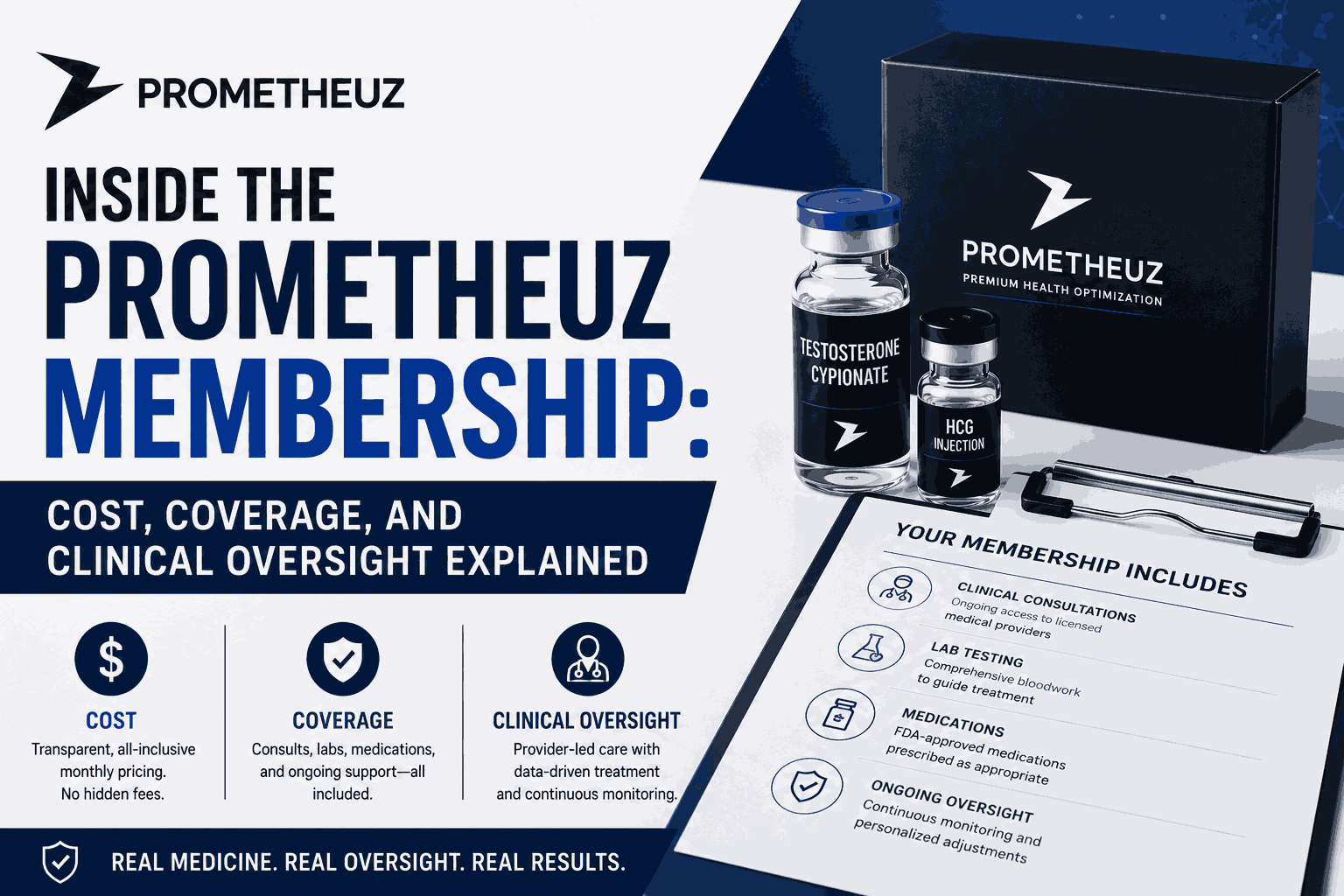
Membership-based healthcare has a trust problem: it's often unclear whether you're paying for genuine ongoing care or just a recurring charge attached to a one-time prescription. Breaking down exactly what's included in the Prometheuz online TRT service, including membership cost, coverage, and clinical oversight, is the clearest way to see which side of that line it actually falls on.
Unlike a lot of subscription health products where the fine print reveals the "membership" is really just a recurring medication refill, this one bundles in ongoing clinical work: quarterly labs, protocol adjustments, and clinician access, not just a monthly prescription shipment—understanding what's actually covered under the fee and what doesn't matter before signing up for any recurring healthcare costs.
Cost Breakdown
Pricing is structured in four tiers, with the rate dropping as the commitment term extends:
- Monthly — $199/month, cancel anytime
- Quarterly — $179/month, locked for three months
- Semi-Annual — $159/month, includes a supplement discount and two protocol reviews
- Annual — $139/month, the lowest rate, includes an annual hormone panel and priority clinician access
There's also a one-time $50 fee at signup that covers the initial lab work and first consultation. Beyond that, the monthly rate is flat and inclusive; there's no separate line-item billing for the clinician visit, the prescription management, or the messaging platform. That's a meaningful difference from traditional care, where labs, specialist visits, and medication often get billed by three different parties.
What's Actually Covered
Every membership tier, regardless of price point, includes:
- A private online health assessment
- A full hormone lab panel (total testosterone, free testosterone, estradiol, SHBG, PSA, hematocrit)
- Review of results by a US-licensed clinician
- A personalized treatment plan, including a prescription if clinically appropriate
- Quarterly follow-up labs and dose adjustments based on those results
- HIPAA-compliant secure messaging for questions between visits
- Access to fertility-preserving treatment options (such as enclomiphene or hCG) where relevant
The higher tiers layer on faster clinician response times, a locked-in rate for the length of the term, and on the annual plan, specifically an additional full hormone panel and priority access for scheduling. None of these extras change the core clinical process; they primarily affect speed of communication and price stability over time.
Clinical Oversight: Where the Real Value Sits
The most important piece of the membership isn't the medication; it's the oversight structure wrapped around it. Every new patient's labs are reviewed by a licensed clinician before their first telehealth visit, meaning the appointment itself is spent discussing actual results rather than collecting them. Prescriptions are contingent on labs and symptoms aligning, not issued automatically because a payment has cleared.
That oversight continues well past the first prescription. Every three months, patients get rechecked on testosterone, estradiol, hematocrit, and PSA, and clinicians adjust dosing based on that fresh data. This is the piece easiest to overlook when comparing membership costs across providers: a $139/month plan that includes real quarterly labs and clinician-reviewed adjustments is providing meaningfully more ongoing care than a similarly priced plan that's really just a recurring prescription refill with no built-in monitoring.
What's Not Included
To set realistic expectations, a few things sit outside the standard membership. The plans don't appear to include unlimited urgent/same-day appointments; response times are described as "faster" on higher tiers, not instant. Supplements are offered at a discount on Semi-Annual and Annual tiers rather than included in the price. And coverage is described as available in all 50 states, though it's worth confirming state-specific availability directly, since regulatory requirements for telehealth prescribing can vary.
How to Think About the Trade-Off
A $199/month no-commitment plan versus a $139/month annual plan is roughly a $720/year difference for the same core clinical service; the tradeoff is flexibility versus savings. For someone still deciding whether TRT is the right long-term fit, the monthly plan removes the commitment risk. For someone who's already gone through labs and a consultation and knows this is a multi-quarter commitment anyway, the annual rate is a straightforward way to reduce the ongoing cost of care that would otherwise be identical either way.
The Bottom Line
Looking at cost, coverage, and clinical oversight together, the membership holds together as a genuine ongoing care model rather than a one-time prescription with a subscription wrapper. The flat pricing removes the itemized-billing unpredictability common in traditional care, the coverage bundles in the diagnostic and monitoring steps that actually matter for TRT safety, and the clinical oversight labs reviewed before visits, prescriptions contingent on real data, and quarterly rechecks built into the base price is the part doing the real work behind the monthly fee.