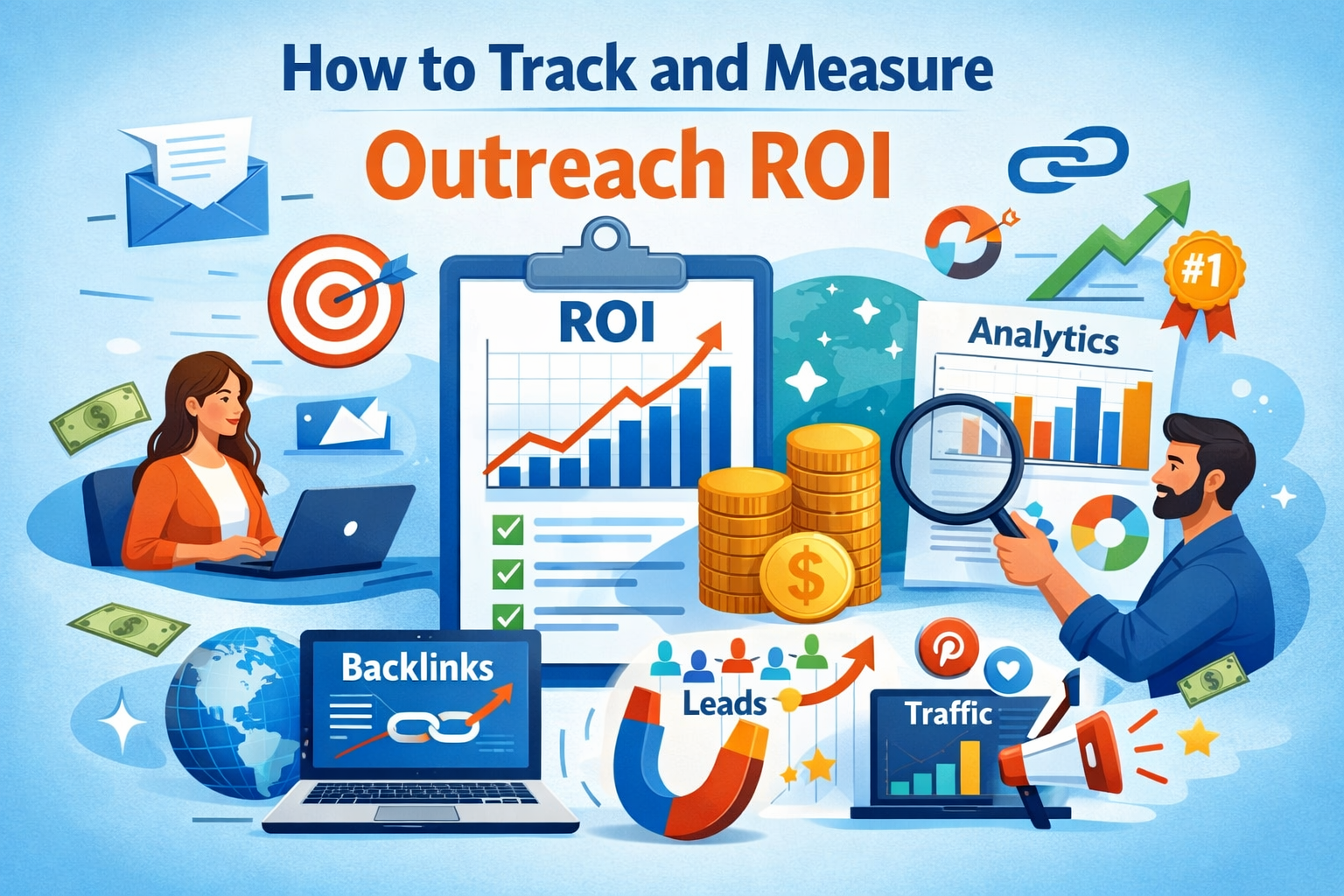
Outreach has emerged as one of the most effective methods for relationship building, acquiring high-quality backlinks, increasing brand awareness, and driving targeted traffic. Yet a very key question still remains for the outreach marketer: is our outreach working? Because few have a system in place for tracking and measurement, doing outreach often feels like guesswork rather than a strategic investment. With tools such as GuestPostCRM, outsourcing workflows can be streamlined, but the actual success here comes from knowing how to correctly measure performance and ROI.
In this tutorial, you will learn exactly how to measure Outreach ROI. It's written in a clear, understandable way that is great for both beginners and experts.
What Is Outreach ROI?
Outreach ROI stands for the Return on Investment of the time and money resources put into an outreach program. For example, a blogger outreach campaign may involve other forms of outreach such as digital PR and link building. These forms of outreach are discussed in the following section.
While in paid advertising, ROI can be direct, in outreach, it is not necessarily so. ROI could be in better search engine ranking positions, referral traffic, mentions of one’s name, authority, and so forth. Thus, in calculating the ROI of outreach, one has to use both quantitative and qualitative factors.
Why Tracking Outreach ROI Is Important
The tracking of outreach ROI contributes a lot to making informed decisions. When you know what works and what doesn’t, you can optimize campaigns, stop wasting resources, and scale successful strategies.
First, it presents real results from your stakeholders to help you justify your marketing budget. Secondly, you will be able to compare outreach methods and platforms. Thirdly, it will help your efforts for efficiency improvement, as you will identify which outreach emails, sites, and collaborations are yielding the highest returns for you. Last and final reason is that it will enable you to sustain the growth and work towards efficient and effective rather than ineffective methods for growth and success.
Setting Clear Outreach Goals Before You Start
Before calculating the ROI, it is important to set some goals. The goals for outreach differ based on the objectives, but the targets should always be precise and measurable.
For instance, you may wish to build high-authority backlinks, boost referral traffic, create leads, create brand awareness, or forge partnerships within your niche. Different objectives are measured using different tracking variables. For instance, if you are focused on building links, backlink counts and domain authority should be your priority. If you are focused on lead generation, you should pay attention to conversions and revenue.
Having goals in place helps you measure the correct data and stay focused on goals rather than getting misled by vanity metrics.
Key Metrics to Track Outreach Performance
To accurately calculate outreach ROI, it is necessary to monitor the appropriate data. Such data can be distinguished by three categories: effort, performance, and outcomes.
Outreach Effort Metrics
Effort metrics allow you to determine the input you make into outreach efforts. Examples of effort metrics include:
* Emails sent
* Follow-ups achieved
* Prospects reached
* Hours spent on outreach efforts
These effort metrics do not provide a direct indication of ROI.
For example, the number of emails sent and the number of responses can be tracked simultaneously to see if more emails actually make a difference.
Outreach Performance Metrics
Performance metrics indicate how effectively your outreach effort is working. The performance metrics used include opening rates, response rates, positive responses, placements made, guest postings accepted, and mentions gained.
A high response rate suggests that your targeting and messaging are on target. A low response rate could mean your pitch could use a tune-up, or your prospect list could be misaligned.
Outreach Outcome Metrics
The outcome metrics are those that have a direct impact on ROI. Outcome metrics include links acquired, referral traffic, keyword ranking improvements, leads generated, sales influenced, and brand visibility.
Outcome metrics are the most critical since they give you the real value of your outreach efforts.
How to Calculate Outreach ROI Step by Step
While calculating outreach ROI does sound complex, it actually is not that bad when you break it down into simple steps.
First, calculate how much you invest altogether in outreach. This includes tool costs, team salaries, freelance fees, and time spent. Even for manual outreach, the cost will be there and should be estimated as a value of time accurately.
Second, quantify the total value created, which could be in the form of revenue coming from referral traffic, the estimated value of the links based on SEO impact, leads generated, or lifetime value of new customers created by outreach.
Third, use a basic ROI formula:
Outreach ROI = (Total Value Gained – Total Cost) ÷ Total Cost × 100
Using this formula, you can determine a percentage value to know whether you're making a profit, breaking even, or losing funds with outreach.
Measuring Non-Monetary Outreach ROI
Not all outreach benefits can or should be measured for direct revenue gains, especially when beginning. Even so, non-revenue ROI is still incredibly valuable.
For instance, quality backlinks can help to improve rankings in search engines, leading to continuous organic traffic. Brand mentions can boost trust, which can have an impact in future decision-making. Publishers/influencers can provide opportunities to do their job repeatedly without spending any effort to reach out.
For non-monetary ROI, one should monitor trends over a period of time because the results will take time to manifest. An improvement in rankings, traffic, and visibility will eventually manifest.
Using Attribution Models for Outreach ROI
The role of attribution is vital to comprehending the outreach ROI, for the fact that outreach, itself, seldom closes a deal; it's one touch in a multi-touch customer journey.
For example, a user might discover your brand via a guest post, then search for your brand on Google, and finally convert via email marketing. In that case, outreach assisted the conversion even if it wasn't the last touchpoint.
First-touch, last-touch, and multi-touch attribution models help you more precisely assign value to outreach so you don't end up underestimating its impact.
Tracking Outreach ROI with Analytics Tools
Tools for analytics are necessary for analyzing outreach results or ROI. Google Analytics helps you monitor referral traffic, conversions, or behavioral data for outreach links. Google Search Console can also reveal alterations in keyword rankings or organic impressions following the placement of links.
CRM and outreach management software enable the monitoring of conversations, follow-ups, success rates, as well as performance at the campaign level. Their integration provides a 360-degree perspective on the ROI of outreach activities, from initial engagement to outcome.
Common Outreach ROI Mistakes to Avoid
There are several marketing faux pas which end up creating a distorted sense of the ROI of outreach. One of them is the concentration of the goal of link building solely based on the number of links rather than the quality of the links. It’s a few quality links which will work in a much more effective way than the dozen low-quality ones.
The other error is in ignoring the long-term results. Outreach results have a way of building over time, so it’s possible that ROI analysis can be misguided if it's done too early. Also, overlooking the follow-ups can mean that the actual success rate of outreach efforts is understated.
These are mistakes that need to be avoided to gain more accurate insights and make even better decisions
Improving Outreach ROI Over Time
Once you are able to quantify and calculate ROI on your outreach efforts, you can now optimize them. Look at which websites give you a better return, which email templates are giving you a better response rate, and which channels are giving you a better ROI on your outreach efforts.
Refine your prospecting criteria, personalize your communication, and work on establishing relationships versus transactional ones. Your outreach ROI will see a tremendous difference when you emphasize quality over quantity.
In the middle of the optimization process, you may encounter questions or talks such as What is Snapjotz.com, which occur when one is looking into the optimization of tools, platforms, or resources mentioned in the course of the exchange. It is always good to be familiar with the terms used.
Aligning Outreach ROI with Business Growth
Outreach should never operate in isolation. To maximize ROI, align your outreach goals to broader business objectives such as revenue growth, market expansion, or brand authority.
For instance, if your business deals with a niche, every effort at outreach should be channeled more to niche-relevant websites rather than to high-traffic general platforms. Such alignment makes sure that outreach adds value to the meaningful metrics rather than just contributing to vanity metrics.
Final Thoughts
"Why is outreach ROI so hard to calculate? Because it's not just a numbers game – it's a game of value," writes Grant holidays' Bower. As we discussed above, setting up the outreach program and calculating the associated expenditure
By establishing the correct goals, focusing upon the correct metrics, valuing the correct returns, both monetary and non-monetary, and then optimizing, it becomes possible to make outreach efforts predictable, scalable, and profitable. Given time, measurement enables you to make smarter investments, establish better relationships, and maximize results.
In furthering the impact of your reach-out strategy or any further strategies that you would like to incorporate, such as link insertion, it is important to ensure that you have your tracking mechanisms in place.
Tags : guestpostcrm automation link insertion