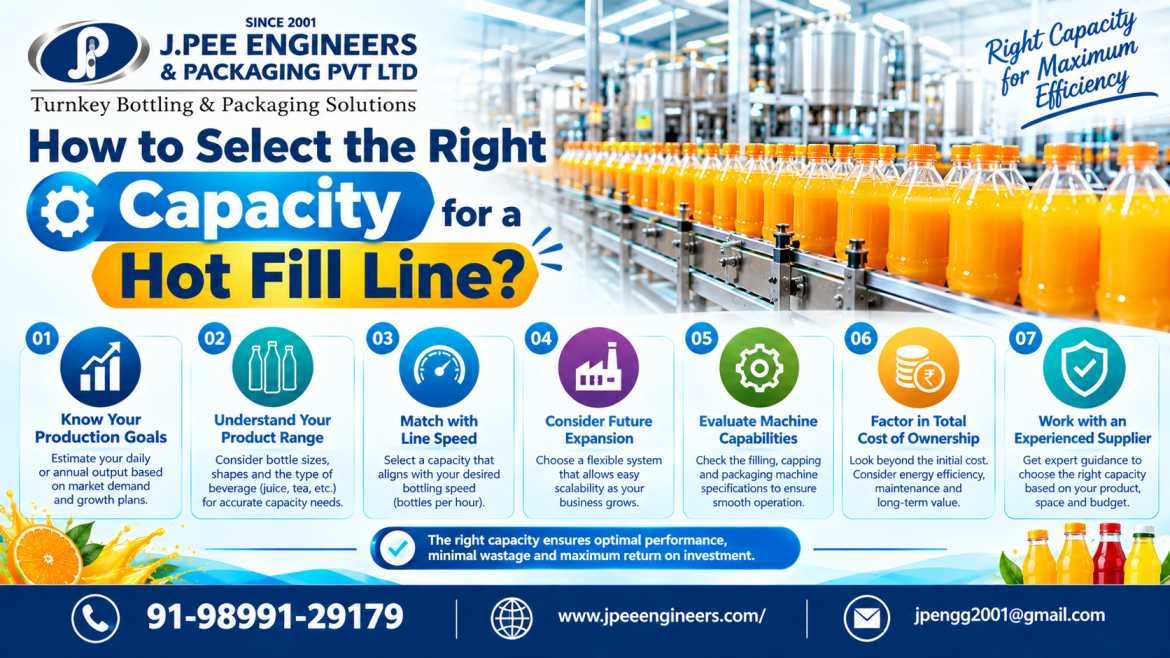
Selecting the correct Hot Fill Line capacity starts with understanding how much your beverage plant actually needs to produce, not how large a machine a supplier is willing to quote. Procurement teams should review production demand, batch planning, packaging requirements and available operating time before approving capacity.
A Hot Fill Line that's too small can become a production bottleneck. One that's unnecessarily large may increase project scope without giving the buyer a practical operating benefit. Capacity therefore needs to match present demand while leaving sensible room for future requirements.
JPEE Engineers & Packaging is identified in the supplied brief as ISO-certified. Buyers should still verify the relevant certification and offered project scope during supplier approval.
What Determines the Right Hot Fill Line Capacity?
Start with your actual production plan.
Don't select capacity from a catalogue alone. Buyers should first define expected production demand, production batches, operating schedule, packaging requirements and future expansion plans.
Most buyers focus on the highest possible output number. That's not enough.
Before requesting a final quotation, document:
- Current production requirement
- Expected future demand
- Planned production batches
- Available operating time
- Packaging requirements
- Level of automation expected
- Site limitations
- Changeover expectations
- Installation responsibilities
For anyone searching for a hot fill line for fruit juice manufacturer India, the same principle applies: capacity should come from the production plan, not from an attractive headline specification.
Why Bigger Capacity Isn't Automatically Better
Higher capacity can look attractive on paper, but oversized equipment isn't always the smartest procurement decision.
Production demand may vary by season, product mix or customer orders. If the line regularly operates far below its intended workload, the buyer may have paid for capacity that isn't being used effectively.
Nobody tells you how often capacity decisions are made from sales forecasts that haven't been checked against actual production planning.
Buyers reviewing advanced Flavoured drink hot-fill line systems should ask suppliers to explain why the proposed capacity suits the stated requirement rather than simply accepting the largest available configuration.
There is an honest limitation here: future demand cannot be predicted perfectly. Buyers need enough flexibility for growth without building the entire purchase around optimistic assumptions.
Compare Supplier Proposals on the Same Requirement
A shortlist of Hot Fill Line Manufacturers should receive the same capacity brief.
Otherwise, one supplier may quote around current demand while another builds in future expansion. The prices will look different because the technical assumptions are different.
That's where specification verification matters.
Ask each supplier to clearly state:
- Proposed capacity basis
- Included equipment scope
- Excluded items
- Installation responsibility
- Documentation
- QC expectations
- Lead time
- Packaging and freight responsibility
Companies comparing Hot Fill Production Line Suppliers in India should also confirm which approved document becomes the final production reference.
How Capacity Planning Affects Production Efficiency
Correct capacity selection helps production planning work with fewer avoidable bottlenecks.
If the line requirement is clearly documented, procurement can align the PO with production expectations, while QC teams know which approved specifications they are checking.
One mistake buyers make is changing capacity requirements after the quotation has already been commercially approved.
A capacity revision can affect equipment scope, price, lead time and installation planning. If a change is necessary, update the technical approval and purchase order rather than relying on informal communication.
Buyers researching Beverage pasteurisation plants in India should apply the same discipline and avoid assuming that capacity alone defines the complete process requirement.
Why Supply Chain Planning Matters Before Approval
Capacity selection also affects procurement timing.
Buyers working with Hot Fill Production Line Suppliers should ask what the quoted lead time depends on and whether technical approval must be completed before production planning begins.
Delayed shipment often starts much earlier than dispatch. Unclear specifications, pending approvals and late PO revisions can hold up the schedule.
For a hot-fill bottling line set up in India, site preparation should also be aligned with expected dispatch so equipment doesn't reach the plant before receiving and installation arrangements are ready.
MOQ-related conditions, if any, should be clarified during commercial discussions rather than after approval.
What Manufacturers Should Explain About Capacity
Companies evaluating Hot Fill Line Manufacturers in India should ask suppliers to explain the reasoning behind the proposed line size.
A useful supplier discussion should cover production demand, operating schedule, packaging requirement, expected future growth and any limitations attached to the quoted configuration.
Even experienced buyers sometimes approve a capacity because it sounds impressive rather than because it fits the production plan.
If a supplier cannot explain why a certain capacity has been recommended, ask for clarification before releasing the PO.
Buyers researching Juice bottling plants without preservatives in India should also verify product-process requirements separately. Capacity selection alone does not establish preservation performance or product suitability.
What to Check Before Final Purchase Approval
Before approving the order, compare the final technical proposal with the purchase order.
Confirm capacity, equipment scope, exclusions, lead time, QC requirements, packaging, freight responsibility and documentation.
Before dispatch, the packing list and approved order should also be cross-checked. Packaging problems frequently become visible after loading and transportation rather than while equipment is stationary in the factory.
A clear complaint-handling process is worth checking too. A supplier who cannot explain how complaints are recorded and escalated leaves unnecessary uncertainty after delivery.
Conclusion
Selecting the correct Hot Fill Line capacity means balancing current production demand, realistic growth plans, operating schedules and project scope.
For JPEE Engineers & Packaging, buyers should verify the proposed capacity against their own production requirement, confirm the stated certification, review the final quotation carefully and make sure the purchase order matches the approved technical scope before manufacturing begins.
FAQs
1. How do I calculate the right Hot Fill Line capacity?
Start with actual production demand, operating hours, batch planning and packaging requirements. Then discuss expected growth with the supplier before finalising the specification.
2. Should I always choose extra capacity for future growth?
Some spare capacity can be useful, but too much may increase project scope without immediate benefit. Use realistic demand forecasts rather than optimistic assumptions.
3. Can capacity be changed after placing the order?
It may be possible, but changes can affect price, equipment scope and lead time. Capacity should ideally be frozen before production planning begins.
4. Why should multiple suppliers receive the same capacity requirement?
Because quotation comparison only works when suppliers are solving the same problem. Different assumptions create misleading price comparisons.
5. What should I verify before approving the final quotation?
Check capacity basis, equipment scope, exclusions, lead time, QC expectations, installation responsibility, packaging, freight and complaint handling before PO release.