A wrong die casting tool can stop an entire production line before the first batch reaches the market. Buyers usually focus on the tool price, but the real cost appears later: delayed production, repeated modifications, poor surface finish, and rejected components.
Choosing reliable Die casting tool manufacturers is not only a sourcing decision; it directly affects product quality, cycle time, and long-term manufacturing cost. Many procurement teams make the mistake of selecting suppliers only by quotation value. That approach often creates expensive problems after tooling begins.
Integrated Solutions works with manufacturers that need accurate tooling support for aluminum and zinc components where precision, repeatability, and production reliability matter.
Die Casting Tool Specifications Buyers Should Check Before Ordering
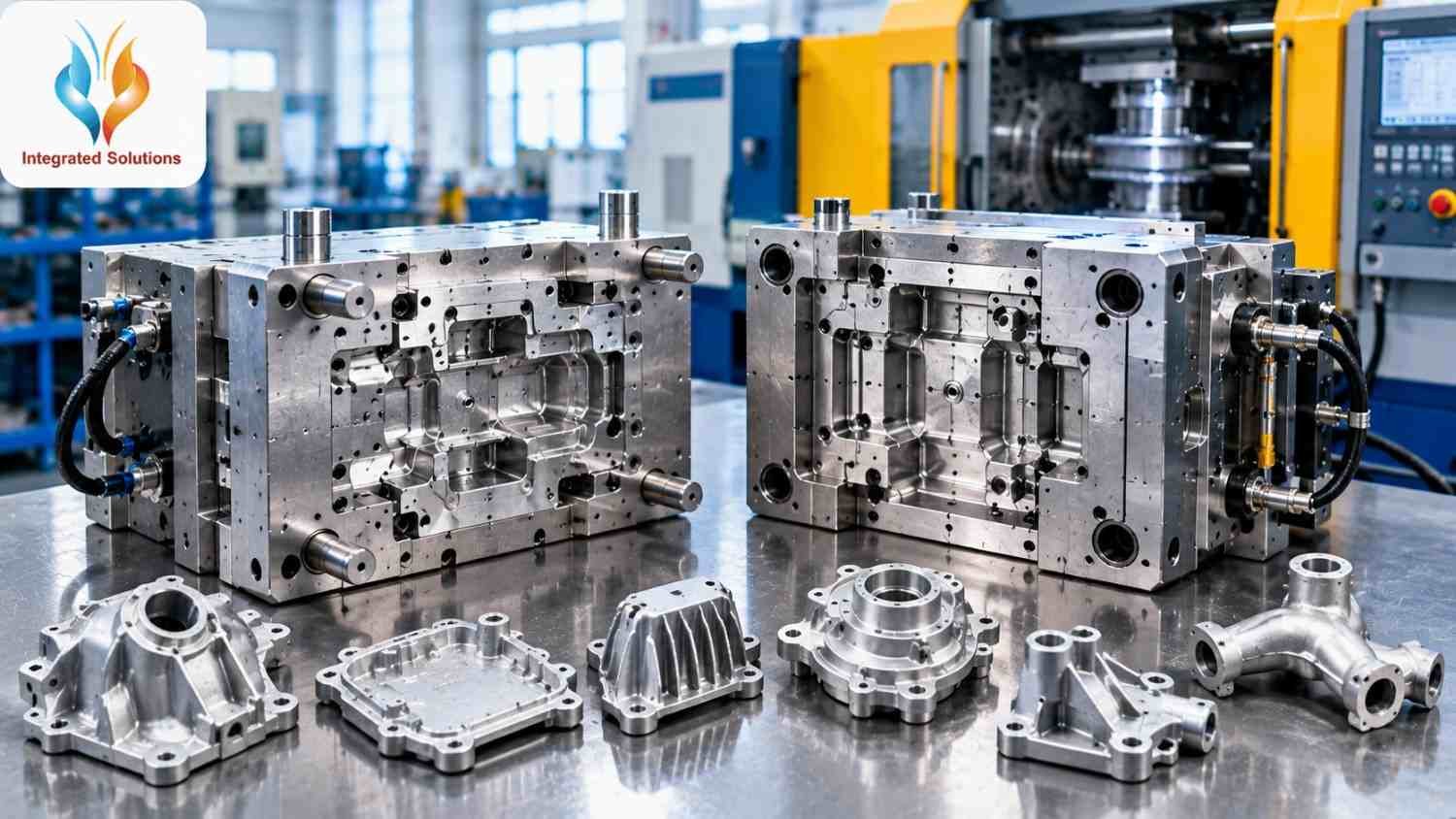
A Die casting tool is engineered to produce metal components under high pressure and repeated cycles. The tool design directly influences dimensional accuracy, component life, and maintenance requirements.
Aluminum and Zinc Pressure Die Casting Tool Types
Different applications require different tooling approaches:
Hot Chamber Die Casting Tools
These are commonly used for zinc alloys because the melting unit remains connected with the machine. They support faster production cycles but are not suitable for high-temperature aluminum alloys.
Cold Chamber Die Casting Tools
These tools are preferred for aluminum die casting because aluminum requires higher melting temperatures. The metal is transferred into the chamber before injection.
Single Cavity and Multi-Cavity Tools
Single cavity tools are suitable for lower production volumes or large components. Multi-cavity tooling helps reduce per-piece cost when production quantities increase.
The Spec Detail Most Buyers Skip
Cooling channel design is often ignored during supplier discussions. A tool may look perfect in CAD drawings, but poor cooling placement can create warpage, uneven solidification, and longer cycle times.
That is where many buyers underestimate the difficulty. Designing a die casting tool is not just machining steel; it requires understanding metal flow, heat behaviour, ejection forces, and expected production volume.
5 Criteria to Evaluate Die Casting Tool Manufacturers in India
Selecting Aluminum/ Zinc Pressure Die Casting Tool manufacturers in India requires more than checking a catalogue or comparing quotations. A serious supplier should answer technical questions clearly.
1. Tool Design Capability
A good supplier should understand simulation, draft angles, shrinkage allowance, and parting line selection.
Bad answer: “Our design team will manage everything after order confirmation.”
That response usually means the buyer will discover design problems after payment.
2. Material Selection Knowledge
Tool steel selection affects tool life. Materials such as H13 steel are commonly used because they handle repeated thermal cycling.
Bad answer: “We always use the same steel for every project.”
Different components have different production requirements. A small zinc fitting and a large aluminum automotive part cannot be treated identically.
3. Trial and Testing Process
Ask how many trial runs are included before final approval.
Bad answer: “We will adjust defects after production starts.”
A supplier without a proper trial process transfers the risk to the buyer.
4. Manufacturing Equipment and Inspection
Check whether the supplier uses CNC machining, EDM machines, CMM inspection, and proper measurement systems.
A tool dimension error of even 0.05 mm can create assembly problems in precision components.
5. After-Sales Modification Support
Tool modification is sometimes unavoidable because real production conditions reveal issues.
Bad answer: “Modification charges will be discussed later.”
That conversation usually becomes expensive after the tool is already installed.
Benefits of Selecting the Right Aluminum Zinc Pressure Die Casting Tool Partner
The right tooling supplier protects more than production quality. It protects your margins.
Lower Production Rejection
Accurate tooling reduces defects such as porosity, flashing, incomplete filling, and dimensional variation.
Longer Tool Life
Proper material selection and heat treatment help tools withstand thousands of casting cycles.
Faster Product Launch
A supplier with strong engineering support can identify design issues before manufacturing begins.
Reduced Maintenance Expenses
Poorly designed tools require frequent repairs, increasing downtime and affecting delivery commitments.
Better Component Consistency
Stable tooling performance helps manufacturers maintain identical output across large production batches.
Improved Cost Control
Cheap tooling often becomes expensive after repeated corrections, machine stoppages, and delayed orders.
Finding Aluminum Zinc Pressure Die Casting Tool Manufacturers in India
India has become a major sourcing destination for tooling because of skilled engineering talent, competitive manufacturing costs, and growing precision machining capabilities.
Industrial clusters in Pune, Ahmedabad, Rajkot, Chennai, Bengaluru, and Noida have strong die casting and tooling ecosystems.
Location matters, but not in the way many buyers think. A supplier 1,500 km away with better inspection systems can be a smarter choice than a nearby vendor with weak engineering control.
For companies searching for Aluminum/ Zinc Pressure Die Casting Tool manufacturers, evaluation should focus on technical capability, production experience, and communication reliability rather than only geographical convenience.
About Integrated Solutions
We at Integrated Solutions understand that tooling mistakes create production delays that affect the entire supply chain. Our approach focuses on understanding component requirements, production quantity, material selection, and application conditions before recommending tooling solutions.
We have worked with industrial manufacturers where small design changes made a major difference in production performance. One practical lesson we learned: a tool that looks economical on paper can become expensive if the supplier ignores maintenance access and future modification requirements.
Our focus is simple — help manufacturers achieve reliable tooling performance with proper engineering planning.
Share your component drawing, material requirement, production quantity, and existing tooling challenges with Integrated Solutions.
Our team will review your requirement and respond within 2 working days with the next technical discussion steps.
For faster evaluation, send:
- 2D/3D component drawings
- Material specification (Aluminum/Zinc alloy)
- Expected monthly production volume
- Existing tool issues, if any
Choosing the Right Die Casting Tool Manufacturer for Long-Term Production
A reliable Die casting tool manufacturer is not the one offering the lowest quotation. It is the supplier who understands your production targets, identifies risks early, and delivers tooling that performs consistently.
As manufacturing requirements become more demanding, choosing the right tooling partner will decide how efficiently your products move from design to production.
FAQs About Die Casting Tools
1. How do I choose Die casting tool manufacturers in India?
Check design capability, machining facilities, inspection methods, trial procedures, and previous industry experience. A supplier should explain technical decisions clearly instead of only discussing prices.
2. What is the difference between Aluminum Zinc Pressure Die Casting and other casting methods?
Aluminum Zinc Pressure Die Casting uses high-pressure injection to produce accurate metal parts. It offers faster production and better dimensional consistency compared with many traditional casting methods, but tooling investment is higher.
3. How long does a die casting tool usually last?
Tool life depends on material, component design, casting alloy, maintenance, and production conditions. A well-maintained H13 steel tool may support hundreds of thousands of cycles, but this varies by application.
4. Can Aluminum/ Zinc Pressure Die Casting Tool manufacturers modify existing tools?
Yes, modifications are possible, but the extent depends on tool condition and design limitations. In some cases, rebuilding a tool may be more economical than repeated modifications.
5. What information should I provide before ordering a die casting tool?
Provide component drawings, alloy details, production quantity, surface finish requirements, and machine specifications. Missing information at the beginning often causes delays later.
6. Why should I consider Aluminum/ Zinc Pressure Die Casting Tool manufacturers in India?
Indian manufacturers offer competitive tooling costs along with skilled engineering support. However, buyers should still verify quality systems and technical capability before finalizing a supplier.
7. What is the biggest mistake buyers make while selecting die casting tool suppliers?
Choosing only based on the lowest price is the biggest mistake. A cheaper tool can create higher expenses through defects, downtime, and repeated corrections.