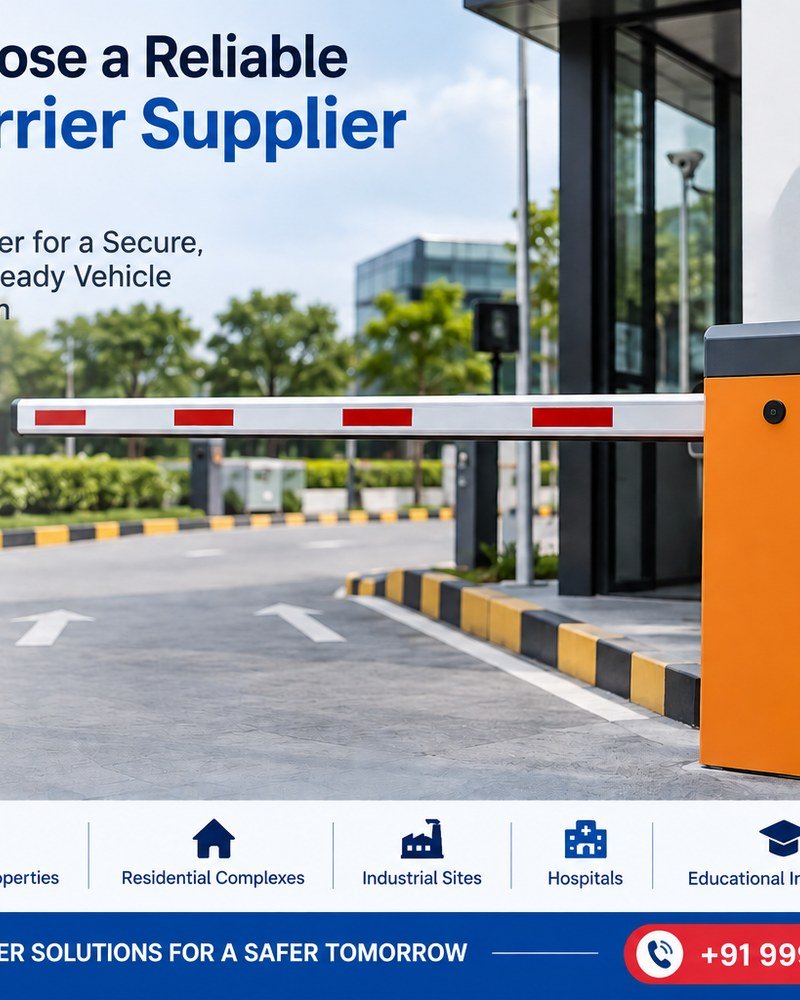
Vehicle entry and exit points are critical areas for businesses, industrial facilities, residential complexes, parking areas, and institutions. A boom barrier helps control vehicle movement and can be integrated with technologies such as RFID, ANPR, access-control systems, and parking management solutions.
However, choosing the right Boom Barrier Supplier involves more than comparing prices. The supplier should be able to provide a suitable system, proper installation, integration support, maintenance, and after-sales service.
Here are the key factors to consider when selecting a reliable boom barrier supplier in India.
1. Understand Your Vehicle Access Requirements
Before contacting a supplier, identify how the boom barrier will be used.
Consider:
- Number of vehicles entering and exiting daily
- Entrance and exit lane width
- Indoor or outdoor installation
- Required opening and closing speed
- Available power supply
- Traffic conditions
- Security and access-control requirements
A supplier should understand these requirements before recommending a particular boom barrier model.
2. Check the Quality of the Boom Barrier
The construction quality directly affects long-term operation. Ask the supplier about the materials used for the cabinet, boom arm, internal mechanism, and other important components.
For outdoor applications, the system should be appropriately designed for the installation environment.
Instead of choosing a system based only on appearance or price, evaluate its construction, operating mechanism, safety features, and suitability for your site.
3. Ask About Operating Performance
Different locations have different traffic volumes. A barrier installed at a residential society may have very different operating requirements from one used at a commercial parking facility or industrial plant.
Ask the Boom Barrier Supplier about:
- Operating cycle
- Opening and closing time
- Expected traffic volume
- Motor and drive mechanism
- Duty cycle
- Manual release mechanism
- Safety features
The selected system should match the expected frequency of operation.
4. Consider Access-Control Integration
Modern boom barriers can work as part of a larger vehicle access-control system.
Depending on the application, integration may include:
- RFID readers
- ANPR cameras
- QR codes
- Long-range vehicle identification
- Parking management systems
- Ticketing systems
- Access-control software
For example, an ANPR camera can identify a vehicle while the access-control system determines whether the barrier should open.
A reliable supplier should be able to explain how the boom barrier can integrate with your existing or planned security infrastructure.
5. Evaluate Safety Features
Vehicle barriers operate around moving vehicles and pedestrians, so safety should be considered during system selection.
Ask about features such as:
- Obstacle detection
- Automatic reversal or protection mechanisms
- Emergency/manual release
- Safety sensors
- Warning indicators
- Access-control interlocking
The exact safety configuration should be selected according to the site layout and system design.
6. Don't Compare Suppliers on Price Alone
Price is an important part of any procurement decision, but the lowest initial price may not represent the overall cost of ownership.
When comparing quotations, consider:
- Equipment cost
- Installation
- Civil and electrical work
- Access-control integration
- Accessories
- Warranty
- Maintenance
- Spare parts
- Technical support
A detailed quotation makes it easier to compare different suppliers on the same basis.
7. Check Installation and Commissioning Support
Correct installation is important for reliable operation.
Ask whether the supplier provides installation and commissioning support and whether the quotation clearly defines what is included.
The installation may involve:
- Foundation preparation
- Electrical connections
- Sensor installation
- Access-control integration
- Testing
- System configuration
- Operator guidance
A supplier who understands the complete installation process can help reduce potential problems during commissioning.
8. Review Warranty and After-Sales Support
A boom barrier is an operational system, so support after installation should be part of the evaluation.
Before purchasing, ask about:
- Warranty period
- Service availability
- Spare parts
- Preventive maintenance
- Breakdown support
- AMC options
- Response procedures
Clear after-sales terms can help facility managers plan maintenance and future service requirements.
9. Look at the Supplier's Experience
Experience in similar installations can be useful when evaluating a supplier.
Ask for information about relevant applications such as:
- Corporate offices
- Residential communities
- Shopping centres
- Hospitals
- Hotels
- Factories
- Warehouses
- Airports
- Parking facilities
- Educational institutions
The important point is not simply how long a company has been operating, but whether it understands the requirements of installations similar to yours.
10. Ask for a Complete Technical Proposal
Before finalizing a Boom Barrier Supplier in India, request a detailed technical and commercial proposal.
It should ideally explain:
- Recommended boom barrier model
- Technical specifications
- Lane configuration
- Access-control integration
- Safety components
- Installation scope
- Warranty
- Maintenance options
- Commercial terms
This allows your procurement or facility team to compare suppliers more systematically.
Simple Boom Barrier Supplier Checklist
Before placing an order, check whether the supplier can provide:
☑ Suitable system for your traffic volume
☑ Appropriate boom arm and lane configuration
☑ Required safety features
☑ RFID/ANPR/access-control integration
☑ Installation and commissioning
☑ Warranty support
☑ Spare parts availability
☑ Maintenance/service support
☑ Clear technical specifications
☑ Transparent commercial quotation
Why the Right Supplier Matters
A boom barrier is not simply a physical gate. In many installations, it forms part of a broader vehicle access-control system.
Selecting the right supplier can therefore help ensure that the equipment, installation, integration, and maintenance requirements are considered together.
For organizations planning a new vehicle entry system, evaluating the supplier based on product suitability, technical capability, integration support, installation, and after-sales service can make the procurement process more effective.
Looking for a Boom Barrier Supplier in India?
Houston Systems provides automatic boom barrier solutions for controlled vehicle entry and exit applications. The systems can be considered for parking facilities, commercial properties, residential complexes, industrial locations, and other controlled-access environments.
If you are planning a new installation or upgrading an existing vehicle access-control system, review your site requirements and discuss the required configuration with a qualified supplier.
Learn more about automatic boom barrier solutions:
https://www.houstonsystems.in/products/boom-barriers