How Smart Vehicle Access Control Improves Commercial Security
By sunilkumar housysgroup 14-10-2026 42
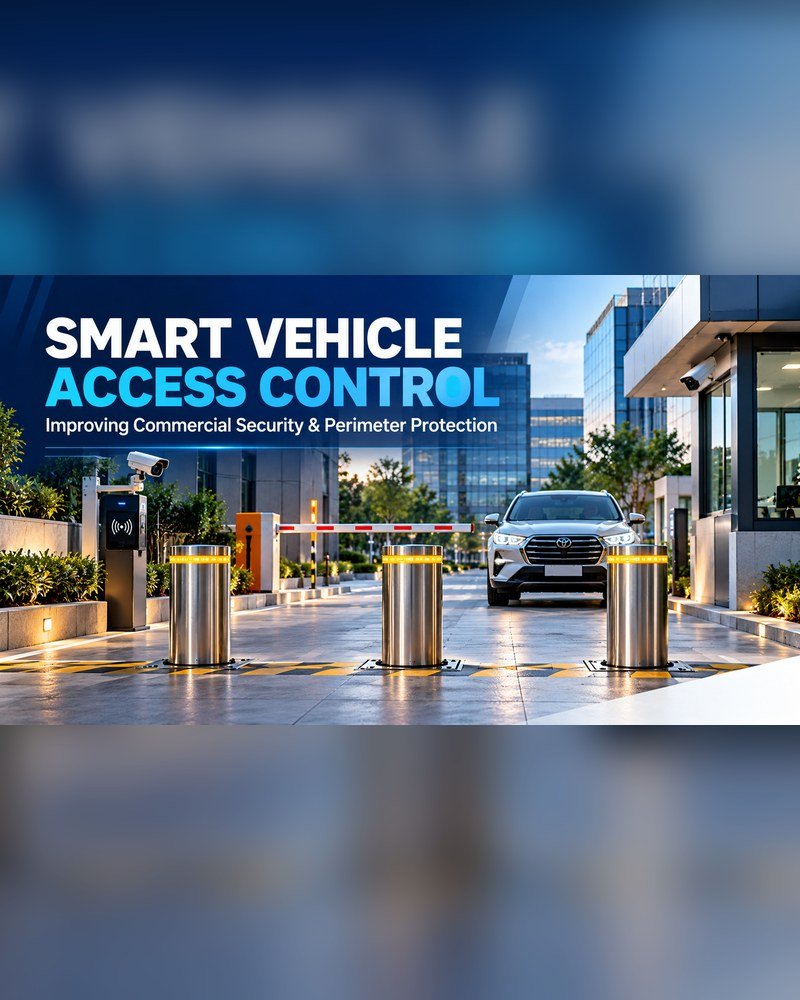
Modern commercial and industrial facilities need effective ways to manage vehicle entry, protect restricted areas, and maintain smooth traffic flow. From corporate offices and manufacturing plants to warehouses and commercial complexes, vehicle access control plays an important role in facility security.
Smart vehicle access control combines physical security equipment and access management technologies to help organizations regulate vehicle movement, improve access procedures, and strengthen perimeter protection.
What Is Smart Vehicle Access Control?
Smart vehicle access control refers to the use of security equipment and electronic technologies to manage which vehicles can enter or exit a property. Depending on the site's requirements, a system may include automatic boom barriers, hydraulic rising bollards, RFID readers, Automatic Number Plate Recognition (ANPR) cameras, and centralized monitoring systems.
These technologies help security teams manage vehicle movement while maintaining a more organized entry and exit process. The appropriate configuration depends on traffic volume, security requirements, site layout, and operational procedures.
Key Components of a Vehicle Access Control System
1. Automatic Boom Barriers
Automatic boom barriers are commonly used at parking entrances, office complexes, residential communities, industrial facilities, and other controlled entry points. They regulate vehicle movement by raising or lowering a barrier arm after an authorized command.
When integrated with suitable access control equipment, boom barriers can support RFID cards, remote controls, ticketing systems, and compatible ANPR solutions.
2. Hydraulic Rising Bollards
Hydraulic rising bollards are retractable posts that rise above ground to restrict vehicle movement and lower below the surface when authorized passage is required.
They can be considered for security-sensitive entrances, restricted areas, commercial properties, and industrial premises. Their suitability depends on the required security level, model specifications, installation conditions, and supporting performance documentation.
Explore hydraulic rising bollard solutions from Houston Systems to learn more about vehicle access control and perimeter security options.
3. RFID Access Control
RFID technology enables authorized vehicles or users to be identified through compatible cards or tags. When connected to an appropriate control system, it can help automate entry procedures and reduce reliance on manual verification.
The actual operation depends on the reader, controller, software, and integration configuration.
4. Automatic Number Plate Recognition
ANPR uses cameras and image-processing technology to read vehicle registration plates. Depending on system configuration, recognized plates can be compared against authorized vehicle records to support automated access decisions.
Camera placement, lighting, plate visibility, and software compatibility are important considerations when planning an ANPR-based installation.
5. Centralized Monitoring
Centralized monitoring can help security personnel review access events and manage connected equipment through a common interface, where supported. The available features depend on the selected software and integration design.
Benefits of Smart Vehicle Access Control
A properly planned system can offer several operational benefits.
Improved access management: Organizations can establish defined procedures for authorized vehicle entry and exit.
Better traffic organization: Automated controls can help structure vehicle movement at designated access points.
Support for perimeter security: Rising bollards and other suitable physical security devices can provide additional restrictions at selected entrances.
Reduced manual intervention: Compatible automated systems can reduce repetitive access management tasks.
Integration opportunities: Boom barriers, RFID readers, ANPR cameras, and monitoring software may be combined when their interfaces and operating requirements are compatible.
How to Choose the Right System
Before selecting vehicle access control equipment, organizations should evaluate several factors.
First, assess the site's security risks and determine whether the primary objective is routine traffic management, restricted-area access, or a higher level of physical vehicle protection.
Second, consider traffic frequency and expected vehicle types. High-traffic entrances may require equipment designed for frequent operation, while other sites may have different operational needs.
Third, review installation requirements, including electrical supply, foundation work, underground utilities, drainage, available space, and equipment placement.
Finally, confirm compatibility between the proposed equipment and existing access control systems. Check product specifications, maintenance requirements, warranty terms, and relevant performance documentation before procurement.
Conclusion
Smart vehicle access control helps commercial and industrial facilities manage vehicle movement through a combination of physical security equipment and electronic access management technologies. Automatic boom barriers, hydraulic rising bollards, RFID, ANPR, and centralized monitoring can serve different roles depending on project requirements.
The most suitable solution is one that matches the site's traffic conditions, security objectives, installation constraints, and long-term operating needs.
Houston Systems provides vehicle access control and perimeter security solutions for a range of commercial and industrial applications.