How Neuroscience Explains Social Media’s Harmful Effect on Thinking
By Briston Perriha 09-01-2026 596
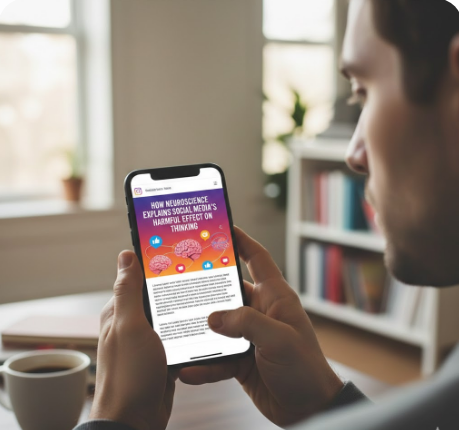
Social media changed how we connect. It also changed how our brains work. Scientists now study the effects of platforms like Facebook, Instagram, TikTok, and Twitter on cognitive function, attention, memory, decision-making, and emotional control. Research from neurophysiology and cognitive science shows the negative impact isn’t just psychological—it’s neurological.
In this blog, we will break down the neuroscience behind why social media may ruin your thinking capabilities and what current research tells us.
The Brain Loves Rewards — and Social Media Exploits That
At the core of modern social media lies a reward system built on dopamine, a neurotransmitter associated with pleasure and motivation. Platforms are engineered to trigger dopamine hits through likes, comments, reels, and notifications. Each positive feedback stimulates the brain’s reward pathways. Over time, this reinforces habitual checking and compulsive use.
Researchers have found that repeated social media interactions activate the same neural circuits seen in addictive behaviors. These are not imaginary effects—neuroscientific measurements show changes in brainwave activity that resemble addictive patterns.
Why this matters:
✔ Dopamine cycles make instant gratification more appealing than delayed rewards.
✔ The prefrontal cortex—responsible for decision-making and impulse control—weakens under constant short bursts of reward.
✔ This decreases our ability to engage in deep, sustained thinking.
Attention Span Shrinks — Science Says So
One of the most documented impacts social media has on the brain is a reduction in sustained attention. The brain has a limited capacity for focused attention and working memory. Constantly switching between social feeds, notifications, and apps fragments attention and overloads working memory.
Cognitive load theory explains it best: the brain struggles when too much information arrives too fast. Social media feeds are designed to overwhelm with rapid content, preventing deep thinking.
This means:
🔸 You find it harder to concentrate on one task for long.
🔸 Even reading long texts or thinking deeply becomes exhausting.
🔸 Critical thinking weakens because your brain learns shallow processing.
Brainwave Patterns Change With Social Media Use
A study using electroencephalography (EEG) recorded brainwave changes during social media use. It found real, measurable effects:
Alpha waves (linked to relaxed focus) dropped during emotional content.
Beta and Gamma waves (linked to active thinking and excitement) rose and stayed high even after use ended.
This indicates extended cognitive arousal and emotional engagement, not deep thought.
What that tells neuroscientists: social media keeps the brain in a heightened state of arousal—not the calm focus needed for reflective thinking.
Executive Functions and Decision-Making Suffer
Executive functions include planning, problem-solving, judgment, and inhibitory control (self-discipline). A systematic review of scientific literature shows that excessive social media use is linked to impaired executive functioning in adolescents and young adults.
Key impacts include:
✔ Poor impulse control
✔ Reduced cognitive flexibility
✔ Difficulty in long-term planning
✔ Weaker inhibitory control (like resisting distractions)
This isn’t just theory. Neuroscientific investigations consistently link heavy social media engagement with these deficits.
Memory Problems and Cognitive Overload
Multitasking between tasks—common while checking feeds—has been shown to impair working memory. A study involving college students using functional near-infrared spectroscopy (fNIRS) reported that social media consumption can affect cognitive performance on memory tasks such as Go/No-Go tasks.
This means:
🔹 Your brain holds less information at once.
🔹 You’re more prone to forgetting details.
🔹 Complex reasoning becomes harder.
Memory, decision-making, and deep thinking are all interconnected. When one deteriorates, all suffer.
Emotional Regulation Gets Distorted
Beyond thinking skills, neural circuits responsible for emotional regulation also change under prolonged social media use. Emotional content increases coupling between the amygdala (emotional center) and parts of the prefrontal cortex. This weakens rational thought when emotions spike—especially during intense or controversial content.
The result:
✔ You react emotionally rather than logically
✔ You care more about likes and comments than real social signals
✔ Critical thinking takes a back seat to emotional response
This trains the brain to prefer superficial emotional reactions over thoughtful analysis.
Social Media Mimics Addiction — Neuroscience Confirms It
Many studies compare social media use with addictive patterns seen in substance abuse and games. For example, repetitive engagement with short videos triggers reward circuit responses similar to alcohol addiction, associated with impulsivity and reduced sensitivity to negative outcomes.
Even short usage sessions can:
🔹 Increase impulsive decision-making
🔹 Reduce emotional control
🔹 Decrease pleasure from non-digital rewards
These are not dramatic metaphors. These are neurological changes observed in controlled research.
Does All Social Media Hurt the Brain?
Not necessarily—all use isn’t bad. Social media can help with communication, creativity, learning, and networking. However, excessive, uncontrolled use contributes to cognitive overload, decreased focus, and reward-driven neural changes.
The difference lies in moderation, structure, and intention.
What Neuroscience Suggests You Can Do
Researchers and psychologists now recommend strategies to mitigate these effects:
1. Digital Boundaries
Set specific times for social media. Avoid mindless scrolling.
2. Reduce Notifications
Turn off alerts to minimize interruptions and protect sustained attention.
3. Practice Deep Work
Engage in tasks requiring focus without distractions.
4. Mindfulness and Breaks
Short breaks and mindfulness practices help reset cognitive load.
5. Digital Detox Periods
Temporary breaks can improve mood, focus, and executive function. You can watch movies on your favorite platforms like Netflix, Hulu, Flixtor si, Paramount, or more.
Science shows the brain is plastic. That means it can change for the worse with overload—but it can also recover with intentional habits.
Final Thought
The neuroscience evidence is clear: social media isn’t just a psychological issue—it affects the brain’s structure and function related to attention, memory, decision making, and emotional regulation. The short-term rewards may feel good, but they teach the brain to chase quick hits rather than deep thinking.
Science doesn’t say “avoid social media forever.” But it does say, use it wisely. Only then can your thinking capability stay sharp in the digital age.