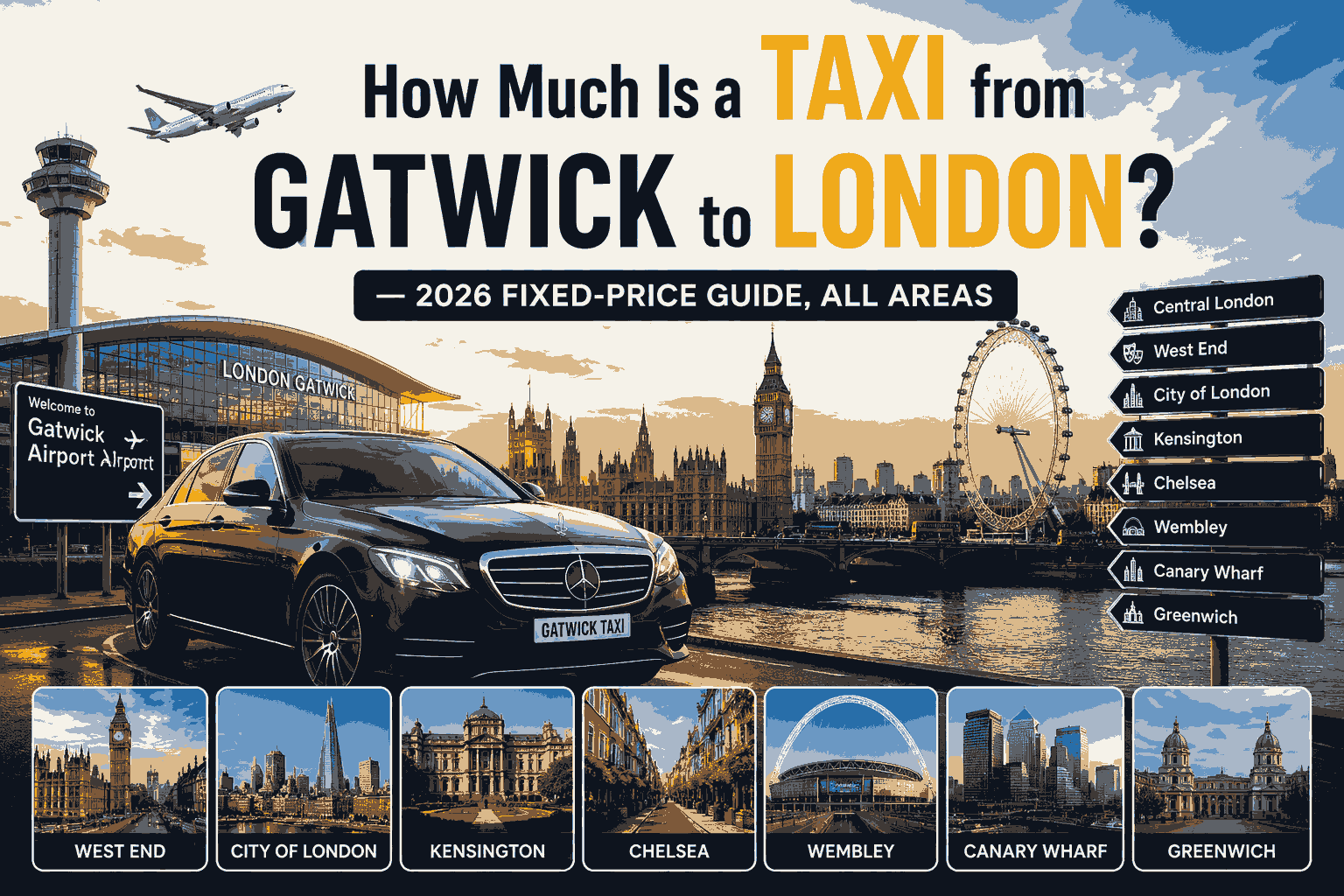
You've booked the flight. Now there's that nagging little question at the back of your mind: what's the taxi into London going to set me back? It's the thing nobody tells you upfront, and it's exactly the kind of cost that can sour the start of a trip if you get caught out. So let's clear it up properly.
Here's the short version. Most people pay somewhere between £60 and £120 for a Gatwick-to-London taxi. Pre-book a fixed fare and you're usually looking at £70 to £100 — and that number doesn't budge, traffic or no traffic. Hop in a metered black cab instead and you could be staring at £90 to £140 by the time the meter stops ticking. The rest of this guide explains why, so you can work out what your own ride will actually cost.
What you'll pay, depending on where you're going
Gatwick is about 28 miles south of central London, so where you're headed matters more than anything else. Rough fixed-fare guide for a standard saloon in 2026:
| Destination | Journey time | Fixed fare (from) |
|---|---|---|
| Central London (Zone 1) | 45–60 min | £70 |
| Croydon | 25–35 min | £45 |
| Crawley (just up the road) | 10–15 min | £25 |
| Brighton | 30–40 min | £60 |
| Canary Wharf / East London | 60–75 min | £80 |
| Heathrow (airport-to-airport) | 60–75 min | £95 |
One thing worth stressing: these are pre-booked prices. What you're quoted is what you pay when you climb out at the other end. No little extras tacked on while you're not looking.
The car you pick changes things
A saloon is the cheapest way to travel and, honestly, it's all most people need — a couple of passengers, a couple of suitcases, done. Step up in size and the price steps up with it:
- A saloon handles solo travellers and couples comfortably.
- An estate or MPV gives you the boot space for a family's worth of luggage and a pushchair.
- An executive car (think Mercedes E-Class or BMW 5 Series) is the one to book when it's a work trip and you'd rather arrive looking sharp.
- An 8-seater swallows a whole group in one go — and split between everyone, it usually beats running two cars.
If you're travelling as a family or a group, don't overthink it: the bigger vehicle nearly always works out better value once you divide the fare.
Why two identical trips can cost different amounts
A handful of things move the price around — distance first and foremost, then the time of day (those 4am and after-midnight runs can carry a small premium), the size of car, and how many of you there are with how many bags. Traffic's on that list too, but only if you're in a metered cab. With a fixed fare, a jam on the A23 is the driver's problem, not yours.
And that fixed-versus-metered distinction is really the whole ballgame. So let's get into it.
Fixed fare, metered cab, or Uber?
This is where trips quietly get expensive. A metered cab charges by time and distance, which sounds fair until you hit standstill traffic and watch a £60 ride creep up to £85 — and you've no idea of the damage until the very end. The apps have their own catch. Since January 2026, Uber and Bolt add 20% VAT to every London fare, and surge pricing has a habit of showing up at the worst possible moment: Friday nights, bank holidays, the early-morning rush, that midnight budget-airline landing.
A pre-booked fixed fare sidesteps all of it. Book with someone like Gatwick Drop Off Charge and the price is set the second you confirm — no surge, no meter, no awkward surprise at the forecourt. The £10 Gatwick drop-off charge, the tolls, the congestion charge if it applies: all baked in already. The figure on screen is the figure you hand over.
What about the Gatwick Express?
Fair question, because the train is genuinely good. The Gatwick Express runs to Victoria in around 30 minutes for roughly £20 to £22, and if you're on your own and Victoria is where you actually want to be, it's tough to argue with. The maths shifts the moment your destination isn't Victoria, though. Tube or another cab on top, dragging cases down escalators — suddenly that £22 has grown an extra leg in both time and money.
A taxi just takes you to the door. For three or four of you, splitting one fixed fare often lands close to the cost of four separate Express tickets, minus the platform shuffle. Travelling with kids, a mountain of luggage, or landing late when the trains thin out? The taxi's usually the easier call.
How long is the drive?
Reckon on 45 to 75 minutes into central London on a normal day — quicker off-peak, slower if you hit the morning or evening crawl on the M23. Book ahead and your driver keeps an eye on your flight, so if you land late, the pickup simply shifts to match. No missed car, no penalty for a delay that wasn't your fault.
A few ways to keep it cheap
- Book 24 to 48 hours out. Last-minute almost always costs more, especially in peak season.
- Hand over your flight number and terminal (North or South) when you book — it's the difference between your driver finding you straight away and you both standing around.
- Right-size the car. No point paying for an MPV you don't need, and no fun cramming a family into a saloon.
- Pile in together. One shared vehicle beats everyone booking their own ride, every single time.
So, the bottom line
Budget £60 to £120 for a Gatwick-to-London taxi in 2026. Pre-book a fixed fare and you'll likely land in the £70 to £100 bracket for central London, charges and all. For couples, families, or anyone who'd rather not wrestle luggage across the city after a flight, the door-to-door comfort and flight tracking make it the calmest way to start — or finish — a journey.