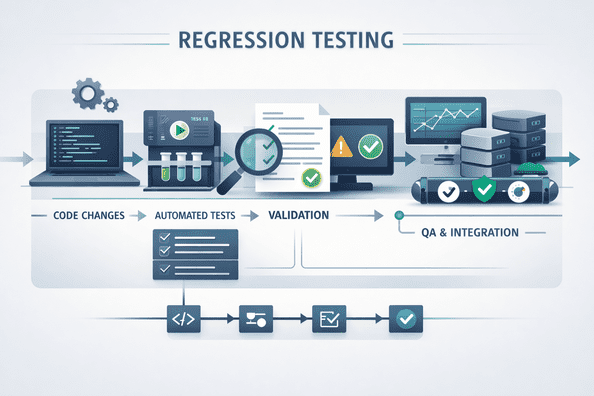
Regression testing has always been essential for maintaining system stability. But as systems grow and release cycles accelerate, the way teams approach it is changing.
Modern engineering teams are not just running more tests—they are rethinking how regression testing fits into fast-moving development workflows.
The focus has shifted from volume to efficiency.
The Shift Toward Smarter Testing
In the past, regression testing often meant running large test suites after every change.
Today, that approach doesn’t scale.
Modern teams are instead asking:
What actually needs to be tested?
When should it be tested?
How can testing stay fast without losing confidence?
This shift in thinking is what’s driving improvements in regression testing efficiency.
Prioritizing What Matters Most
One of the biggest changes is how teams prioritize tests.
Instead of treating all tests equally, they focus on:
Critical user workflows
High-impact features
Frequently used system paths
This ensures that regression testing delivers value where it matters most, without slowing down development.
Moving Away from Heavy, Monolithic Test Suites
Large, monolithic test suites are difficult to maintain and slow to execute.
Modern teams are breaking them down into:
Smaller, focused test groups
Modular test structures
Independent validation layers
This makes it easier to run relevant tests quickly and keep pipelines efficient.
Leveraging Faster Feedback Loops
Speed is central to efficient regression testing.
Teams are optimizing feedback by:
Running fast tests on every commit
Deferring heavier tests to scheduled runs
Providing immediate insights into failures
Faster feedback allows developers to identify and fix issues early, reducing overall effort.
Using Behavior-Focused Validation
Traditional approaches like black box testing remain valuable, but they are being applied more strategically.
Instead of only validating inputs and outputs in isolation, teams are:
Testing complete workflows
Simulating real user interactions
Focusing on system behavior
This ensures that regression testing reflects how the system is actually used.
Embracing Parallel and Distributed Testing
To handle larger test suites without increasing execution time, teams are leveraging parallelization.
This allows them to:
Run multiple tests simultaneously
Reduce overall pipeline duration
Scale testing with system growth
Parallel execution has become a key factor in maintaining efficiency.
Keeping Test Suites Lean and Relevant
Efficient regression testing depends on maintaining a clean test suite.
Modern teams regularly:
Remove redundant tests
Update outdated scenarios
Refine test coverage
This prevents test suites from becoming bloated and difficult to manage.
Aligning Testing with System Architecture
Testing strategies are increasingly aligned with how systems are built.
For example:
API-level tests for microservices
Service-level validation for distributed systems
Targeted end-to-end tests for critical flows
This alignment ensures that regression testing scales naturally with system complexity.
Continuous Improvement Through Feedback
Production insights play a growing role in improving regression testing.
Teams analyze:
Real-world failures
Usage patterns
Performance data
These insights are used to refine test strategies and improve coverage where it matters most.
Building a Culture of Efficient Testing
Efficiency is not just about tools or techniques—it’s also about mindset.
Modern teams:
Treat testing as an ongoing process
Focus on value rather than volume
Continuously refine their approach
This cultural shift is key to sustaining long-term improvements.
The Future of Regression Testing Efficiency
As systems continue to evolve, regression testing will become more adaptive.
Future approaches will focus on:
Smarter test selection
Faster execution
Better alignment with real-world behavior
Efficiency will no longer be optional - it will be a requirement.
Final Thoughts
Improving regression testing is not about doing more - it’s about doing it better.
Modern teams are achieving this by:
Prioritizing critical scenarios
Optimizing execution
Continuously refining their approach
The result is regression testing that keeps up with development speed while maintaining system reliability.
Because in fast-moving environments, efficiency is what makes testing sustainable.