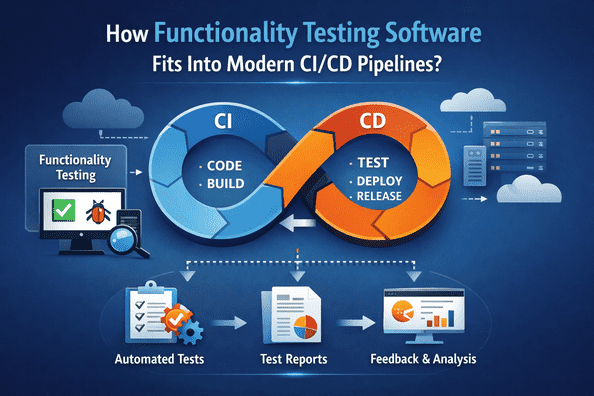
Continuous integration and continuous delivery (CI/CD) pipelines are central to modern software development. They enable teams to deploy new features rapidly while maintaining reliability. However, ensuring that complex workflows function correctly across multiple services remains a challenge. This is where functionality testing software becomes essential. It validates end-to-end behavior, ensures business logic is intact, and integrates seamlessly into CI/CD pipelines.
Why CI/CD Pipelines Need Functionality Testing
CI/CD pipelines typically automate building, testing, and deploying code. While unit tests, integration tests, and regression tests cover code correctness and basic integration, they may not catch failures in critical workflows or business logic. Missing these issues can result in:
Production incidents due to broken workflows
Regressions in complex features
Delayed releases caused by unexpected failures
Functionality testing software bridges this gap by validating the system as a whole, simulating real-world user interactions and system events.
How Functionality Testing Software Works in CI/CD
Functionality testing software focuses on inputs, outputs, and system behavior, rather than internal code structure. Within CI/CD pipelines, it can:
Run automated workflows after builds:
Simulate end-to-end user journeys such as signup, checkout, or data processing to validate business logic.
Compare against baseline behavior:
Detect deviations from expected outcomes or prior system behavior, even when unit tests pass.
Identify critical failures early:
Provide actionable feedback to developers before changes reach staging or production.
Integrate with staging and production-like environments:
Validate interactions with external services, databases, and APIs in environments that closely resemble production.
Benefits for Developers
Faster Feedback Loops:
Developers quickly see if new changes break critical workflows.
Reduced Risk of Production Incidents:
Functional validation ensures that new deployments maintain business logic integrity.
Confidence in Incremental Releases:
Teams can safely ship features in smaller increments, knowing critical paths are tested.
Improved Collaboration Between QA and Dev Teams:
Functionality testing outputs are clear, highlighting which workflows failed and why, reducing back-and-forth debugging.
Best Practices for Integrating Functionality Testing
Prioritize High-Impact Workflows: Focus testing on features that affect revenue, compliance, or user experience.
Automate in CI/CD: Schedule functional tests after every build to catch regressions early.
Use Baseline Comparisons: Detect subtle behavioral changes that unit tests may miss.
Maintain Test Scenarios: Update tests as business logic evolves to avoid false positives.
Monitor Test Reliability: Avoid brittle tests that fail intermittently, which can slow down pipelines.
Real-World Example
Consider a SaaS platform with a subscription billing workflow. Unit tests confirm individual calculations, but only functionality testing can validate the entire workflow: creating an account, choosing a plan, applying discounts, processing payment, and sending confirmation emails. By integrating these functional tests into the CI/CD pipeline, developers detect errors before code reaches production, ensuring a smooth experience for end users.
Complementing Other Testing Approaches
Functionality testing software does not replace unit or integration tests—it complements them. Unit tests check individual components, integration tests verify their interactions, and functionality testing validates the end-to-end system behavior. Together, these layers provide comprehensive coverage, ensuring high confidence in every release.
Conclusion
Modern CI/CD pipelines demand more than just green unit tests—they require assurance that workflows work correctly under real-world conditions. Functionality testing software fills this critical role by validating business logic, simulating user interactions, and integrating seamlessly into automated pipelines. For development teams, this means faster feedback, reduced production risk, and greater confidence in delivering high-quality software.
Integrating functionality testing into CI/CD pipelines transforms the pipeline from a sequence of automated steps into a robust system that continuously ensures functional correctness across the application.