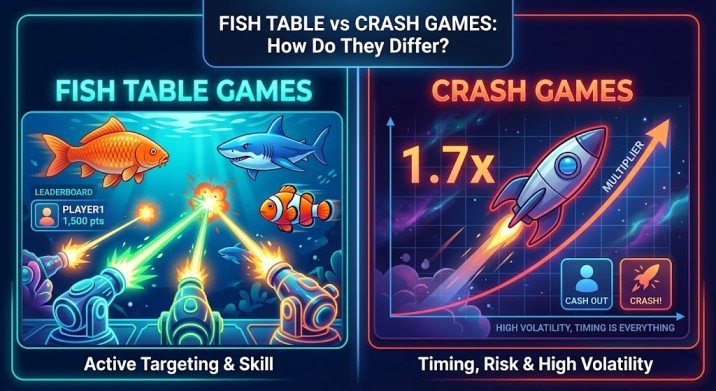
Fish table games and crash formats are both built around real-time interaction, but they operate on very different structural principles. In crash games, the core mechanic is centered on a rising multiplier that can end unpredictably, requiring timed exit decisions. In contrast, fish table systems are action-based environments where players continuously interact with moving targets.
For players exploring fishing table games, the experience feels more like a live interactive arcade system. Instead of watching a single progression curve, players are actively aiming, tracking, and responding to dynamic movement on screen.
Understanding the difference between these two formats helps clarify how engagement, pacing, and decision-making vary across real-time gaming systems.
Core Gameplay Structure Differences
The most fundamental difference lies in structure. Crash games follow a single progression loop, while fish table games rely on continuous interaction.
In crash games, each round begins with a multiplier that rises until it suddenly crashes. The only decision is when to exit before that point. This creates a timing-based model where anticipation is the main focus.
In fishing table games environments, gameplay is not tied to a single outcome cycle. Instead, players interact with multiple moving elements at the same time. Targets appear, move, and disappear continuously, creating an ongoing action loop rather than a single progression path.
This structural difference defines how each format feels from the moment it starts.
Interaction Style and Player Control
Crash games offer limited interaction during the round. The player’s main input is deciding when to cash out, and everything else is automated by the system.
In crash games, control is concentrated into one key decision point per round. That makes the format highly focused but also passive between decisions.
Fish table games operate differently. In fishing table games, players remain active throughout the entire session. They aim, shoot, track movement, and adjust constantly based on target behavior.
This creates a more continuous control loop where engagement does not pause between rounds. Instead, interaction is ongoing and reactive.
Pacing and Session Flow
Pacing is another major difference between the two formats. Crash games are structured in short, repeated cycles with clear start and end points.
In crash games, each round builds tension quickly and resolves just as fast. This creates a rhythm of anticipation followed by reset.
Fish table games follow a continuous flow model. In fishing table games environments, there is no strict round boundary. The session feels uninterrupted, with targets constantly entering and leaving the screen.
This results in a more fluid pacing style where attention remains active for longer periods without distinct breaks.
Skill vs Timing Focus
Crash games are primarily timing-based. The main challenge is deciding when to exit based on rising risk. There is no physical aiming or real-time targeting.
In crash games, the experience revolves around risk perception and timing judgment. Players evaluate when the multiplier might stop and act accordingly.
Fish table games shift the focus toward coordination and tracking. In fishing table games, players must observe movement patterns, adjust aim, and respond quickly to changing targets.
This makes fish table formats feel more action-oriented, while crash games feel more decision-focused.
Visual Engagement Differences
Crash games typically use minimalistic visuals. The screen is usually centered around a multiplier that rises steadily, with effects that highlight key moments.
In crash games, visual simplicity is intentional because it keeps attention focused on timing rather than distractions.
Fish table games are visually dense by design. In fishing table games environments, the screen often contains multiple moving targets, animations, effects, and layered environments.
This creates a more immersive visual field where attention is distributed across multiple elements instead of a single indicator.
Risk Structure and Decision Pressure
Crash games create risk through uncertainty in timing. The longer a player stays in a round, the higher the potential reward but also the higher the risk of a sudden crash.
In crash games, risk is concentrated in one decision moment per round, making each exit choice critical.
Fish table games distribute risk differently. In fishing table games, the challenge is not about a single exit point but about continuous resource management across multiple actions.
This spreads decision pressure across the entire session rather than focusing it into one key moment.
Why Players Experience Them Differently?
Players often perceive crash games as more analytical and fish table games as more interactive. This difference comes from how each system handles control and feedback.
In crash games, players observe progression and respond at the right moment. In fishing table games, players are constantly acting and adjusting in real time.
That distinction shapes how attention is used. One format emphasizes timing discipline, while the other emphasizes continuous engagement.
Concluding Thoughts
Fish table games and crash games may both fall under real-time interactive formats, but they differ significantly in structure, pacing, and interaction style. In crash games, gameplay is centered on timing a single decision within each round. In fish table games gameplay is continuous, action-driven, and focused on constant interaction.
Together, they represent two distinct approaches to real-time engagement: one built around anticipation and timing, and the other built around motion and active control.
Tags : crash games fishing table games