How Custom Brand Identity Design Builds Businesses People Actually Remember
By Mitu Das 23-06-2026 113
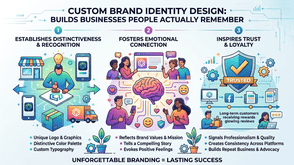
Let me be direct with you: most businesses get their branding wrong not because they lack creativity, but because they treat it as decoration rather than strategy.
I've worked with dozens of businesses, from solo consultants to mid-sized product companies, and the pattern is consistent. The ones that grow with less friction almost always have a clear, cohesive visual identity from the start. The ones that struggle often have a logo slapped together in Canva, three different brand colours across their website, and a font that looks different on mobile vs desktop.
This article is going to walk you through what custom brand identity design actually means, why logo and visual identity design is just one piece of a larger system, and how to approach it in a way that gives your business a real competitive edge.
What Custom Brand Identity Design Actually Means
People often confuse brand identity with a logo. That's like confusing a house with its front door.
Your brand identity is the full visual and emotional language your business speaks. It includes your logo, yes, but also your colour palette, typography, imagery style, icon system, layout principles, and tone of voice as it shows up visually. When someone lands on your website, opens your packaging, or sees your social post in a feed, they're experiencing your brand identity in real time.
"Custom" is the key word here. It means built specifically for your business, not a template, not a stock illustration, not a Fiverr $5 logo with your name dropped in. Custom work is rooted in research: who you're trying to reach, what they value, who your competitors are, and what position you want to own in their minds.
The output isn't just files. It's a system that's consistent, scalable, and intentionally differentiated.
Why Logo and Visual Identity Design Is the Foundation
Your logo is the anchor of your visual identity. Everything else orbits around it.
A well-designed logo does a few things that cheap ones don't. It works at every size, from a 16x16px favicon to a 10-foot billboard. It works in black and white. It carries meaning without needing text to explain it. And it ages well, rather than screaming the year it was made.
But the logo alone isn't enough. What makes a brand feel premium, trustworthy, or exciting isn't one mark, it's the consistency of the entire visual system around it.
What a Full Visual Identity System Includes
When designers talk about logo and visual identity design as a complete deliverable, they typically mean:
Primary logo: the main version you use in most contexts
Secondary logo variations: stacked, horizontal, icon-only, for situations where the primary doesn't fit
Colour palette: primary and secondary colours with exact hex, RGB, and CMYK values so nothing shifts between print and digital
Typography system: one or two fonts with defined hierarchy rules (heading, subheading, body, caption)
Iconography and illustration style: visual elements that extend your identity into content
Usage guidelines: a brand guide that tells anyone who touches your brand exactly how to use these assets
That last one is the piece most businesses skip. And it's usually why their brand starts drifting within six months.
The Real Cost of Getting Branding Wrong Early
I want to be honest here, because a lot of brand design content glosses over this.
Fixing a brand identity later is expensive and disruptive. If you've already printed materials, built a website, established social media profiles, and created client-facing documents, then decide your brand doesn't actually represent you, you're looking at a rebrand that touches everything.
Not just design work. Customer confusion. Inconsistency during the transition period. Time spent explaining the change. And if you've built any recognition with a previous visual identity, some of that goodwill gets disrupted.
This doesn't mean your first brand needs to be perfect forever. But it does mean it's worth investing in something coherent and intentional from the start, rather than patching it together over time.
How to Brief a Brand Identity Designer Effectively
Most failed design projects fail in the brief, not in the execution.
Here's what a good brand brief actually covers:
Your business in plain language: what you sell, who you sell it to, and what makes you different. Not the corporate version. The version you'd explain to a friend.
Your target audience: ideally with some depth. Not just "women 25 to 45" but what they care about, what they distrust, what they aspire to.
Your competitors: three to five brands in your space, and an honest assessment of where you want to sit relative to them.
Visual references: brands you admire and why. Brands you want to avoid looking like and why. The "why" matters more than the example.
Personality words: three to five adjectives that describe how you want people to feel when they encounter your brand. "Professional but approachable" is a start. "Trusted by operators, not aspirational to hobbyists" is better.
Deliverables and usage: where will this identity actually live? Website, packaging, uniforms, digital ads, print? Each context has implications for the design.
The more specific and honest your brief, the better the work will be. Designers aren't mind readers. They're strategists and craftspeople who need real information to do real work.
What to Look for When Choosing a Brand Identity Partner
Not all design services are created equal, and price is a poor proxy for quality.
Here's what actually matters when evaluating a designer or studio for custom brand identity work:
Portfolio depth: not just pretty logos, but evidence they understand strategy. Case studies that explain the thinking behind the work, not just the output.
Process transparency: do they have a clear discovery and strategy phase before they start sketching? If someone jumps straight to concepts without understanding your business, that's a red flag.
Revision and ownership terms: what do you get at the end? Full file ownership? How many revision rounds are included? Are source files (AI, EPS, Figma) included, or just flat exports?
Communication style: you'll be making important decisions together. Do they explain their thinking? Do they ask smart questions? Are they someone you trust to push back when you're wrong?
A strong logo and visual identity design service should make the process clear upfront. If it's vague about what's included, that ambiguity usually shows up in the work too.
Maintaining Brand Consistency After Launch
Getting a great brand identity is the beginning, not the end.
The most common failure mode I see is a business investing in quality branding, then letting it drift over the next 12 months as different people, social media managers, sales staff, freelance designers, all interpret the brand in their own way.
The antidote is a proper brand guide. Even a simple one, five to ten pages covering your logo rules, colours, fonts, and dos and don'ts, dramatically reduces inconsistency. Share it with anyone who touches your brand. Link it in your new employee onboarding. Give it to every agency or freelancer you work with.
Your brand identity is an asset. Like any asset, it needs maintenance and protection to keep its value.
Bringing It Together
Custom brand identity design isn't a luxury for big companies. It's a strategic decision that affects how you attract clients, price your services, and compete in a crowded market.
Starting with a cohesive logo and visual identity design system, built with intention, documented clearly, and applied consistently, gives your business a foundation that scales. Whether you're launching a new business, repositioning an existing one, or realising your current brand no longer reflects who you are, the investment in getting this right compounds over time.
If you're at the stage of building or refreshing your brand, the next best step is to explore what a custom brand identity design consultation looks like with a studio that understands both the creative and strategic sides of the work. A good brief and the right partner make a bigger difference than the budget alone.