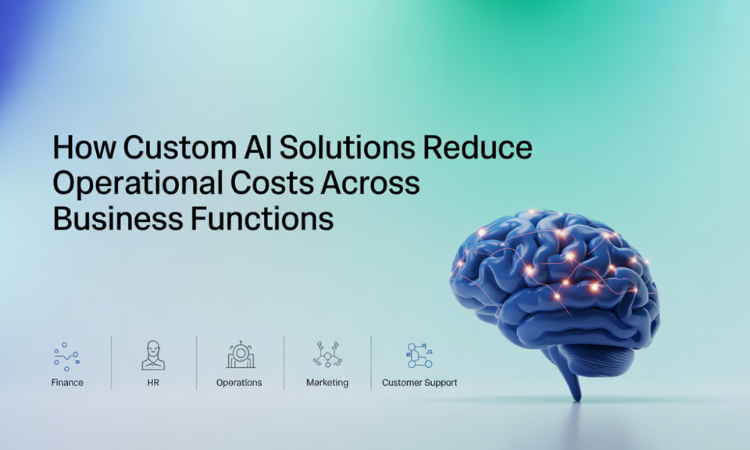
How Custom AI Solutions Reduce Operational Costs Across Key Business Functions
By Cleverbitsai 08-12-2025 72
Efficiency is no longer a “nice-to-have” it’s the lifeline that separates companies that scale from those that just survive. And while buzzwords come and go, custom AI solutions have moved past hype territory. They now sit at the centre of real, measurable cost reduction across business operations.
This shift didn’t happen overnight. Advances in machine learning, natural language processing, and automation matured enough to solve problems once considered “too messy” or “too human.” Today, companies can streamline workflows, cut waste, reduce errors, and make faster decisions without relying on guesswork.
Let’s break down how tailored AI systems trim costs across key functions using logic, real-world practices, and validated principles instead of magical thinking.
Why Custom AI Solutions Matter More Than Generic Tools
Companies often start with off-the-shelf automation tools. They work but only to a point. Generic systems can’t fully adapt to unique workflows, sector-specific regulations, or proprietary processes. That’s where custom AI solutions step in.
They learn from a company’s own data, evolve with real operations, and remove inefficiencies that one-size-fits-all tools can’t even detect.
A tailored model can:
- Understand internal terminology
- Optimize for a company’s unique cost structures
- Integrate with legacy software
- Automate decisions based on historical patterns
- Scale with business growth
Think of it as replacing a “universal remote” with a system designed exactly for your home setup. The difference is night and day.
1. Cost Reduction in Customer Support
Customer support teams often battle high call volumes, long resolution times, and repetitive queries. It’s a money pit when handled inefficiently.
How AI Cuts Costs Here
● Intelligent Automation for Repetitive Queries
AI assistants and classification models identify routine questions and respond instantly based on verified knowledge bases. This lowers the burden on human teams and reduces ticket-handling costs.
● Smart Routing Based on Context
Custom AI solutions analyse message intent and route queries to the right team. No more “Sorry, wrong department” loops. Faster routing = lower operational cost.
● Quality Monitoring Without Manual Overhead
AI models can monitor 100% of interactions, highlight gaps, and recommend improvements.
Human teams usually review only a fraction due to time constraints, which hides inefficiencies and training needs.
Cost Outcome
- Lower staffing costs
- Reduced average handle time
- Improved customer satisfaction (which cuts churn costs)
These aren’t hypothetical results they reflect common measurable gains across industries when AI automates support workflows.
2. Cost Optimization in Supply Chain Management
Supply chains are expensive because unpredictability is expensive delays, overstocking, under-stocking, and manual coordination all add up.
What Custom AI Solutions Improve
● Demand Forecasting
AI models built on your real sales patterns, seasonal trends, and external triggers outperform guess-based forecasting.
This helps companies order smarter and reduce inventory waste.
● Route Optimization
AI analyses delivery windows, driver schedules, geographic constraints, and live traffic patterns to recommend efficient routes.
● Supplier Risk Prediction
Patterns like slower shipment times, inconsistent pricing, or missed SLAs can hint at supply risk. AI spots such patterns early to prevent costly disruptions.
Cost Outcome
- Lower transportation costs
- Reduced storage and warehouse overhead
- Fewer delays and emergency procurement expenses
Supply chains become smoother, faster, and quieter—which is exactly what finance teams like.
3. Cutting Costs in Human Resources
HR is often underrated as a cost-saving function, but inefficiency here drains money fast. Manual screening, paperwork, and compliance tasks take time and introduce errors.
AI’s Role in HR Efficiency
● Automated Candidate Screening
AI models filter resumes based on required skills, experience patterns, and role-specific behaviour markers.
This shortens hiring cycles and saves countless hours of manual work.
● Predictive Employee Retention Risk
AI reviews behaviour indicators (attendance patterns, performance indicators, training progress) to flag attrition risks early.
Catching issues early cuts rehiring and retraining costs—a major expense for most companies.
● Workforce Planning and Scheduling
AI forecasts staffing needs based on demand surges, seasonality, and project loads.
This prevents overstaffing and understaffing—both financially painful scenarios.
Cost Outcome
- Faster hiring processes
- Lower recruitment and onboarding costs
- Reduced turnover expenses
HR becomes more strategic and less buried in repetitive work.
4. Finance and Accounting Cost Efficiency
Finance teams often juggle numbers across systems, formats, and departments. Manual processes invite errors, and errors invite losses.
Where AI Helps
● Automated Invoice Processing
Custom AI solutions extract data from invoices, validate entries, and flag discrepancies—all without human intervention.
● Fraud Detection and Pattern Analysis
Machine learning models catch anomalies in financial transactions, expense claims, or vendor payments using pattern recognition.
● Forecasting and Budgeting
AI produces accurate short- and long-term forecasts using real historical financial behaviours instead of generic templates.
Cost Outcome
- Lower labour costs
- Fewer errors (which means fewer financial leaks)
- Stronger compliance and reduced risk penalties
Finance becomes more accurate and predictable.
5. Marketing and Sales Cost Reduction
Marketing burns money when targeting is poor. Sales drains money when leads aren’t qualified properly. AI fixes both.
AI’s Contribution
● Smarter Audience Segmentation
AI builds segments based on behaviour, interests, and purchase patterns—not gut feeling. Better targeting reduces wasted ad spend.
● Predictive Lead Scoring
AI identifies leads most likely to convert based on behavioural markers and historical sales data.
● Content Personalization at Scale
AI can tailor messaging across channels, increasing relevance and reducing the cost per acquisition.
Cost Outcome
- Reduced ad waste
- Higher conversion rates
- More effective sales cycles
Marketing and sales start to work with surgical precision.
6. Operations and Workflow Automation
Operations teams drown in repetitive tasks—data entry, approvals, reporting, coordination, and more.
Custom AI workflow automation reduces this load dramatically.
Key Efficiency Gains
● Process Automation Across Departments
AI handles tasks like report generation, document validation, and status tracking.
● Anomaly Detection in Operations
When something deviates from normal behaviour—machine temperature, server usage, process delays AI highlights issues before they become expensive.
● Resource Allocation Optimization
AI identifies bottlenecks and suggests where teams should allocate time and budget.
Cost Outcome
- Reduced downtime
- Lower labour costs
- Faster workflows
Operations become lean and predictable instead of reactive.
Why Custom AI Solutions Outperform Traditional Optimization Methods
Traditional efficiency measures rely heavily on human observation. The problem? Humans can’t track thousands of variables in real time. AI can.
Custom models don’t just automate tasks they learn, improve, and refine decisions every day using real-world company data.
This leads to:
- More accurate predictions
- Faster response times
- Consistent performance
- Scalable improvements
Where humans struggle with speed and volume, AI thrives.
How Businesses Ensure Responsible and Realistic AI Deployment
Companies must take a practical, grounded approach to AI adoption. Successful deployments follow these principles:
1. Start With High-Impact Use Cases
Focus on functions where manual cost is high, such as support, HR, or supply chain.
2. Train Models on Verified Internal Data
Reliable AI requires clean, structured historical data not assumptions.
3. Measure ROI Continuously
Track improvements in time saved, errors reduced, and labour costs avoided.
4. Maintain Human Oversight
AI assists; humans direct. That’s how cost reduction stays efficient and ethical.
These practices align with common AI governance frameworks and standard industry guidelines on responsible automation adoption.
How Cleverbits Supports Businesses in Building Practical Custom AI Solutions
Implementing AI isn’t only about writing code or training a model. It requires a team that understands real operational constraints, data behaviour, and the cost pressures companies face every day. That’s where Cleverbits adds real value. Their approach focuses on studying existing workflows, identifying inefficiencies, and shaping custom AI solutions that actually fit how a business runs—rather than forcing a business to adapt to the technology.
Instead of pushing complex systems, they prioritise solutions that integrate smoothly with current tools and processes. This avoids unnecessary disruption and helps companies extract ROI faster. Their ongoing support also ensures AI models stay reliable as new data flows in and operations evolve.
By combining technical depth with practical understanding, Cleverbits helps organisations move from theoretical AI benefits to measurable operational cost reductions.
Final Thoughts
Custom AI solutions have moved from being experimental tools to reliable cost-cutting engines across core business functions. They streamline workflows, eliminate inefficiencies, reduce operational overhead, and help teams make smarter decisions faster.
The impact doesn’t come from generic automation but from systems trained on the company’s own data, challenges, and goals. That’s what drives real savings and long-term efficiency not hype.
If your goal is to reduce operational costs without compromising performance, investing in well-designed custom AI solutions is no longer optional. It's the most practical, scalable path to a leaner, smarter, and more resilient business.
Tags : Fine tuning Ai model