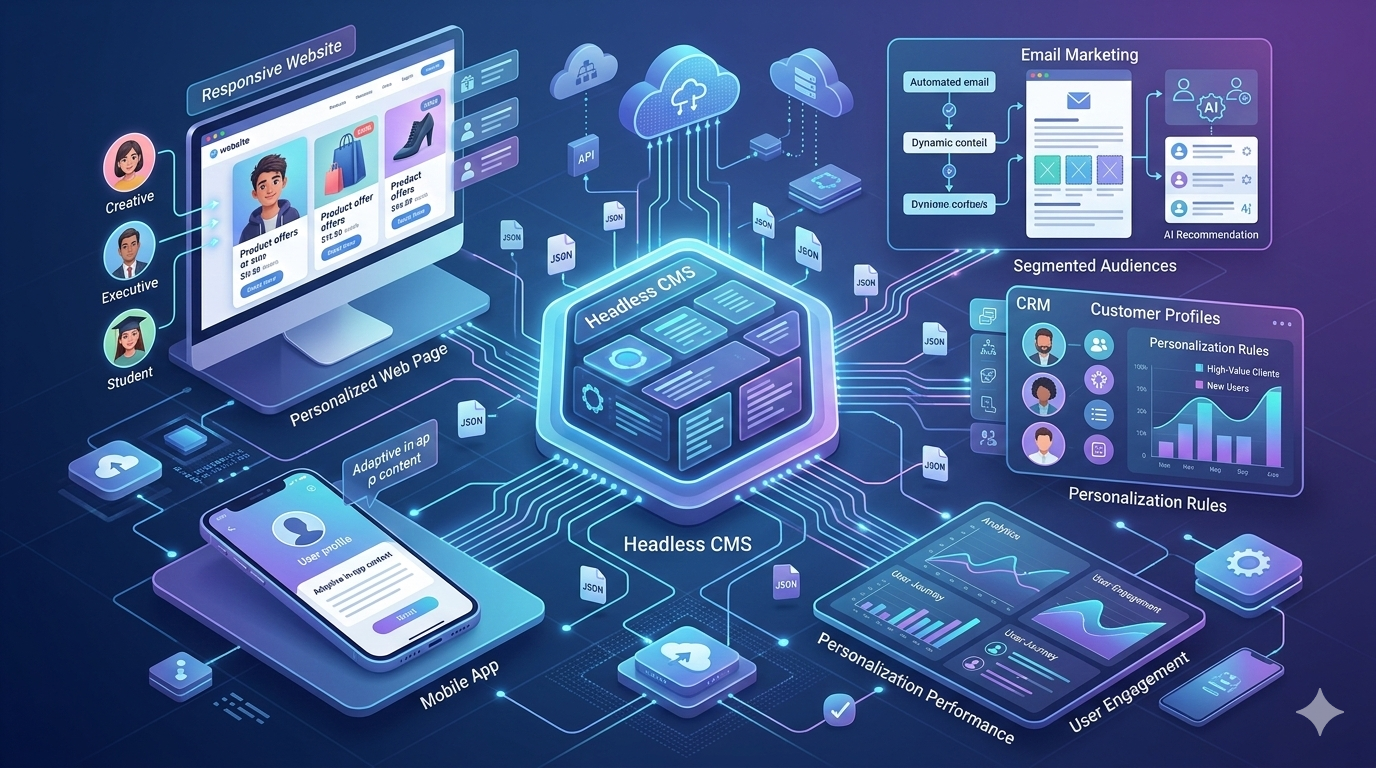
Personalization has become a core expectation in digital experiences. Users want relevant content across websites, apps, emails, and digital platforms. Businesses must deliver tailored messages without slowing down operations. Therefore, scalable personalization depends on strong CMS integrations.
A modern content management system does more than store content. It acts as the central hub for structured data, assets, and digital experiences. However, personalization at scale requires seamless connections between the CMS and other business systems. Many organizations turn to expert partners offering Contentful consulting services to design integration frameworks that connect CRM systems, analytics platforms, marketing automation tools, and data warehouses. As a result, businesses can unify customer data and activate personalized experiences efficiently.
Personalization is no longer limited to inserting a user’s name into an email. It now involves dynamic content variations, behavior driven recommendations, and contextual messaging. To support this complexity, CMS platforms must integrate with multiple data sources. These integrations enable real time decisions based on customer signals.
The Foundation of Scalable Personalization
Scalable personalization begins with structured content. Instead of storing content as static pages, modern CMS platforms organize it into reusable components. This modular approach allows teams to deliver tailored experiences without duplicating efforts.
For example, a product description can include fields for benefits, specifications, images, and regional messaging. When integrated with customer data platforms, the CMS can assemble variations dynamically. Consequently, users in different locations or segments receive relevant versions automatically.
Furthermore, structured content supports omnichannel delivery. A single content model can power websites, mobile apps, kiosks, and email campaigns. This consistency ensures that personalization efforts remain unified across touchpoints.
Integrating Customer Data Platforms
Customer data platforms collect and unify information from multiple sources. These sources include website interactions, purchase history, email engagement, and support tickets. When integrated with a CMS, this data becomes actionable.
For instance, returning visitors can see product recommendations based on browsing history. Meanwhile, new users might see educational content. The CMS retrieves relevant content components and delivers them according to user attributes.
Moreover, real time APIs allow instant updates. If a customer abandons a cart, the system can trigger targeted content within minutes. This responsiveness increases engagement and conversion rates.
Connecting CRM Systems for Contextual Experiences
CRM systems store valuable information about customers and prospects. Integrating CRM data with a CMS enhances contextual messaging. Sales teams can influence content strategies based on customer lifecycle stages.
Consider a B2B website. A visitor identified as an existing client may see account management resources. Conversely, a prospect may see case studies and pricing guides. The CMS adjusts content presentation according to CRM segmentation.
Additionally, CRM integration supports account based marketing strategies. Personalized landing pages can be generated for specific companies. These pages use dynamic content blocks tied to CRM attributes.
Leveraging Marketing Automation Tools
Marketing automation platforms manage campaigns across channels. Integration with a CMS ensures consistent messaging. Content assets stored in the CMS can be reused in emails, landing pages, and ads.
Furthermore, behavioral triggers in automation tools can activate CMS driven content. For example, downloading a whitepaper may unlock related resources on the website. This interconnected experience strengthens brand trust.
Because content is centrally managed, updates appear across all channels instantly. Teams avoid duplication while maintaining message consistency.
Enhancing Personalization with Analytics Platforms
Analytics platforms provide insights into user behavior. These insights guide personalization strategies. However, data must flow back into the CMS environment.
When analytics tools integrate with the CMS, content performance becomes measurable at a granular level. Teams can analyze which variations drive conversions. They can also identify drop off points in user journeys.
Subsequently, content models can be refined based on performance data. High performing modules can be reused more frequently. Underperforming elements can be improved or removed.
This continuous optimization cycle supports long term scalability.
API Driven Content Delivery
APIs play a crucial role in personalization at scale. They allow external systems to request content dynamically. Instead of serving static pages, the CMS delivers structured data through APIs.
Front end applications then assemble personalized views. This decoupled architecture enables flexibility. Developers can create custom experiences for web, mobile, and emerging devices.
Moreover, APIs support microservices architectures. Each service handles specific tasks such as recommendations, search, or authentication. These services communicate with the CMS seamlessly.
Because of this modular structure, businesses can expand personalization features without rebuilding their entire system.
Managing Content Variations Efficiently
One challenge of personalization is content sprawl. Creating countless variations manually leads to inefficiencies. However, CMS integrations simplify variation management.
Through rule based engines and AI driven tools, the system selects relevant components automatically. Editors focus on crafting quality content rather than duplicating pages.
Additionally, localization tools can integrate with the CMS. Regional personalization becomes manageable at scale. Content variations can align with language, culture, and market conditions.
Workflow automation also ensures governance. Approval processes remain intact even as variations increase. This balance protects brand integrity.
Security and Compliance Considerations
Personalization relies on customer data. Therefore, security and compliance are critical. CMS integrations must follow strict data protection standards.
Role based access controls limit who can view or modify content. Encryption protects data in transit and at rest. Furthermore, consent management tools integrate to ensure compliance with privacy regulations.
Scalable personalization must not compromise user trust. Transparent data usage and secure architecture strengthen long term relationships.
Supporting AI Driven Recommendations
Artificial intelligence enhances personalization further. Recommendation engines analyze patterns and predict user preferences. When integrated with a CMS, these predictions influence content delivery instantly.
For example, AI can suggest articles based on reading history. It can also adjust homepage layouts dynamically. The CMS provides structured content that AI systems can manipulate efficiently.
Because integrations handle data exchange seamlessly, AI personalization scales without manual intervention. Businesses can experiment with predictive models while maintaining content consistency.
Empowering Cross Functional Teams
Scalable personalization requires collaboration. Marketing, development, data, and design teams must work together. CMS integrations create a shared ecosystem.
Marketers manage content models and campaigns. Developers handle APIs and front end logic. Data teams analyze behavior and refine segments. Each role contributes without interfering with others.
This separation of concerns improves productivity. Meanwhile, integrated systems ensure alignment across departments.
Reducing Technical Debt
Legacy systems often struggle with personalization. Monolithic architectures limit flexibility. Adding new integrations becomes complex and expensive.
Modern CMS platforms use modular frameworks. Integrations can be added or replaced independently. Therefore, businesses reduce long term technical debt.
As personalization strategies evolve, the system adapts. New tools such as recommendation engines or analytics platforms can connect without disruption.
Measuring ROI of Personalization
Investing in CMS integrations should produce measurable results. Personalization at scale increases engagement, retention, and conversions. However, tracking these outcomes requires proper metrics.
Integrated dashboards consolidate data from multiple sources. Teams can monitor user journeys, campaign performance, and content effectiveness. This transparency supports informed decisions.
Additionally, A B testing tools can integrate directly with the CMS. Businesses can experiment with personalized variants and measure outcomes accurately.
Over time, continuous optimization improves ROI significantly.
Preparing for Future Growth
Digital landscapes change rapidly. New devices and channels emerge regularly. CMS integrations provide flexibility to adapt.
Voice interfaces, IoT devices, and immersive experiences require structured content delivered through APIs. Because integrations form the backbone of personalization, businesses remain prepared for future channels.
Moreover, scalable architecture supports increased traffic and data volume. Cloud infrastructure and distributed systems maintain performance during growth phases.
Organizations that prioritize integration strategies position themselves for sustainable expansion.
Conclusion
Personalization at scale demands more than creative content. It requires strong technical foundations and seamless integrations. A CMS becomes the central engine that orchestrates content across systems.
By connecting CRM platforms, analytics tools, marketing automation software, and AI engines, businesses unlock meaningful experiences. Structured content models ensure flexibility and consistency.
Furthermore, APIs enable dynamic delivery across channels. Governance frameworks maintain quality and compliance. As a result, organizations can personalize confidently without sacrificing control.
Ultimately, CMS integrations transform personalization from a manual effort into a scalable strategy. Businesses that invest in integration driven architectures gain agility, efficiency, and measurable growth