How Can Businesses Prepare Their Continuity Systems for External Assessment?
By sahana sana 28-09-2026 7
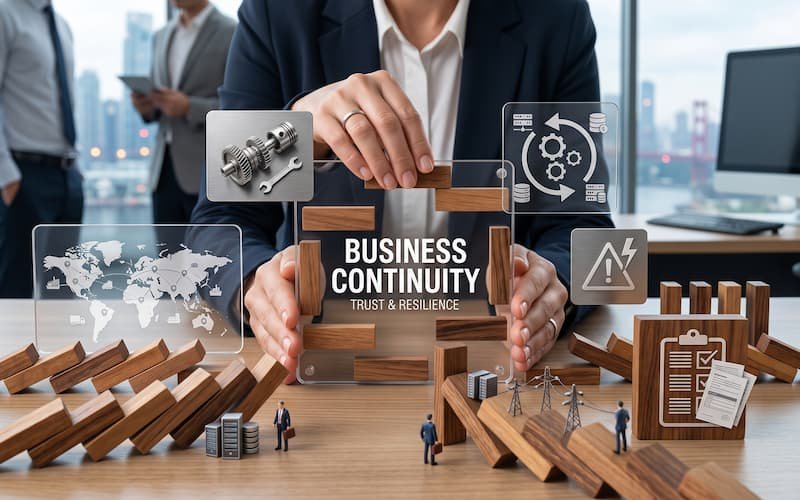
For organizations that rely on critical operations during disasters like technology failures, supply chain interruptions, cyber incidents, natural disasters, and unexpected operational issues, business continuity is essential. Having documented procedures is not enough to prepare for an external assessment. Organizations must demonstrate the structuring, implementation, testing, monitoring and ongoing improvement of its continuity arrangements. An organized approach can be used to determine vulnerabilities before an external expert examines the system, and can provide a structured and clear audit process.
The first step in preparing for iso 22301 certification should be to determine the business continuity requirements, and the organization's own operational risks. The goal is to make policies, business impact analysis, risk assessment, continuity plans, recovery plans, training documentation, exercises and improvement plans consistent. If the elements are managed effectively and substantiated with evidence, companies can show that their continuity plan is realistic and not a “paper plan”.
Be familiar with the requirements of Continuity System.
The first step to prepare for an external assessment is to know what the requirements are on the business continuity management system (BCMS) of the organization. ISO 22301 offers guidance on how to implement, maintain and continually improve a business continuity management system. Organisations should check their current system with the requirements, and look at whether requirements are met through appropriate processes, and documented information.
The review should take into account the context of the organisation, stakeholders, leadership roles, aims, planning processes, operational controls, performance monitoring and improvement processes. Businesses should also make sure that there are clear responsibilities set for the staff members. Staff members responsible for continuity activities need to be aware of what to expect before, during and after a disruptive event.
Read and review the Business Impact Analysis (BIA) and Risk Assessment.
The business impact analysis is a key part of continuity planning as it allows organisations to identify which activities are most critical and the impact that disruption might cause. Businesses should ensure that their business impact analysis is up to date prior to an external assessment, as it should accurately reflect current operations, dependencies, resources, and recovery needs.
Risk assessments should also be reviewed to ensure that any significant risks have been identified and assessed correctly. Technology, suppliers, facilities, workforce arrangements, regulations and business processes change, creating new risks. Risk assessments must not therefore be seen as one and done documents.
The outcome of risk assessments and business impact analyses should be logically related to continuity strategies. For instance, if a critical business process relies heavily on a specific technology platform, the continuity plan should include how that process will continue in the event of the loss of the platform.
Check Continuity Strategies and Recovery Procedures
Organizations should review their continuity programs to see if they are practical and will allow critical functions to be performed in the time frames of their recovery plans. Plans should include who will be responsible for the resources, communication arrangements, alternative facilities, technology solutions, suppliers, and recovery methods (where applicable).
Procedures for recovery should be clear enough to be understood by employees in case of disruption. They should not rely solely on the knowledge of one person. Businesses need to check information about contacts, escalation procedures, emergency resources and supporting documentation is up to date.
When preparing a business continuity system, an organization should match the procedures in the system with the capabilities of its system. On paper, a plan looks complete, but in reality it's not if the resources, technology, employees, or supplier support are not available when they are needed.
Confirm Recorded Information and Records
Continuity management systems are often evaluated externally, usually with the expectation of objective evidence of their implementation and maintenance. For this reason, the organizations should check their documented information prior to the assessment. Policies and procedures, objectives, risk assessments, business impact analyses, continuity plans, exercise records, training documentation, internal audit documentation, management review documentation, corrective actions and improvement records should be suitably controlled.
Additionally, businesses should confirm if the documents have been approved, reviewed, updated, and distributed to the appropriate staff. Older versions shouldn't be used indefinitely as the lack of consistency in documentation can lead to misunderstandings during any actual disruption and can even pose questions during an assessment.
Records are also crucial as they provide evidence that activities have been planned. Evidence of implementation and continual improvement may be established via attendance, exercise outcomes, incident reports, testing outcomes, internal audits and corrective actions.
Carry out continuity exercises and tests
One of the best methods to see if continuity arrangements are effective is to test them. Exercises should be done prior to an external assessment to match the risks and operation of the business. They can be in the form of discussion exercises, communication tests, technology recovery exercises, evacuation scenarios or simulations of particular disruption events, depending on the organization.
A purpose of an exercise is not just to show there is a plan. This is a chance to spot weaknesses, assess the employees' knowledge, quantify response times and gauge the ability to meet recovery objectives.
Careful recording of exercise results should be undertaken. If a gap is identified it should be given appropriate corrective actions, responsibilities, and completion dates. It is better for an organization to show that it has tackled a weakness and has taken steps to address that weakness in order to support evidence of continual improvement.
Review Employee Awareness and Training
Staff are a crucial part of an effective business continuity system. As part of a disaster preparedness drill, organisations should ensure that key staff are aware of the continuity policy, their roles, communications, escalation processes and what they are expected to do in a disaster.
Training to be fit for the job. Training might be more specific to the people who have crisis management responsibilities as opposed to general awareness responsibilities. Relevant continuity information should also be provided to new staff and staff when they change roles.
There should be records of training and awareness activities conducted by organizations. The most crucial aspect is that workers should be able to say what their responsibilities are, not just that they had training.
Carry out an Internal Audit before an External Assessment.
An internal audit can help you uncover any discrepancies, which an external evaluator may not be able to. The audit should assess the ‘fitness’ of the continuity management system within the context of applicable requirements and organization's own processes.
Documentation and implementation should be reviewed by internal auditors. They have access to records, and can interview staff, inspect operations and determine if corrective actions taken during prior audits were completed properly.
Document the findings and address them in a systematic way. Businesses shouldn't end up closing findings the simple way – by changing superficial documents. Corrective action should be taken to correct the root cause of the problem, and should be documented as effective where possible.
Conduct Management Review
Another key consideration in preparing for assessment is management involvement. Senior management should review the performance and effectiveness of the continuity management system and consider issues such as audit findings, exercise results, incidents, changes to the organisation, performance against objectives, resource requirements and opportunities for improvement, etc.
Management review records should show that management are actively involved in maintaining the system. Documentation and follow-up should be done on any decisions made as a result of the review. This helps to illustrate how business continuity is part of the business management process and not just an administrative process.
Close Gaps through Corrective Action
Following internal audits, exercises, reviews and document check, businesses should compile their findings and put corrective actions on top priority. Any issues of consequence should be addressed in an adequate fashion prior to external assessment.
Corrective actions should make it clear what, why, who, how and when will be done to correct the problem. It's important for organisations to keep evidence that actions have been taken and that the solution implemented has resolved the issue.
Preparing for business continuity systems also entails learning from past incidents and exercises. Findings from the lessons learned to be reflected in plans, procedures, training and exercises as appropriate.
Train Staff for the Evaluation
Staff who may be involved with a visiting assessor should be aware of the purpose of the assessment and who they should contact should they need to have access to information for the assessment. They should respond to questions in an honest and truthful way according to their actual duties and not try to rehearse answers.
For organizations, short awareness sessions can be held prior to the assessment to outline the assessment process, the need for employee engagement, important continuity roles and access to the documents. This can help to minimise confusion and assist employees understand the practicalities of continuity arrangements.
Conclusion
When facing an external assessment, organisations must consider more than just documentation, and prove that continuity arrangements work in the real world. Reviewing risks, business impact analysis, recovery strategy, documented information, training, exercises, internal audits, management reviews, and corrective actions can be used to identify weaknesses before the formal assessment process starts. Regular business continuity system preparations also allow the continuity management system to be in line with evolving operational needs.
It is important to remember that a successful preparation process is not a "last minute" assessment exercise, but an on-going management process. Planning, tracking performance, engaging employees, identifying areas for improvement, and recording accurate metrics can help to create a more robust continuity strategy. Business continuity system preparation involves structured exercise scenarios, and by executing these exercises, businesses may show that their continuity exertions are maintained, tried and continually developed to assist business continuity and business resilience.