How AI Agents Can Help Developers Build Personalized Game Experiences
By Urvesh Babariya 28-09-2026 4
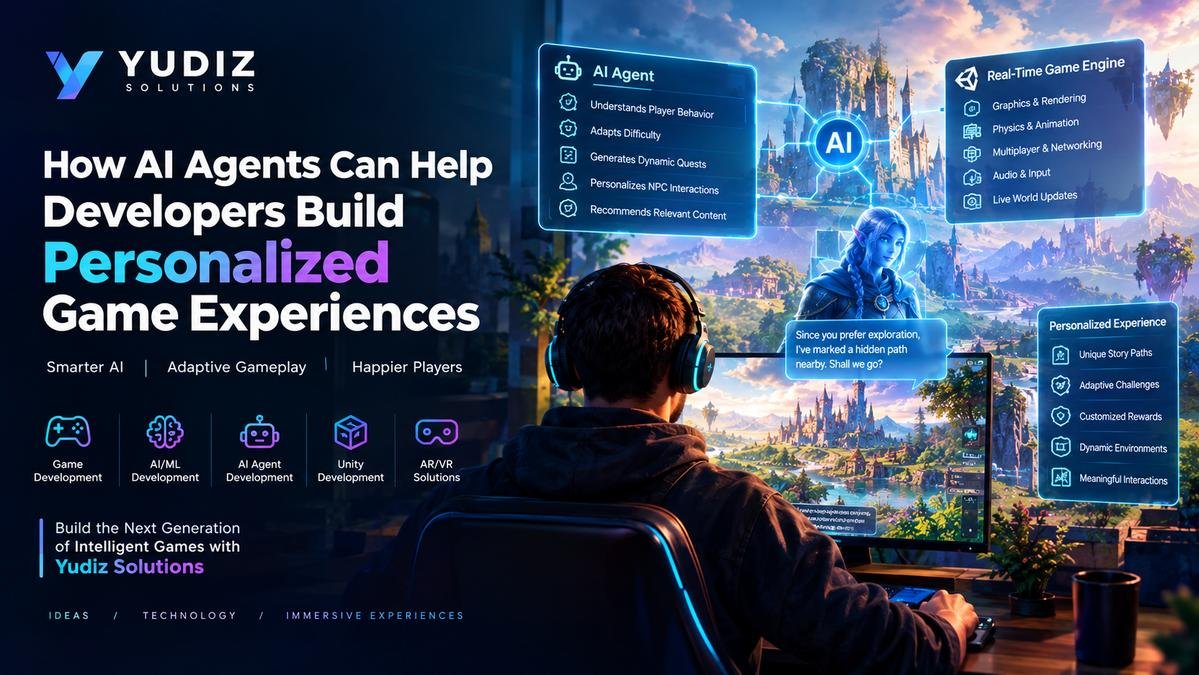
The gaming industry is moving toward a future where experiences are no longer designed exactly the same way for every player. Traditional games provide carefully crafted levels, characters, missions, rewards, and difficulty settings. While these elements remain fundamental, artificial intelligence is introducing new ways to make games more responsive to individual player behavior.
AI agents are particularly interesting in this transformation.
Unlike conventional scripted systems that follow predefined instructions, AI agents can be designed to interpret context, make decisions, use tools, and take actions toward specific objectives. When integrated into games, they can help developers create personalized interactions, adaptive challenges, dynamic quests, intelligent NPCs, and player-specific recommendations.
This does not mean that every part of a game needs AI. Instead, developers can strategically introduce AI agents where personalization can improve the player experience.
For studios and businesses exploring this opportunity, choosing an experienced Game development company with expertise in artificial intelligence can help bridge the gap between creative game design and intelligent technology.
What Is Personalized Game Development?
Personalized game development means designing experiences that can adapt to the needs, preferences, or behavior of individual players.
In a conventional game, two players may encounter the same tutorial, enemies, missions, rewards, and progression system.
A personalized game can potentially adjust some of these elements based on how each person plays.
For example, a player who struggles with a particular mechanic might receive additional guidance. Someone who consistently chooses difficult combat encounters could receive more advanced challenges. A player interested primarily in exploration might be presented with optional discovery-focused content.
Personalization can be applied to:
Game difficulty
Missions and quests
NPC interactions
Tutorials
Rewards
Content recommendations
Character development
Game environments
Story progression
In-game events
AI agents can become the decision-making layer that helps determine which experience is appropriate for a particular player.
How AI Agents Differ From Traditional Game AI
Traditional game AI has typically relied on systems such as finite-state machines, behavior trees, navigation systems, and predefined rules.
These approaches remain extremely useful.
For example, an enemy may have states such as:
Patrol → Detect Player → Chase → Attack → Retreat
The behavior is predictable because developers define the conditions and actions.
AI agents can introduce an additional layer of reasoning and contextual decision-making.
An agent could consider the character's objective, the game state, previous interactions, available resources, and information provided by other systems before selecting an action.
This can be especially valuable for games involving complex narratives, social interactions, strategy, or persistent worlds.
The goal is not to replace conventional game AI. Instead, developers can combine deterministic game logic with AI agents.
The game engine can continue handling movement, physics, rendering, animation, and core gameplay rules while AI agents manage selected higher-level decisions.
AI Agents Can Understand Player Behavior
Personalization begins with understanding the player.
Games already generate a considerable amount of gameplay information. Depending on the game and its privacy practices, developers may have access to signals such as progression speed, frequently selected characters, completed missions, difficulty settings, play patterns, and content preferences.
AI systems can analyze these signals and identify meaningful patterns.
For example, an agent could determine that a player:
Prefers exploration over combat
Frequently skips tutorials
Enjoys difficult challenges
Spends significant time customizing characters
Repeatedly plays with particular teammates
Avoids certain mission types
Progresses unusually quickly
The system could then use these insights to support personalization.
Importantly, developers should establish clear rules around which data is collected and how it is used. Personalization should enhance gameplay while respecting privacy and player expectations.
Personalized NPCs With AI Agents
NPCs are one of the most promising applications for AI-powered personalization.
In many games, NPCs respond according to fixed dialogue trees. A character might have five responses to a particular interaction, and every player encounters essentially the same conversation.
AI agents can enable more contextual interactions.
Imagine an RPG where an NPC remembers selected aspects of the player's previous interactions.
If the player helped that character earlier in the game, the NPC might respond differently later. If the player repeatedly chooses a particular faction, NPCs associated with that faction could recognize the player's reputation.
An AI character agent could manage:
Personality
Objectives
Dialogue
Relationships
Selected memories
Available knowledge
Reactions to player actions
However, developers need strong boundaries.
An AI NPC should not have unrestricted access to every piece of game information. Its knowledge should be controlled so that it does not reveal hidden story elements or behave inconsistently with the game world.
Adaptive Difficulty Without Fixed Difficulty Levels
Difficulty is another area where AI agents can support personalization.
Traditional games often provide difficulty levels such as Easy, Normal, and Hard.
These options are simple and effective, but they do not necessarily reflect the player's actual skill.
AI systems can potentially monitor gameplay and identify patterns.
For example, if a player repeatedly fails the same encounter, the system could determine whether the issue relates to enemy behavior, resource availability, or a specific gameplay mechanic.
It could then make controlled adjustments.
These adjustments might involve:
Enemy tactics
Tutorial assistance
Resource availability
Encounter frequency
Puzzle complexity
Optional hints
Combat intensity
The objective should not be to secretly make the game easier or harder without considering player expectations.
Instead, developers can use AI to create a more responsive experience while giving players meaningful control over their preferred style of play.
Personalized Quests and Missions
AI agents can also help create more relevant quests.
A traditional quest system might assign missions based primarily on the player's current level and location.
An AI-driven system can consider a broader context.
Suppose a player has spent several hours helping a particular faction. A quest agent could identify that relationship and prioritize missions connected to that faction.
Another player might have focused heavily on exploration. Their next recommended mission could involve discovering a new region.
This creates a sense that the game is responding to individual choices.
AI-generated quests should still operate within predefined constraints.
Developers can establish rules for objectives, locations, rewards, difficulty, narrative boundaries, and available characters. The AI agent then works within those parameters.
This approach provides flexibility without surrendering creative and technical control.
Personalized Game Recommendations
AI agents can also act as intelligent recommendation systems.
A game may contain hundreds of characters, weapons, missions, cosmetics, maps, or activities. New players can sometimes feel overwhelmed by the amount of content available.
An AI agent can analyze a player's gameplay patterns and provide contextual recommendations.
For example:
“You have been using long-range characters frequently. Yo
Tags : .....