How Automation Is Changing the Way Industries Handle Chemical Separation and Metal Recovery
By kjhilscientific 10-06-2026 116
Industrial processing has always involved a trade-off between operator control and process consistency. When a trained operator manually manages a distillation run or a metal dissolution cycle, the outcome depends on their attention, experience, and ability to maintain consistent parameters across the full duration of the batch. For low-value products or infrequent runs, this trade-off can be acceptable. For high-purity chemical separations and precious metal recovery, it rarely is.
Automation in processing equipment has moved well beyond simple timers and thermostats. Modern systems use programmable logic controllers, SCADA platforms, and closed-loop feedback mechanisms to maintain parameters that human operators simply cannot hold with the same precision over hours of continuous operation. The result is not just convenience - it is a measurable difference in output purity, yield, and batch-to-batch consistency.
This article examines specifically how automation is reshaping two technically demanding areas of industrial chemistry: fractional distillation for chemical separation, and precious metal refinery operations for recovery and purification.
Why Manual Control Falls Short in Precision Processing
The limitations of manual control in chemical processing are not a matter of operator competence. They are inherent in human physiology and attention. A batch distillation run may last six to twelve hours. Maintaining a precise reflux ratio, monitoring temperature at multiple column points, adjusting heating input as feed composition changes, and timing product take-off windows - all simultaneously, without deviation - is beyond what any operator can reliably sustain across an entire shift.
The consequences show up in the data. Manually operated distillation columns produce higher batch-to-batch purity variation than automated ones, even when run by experienced operators. In pharmaceutical applications, this variation can trigger batch failures against tight specification limits. In solvent recovery, it means inconsistent distillate quality that may require rework before re-use.
In precious metal processing, the same dynamic applies. Acid addition rates, dissolution temperatures, precipitation timing, and reagent stoichiometry all need to be controlled within defined ranges to achieve consistent metal recovery and final product purity. An operator working manually is making judgment calls at each step - judgment that varies with shift, fatigue, and experience level.
Automation does not replace operator involvement in these processes. It changes the nature of that involvement: from moment-to-moment parameter management to process supervision, quality verification, and exception handling.
Automation Tiers in Fractional Distillation Systems
The automation options available for distillation equipment span a wide range, and matching the right tier to the application is as important as specifying the column correctly.
Manual Configuration: Heating, cooling, and reflux control are managed entirely by the operator using local instrumentation - temperature gauges, manual valves, and visual observation of the column. For laboratory-scale research and development work, this level of control is often appropriate because the operator needs the flexibility to intervene and adjust parameters as the experiment progresses. Educational laboratories and early-stage process development fall into this category.
Semi-Automatic Configuration: A PLC handles temperature regulation, data logging, and basic parameter control, while the operator manages material loading, product collection, and process adjustments. This tier represents a significant step up in consistency. The PLC enforces the same temperature profile on every run, eliminating the drift that occurs in fully manual operation. Mid-scale production, pilot plants, and contract manufacturing operations where supervisory oversight is part of the workflow are well-suited to this configuration.
Fully Automatic Configuration: Full SCADA integration brings closed-loop control across all operating parameters - reflux ratio, heating rate, temperature profiling, vacuum level where applicable, and product take-off timing. Recipe management allows the same separation to be executed identically across hundreds of batches. Batch history logging provides complete traceability, which is a regulatory requirement in pharmaceutical environments and a quality management expectation in most others.
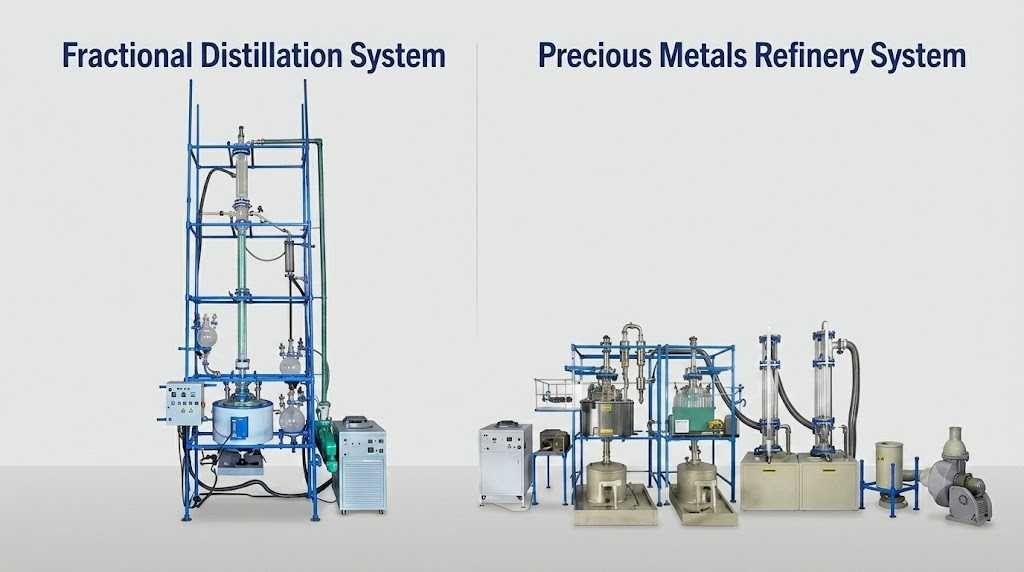
A correctly specified fractional distillation system with full automation can maintain a reflux ratio accurate to within fractions of a percent throughout a twelve-hour run. The same target maintained manually will drift by several percentage points over the same period, with direct consequences for distillate purity.
The Specific Value of Automation in Precious Metal Recovery
Automation delivers particularly significant value in precious metal recovery operations because the chemistry involved is both hazardous and time-sensitive. The dissolution stage using aqua regia generates HCl and NOx gases at temperatures that must be held within a defined range. Too low and dissolution proceeds incompletely, leaving precious metal in the undissolved residue. Too high and acid decomposition accelerates, increasing fume load and reducing the effective acid concentration available for dissolution.
In a manually operated system, the operator monitors temperature with a local gauge and adjusts the heating source accordingly. In a PLC-controlled system, a closed-loop temperature controller maintains the set point continuously, adjusting heating input in real time to compensate for variations in feed load, ambient temperature, and acid concentration.
The precipitation stage presents a similar control challenge. Adding a reducing agent to precipitate gold from solution requires the right stoichiometry - enough reducing agent to drive complete precipitation, but not so much that it introduces contaminants into the product. Automated dosing systems add a precisely calibrated quantity based on the batch parameters, removing the operator-dependent variability that is characteristic of manual addition.
A well-designed precious metal refinery with automated dosing and temperature control consistently achieves final product purities of 99.95% or above. The same process run manually by a skilled operator produces results in the range of 99.5–99.9%, depending on operator experience and the consistency of their technique. For commercial refineries where product purity determines the price received, that difference has direct financial consequences.
Fume Management and Safety Interlocks
One aspect of automation in precious metal processing that often receives less attention than process control is safety interlock management. Strong acid processing environments require that ventilation and scrubbing systems are active before any acid is introduced, and that they remain active throughout the dissolution process and for a defined period afterward.
In manual systems, the responsibility for verifying scrubber operation falls on the operator. In automated systems, ventilation and scrubber status are monitored as part of the control logic, and acid addition is physically interlocked to prevent operation if scrubbing capacity is offline. This is not simply a compliance requirement - it is the engineering control that makes safe operation possible when the process is scaled beyond small laboratory volumes.
Temperature interlocks that prevent excessive heating, level sensors that detect vessel overfill, and emergency dilution systems that activate if abnormal conditions are detected all form part of a complete automated safety architecture. These protections can be specified independently of the process automation tier, but they are most consistently implemented when integrated into a SCADA-controlled system from the initial design.
Automation and the Economics of Batch Processing
The economic case for automation in both distillation and precious metal recovery comes down to three factors: yield, throughput, and labour.
Yield improves because consistent parameter control reduces the proportion of batches that fall outside specification and require rework. In precious metal recovery, where every gram of unrecovered gold represents direct revenue loss, the yield improvement from automated precipitation control typically pays for the automation investment within a defined number of operating cycles.
Throughput increases because automated systems can be cycled continuously, with recipe management allowing back-to-back batches with minimal operator setup time between runs. Manual systems require more inter-batch time for parameter verification and setup.
Labour costs change in character rather than simply decreasing. Automated systems require fewer operators per batch, but they require operators who can interpret process data, manage exceptions, and maintain the control hardware. For organisations with existing skilled technical staff, this transition is straightforward. For those without, it is a factor to plan for during equipment commissioning.
Matching Automation Level to Operational Requirements
There is no universal correct answer for automation level in chemical processing or metal recovery equipment. The right choice depends on production volume, regulatory environment, available technical staff, and the specific purity requirements of the output.
Small workshops and research laboratories with low production volumes and high process variability needs are often better served by manual or semi-automatic systems where operator intervention is part of the design. Industrial-scale production, regulated pharmaceutical environments, and certified commercial refineries require full automation to meet throughput, consistency, and documentation standards.
The critical point is that automation level should be specified as part of the initial process design - not added as an afterthought when manual operation proves insufficient. Retrofitting automation to a manually designed system rarely achieves the same integration quality or safety architecture as a system designed for automated operation from the outset.