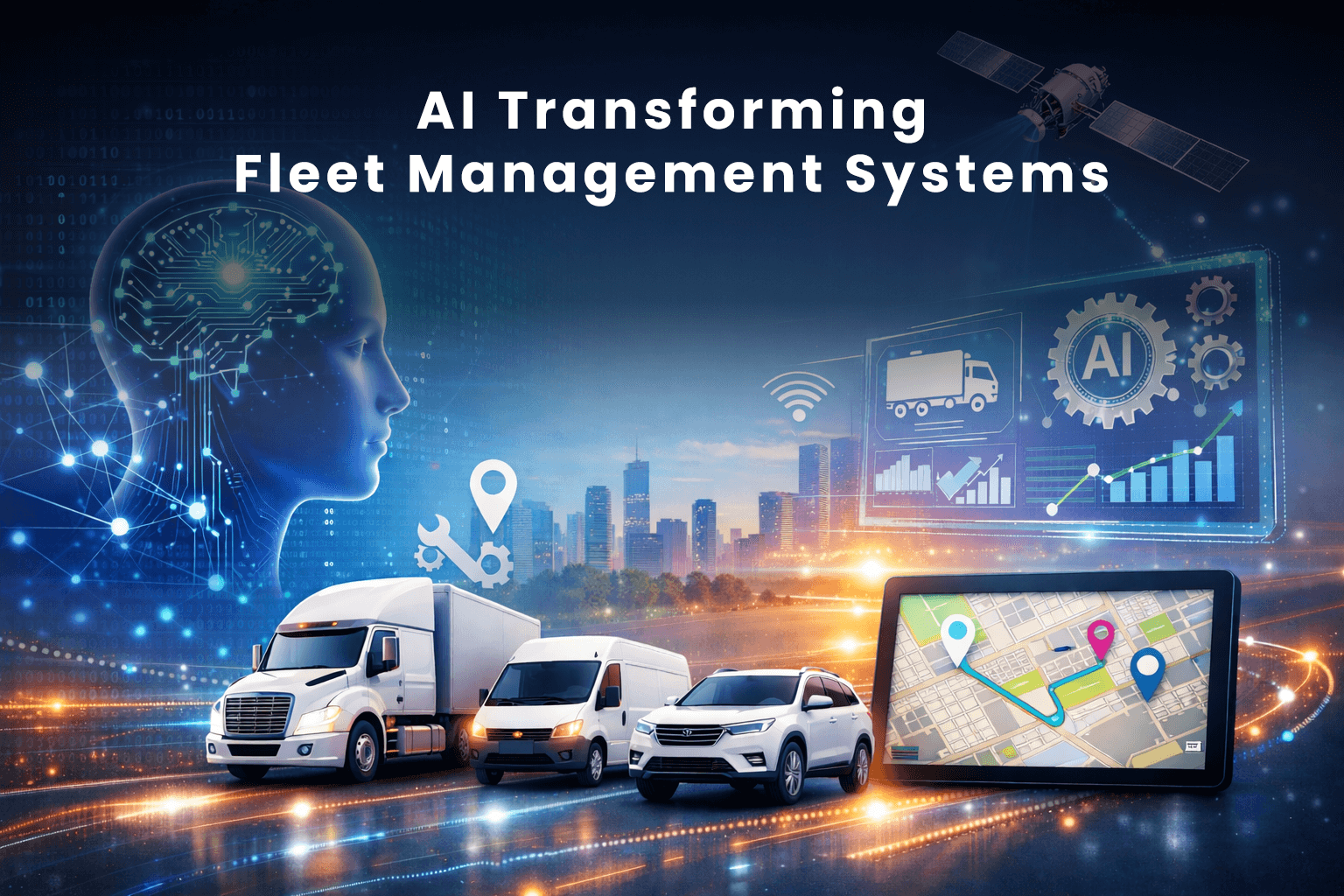
Fleet management has long been a critical function across logistics and transportation, last-mile delivery services, construction fleets, utility operations, government vehicles, and a wide range of field service industries. Traditionally, fleet managers relied on spreadsheets, basic GPS tracking, telematics reports, periodic vehicle inspections, and manual judgment to manage daily operations.
However, today’s highly competitive and fast-paced environment—marked by rising operating costs, growing delivery expectations, volatile fuel prices, strict safety standards, and evolving regulatory requirements—has made traditional fleet management approaches insufficient.
This is where AI-powered fleet management is reshaping the industry. Artificial intelligence is transforming conventional fleet management software into intelligent, self-learning, predictive, and action-driven platforms that go far beyond simple tracking.
The global fleet management software market is projected to grow from $27.55 billion in 2024 to $116.56 billion by 2032, registering a CAGR of 19.76%. Unlike legacy systems that merely monitor vehicles, AI-driven fleet management solutions can analyze data in real time, learn from patterns, predict outcomes, and automatically recommend or execute decisions—without constant human intervention.
In the sections ahead, we’ll explore how AI and machine learning are revolutionizing fleet management and shaping the future of mobility, efficiency, and operational excellence worldwide.
Why Is There a Growing Need for AI in Fleet Management Software?
Rising Fuel and Maintenance Costs
Fuel remains one of the largest operational expenses in fleet management, while vehicle maintenance costs continue to rise. Manual monitoring methods are often slow, reactive, and prone to inaccuracies. AI-powered fleet management systems address these challenges by enabling fleets to:
- Forecast fuel consumption patterns
- Reduce excessive idling and fuel wastage
- Identify inefficient driving behaviors
- Predict vehicle wear and potential failures before breakdowns occur
By shifting from reactive to predictive maintenance and optimization, AI helps reduce unnecessary expenses while ensuring smoother, more reliable operations.
Increasing Demand for On-Time Deliveries
Customer expectations have never been higher. Businesses today must consistently deliver:
- Accurate estimated times of arrival (ETAs)
- Strict adherence to SLAs
- Minimal or zero delivery delays
- End-to-end shipment transparency
- Reliable service experiences
AI-driven fleet management software supports these demands through intelligent route optimization, real-time forecasting, and automated decision-making—helping fleets meet delivery commitments with confidence.
Driver Shortages and Growing Safety Requirements
Fleet operators are facing multiple workforce and safety challenges, including:
- A shortage of skilled drivers
- Rising accident risks
- Driver fatigue and distraction
- Increasing compliance and safety regulations
AI-based fleet systems enhance driver safety through continuous behavior monitoring, real-time alerts, driver coaching, and camera-based intelligence, creating safer roads and more compliant fleet operations.
Limitations of Traditional Fleet Management Software
Conventional, rule-based fleet systems struggle in dynamic, real-world conditions because:
- They react to problems instead of predicting them
- They fail to learn from historical and real-time data
- They cannot interpret external factors such as traffic, weather, or road conditions
- They lack advanced decision-making intelligence
AI overcomes these limitations by continuously learning, adapting, and predicting outcomes before issues arise.
The Need for Predictive, Automated, Data-Driven Decisions
Modern fleet operations demand more than simple tracking. They require:
- Real-time operational optimization
- Proactive maintenance planning
- Predictive and automated decision-making
- Data-driven strategic planning
AI-powered fleet management solutions deliver these capabilities at scale, enabling fleets to operate with greater accuracy and agility.
AI Transforms Fleet Software into Intelligent Operational Platforms
Rather than functioning as basic monitoring tools, modern AI fleet management platforms are designed to:
- Predict vehicle and system failures
- Recommend optimal routes and schedules
- Automate dispatch and workload allocation
- Enhance driver and vehicle safety
- Optimize operational costs
- Enable autonomous, data-backed fleet decisions
This shift marks the evolution of fleet management software—from simple tracking systems to intelligent, AI-driven operational engines that power the future of the fleet industry.
Evolution of Fleet Management Software: From Manual Tracking to AI-Driven Intelligence
Fleet management has evolved dramatically over the decades. What once involved paper logs and manual vehicle tracking has transformed into intelligent, proactive, AI-powered systems. Initially, fleet management focused mainly on knowing vehicle locations and basic operating conditions.
Traditional Fleet Management: GPS Tracking and Basic Reports
Early fleet management systems relied heavily on GPS tracking and simple reporting. Fleet managers monitored real-time vehicle locations, estimated travel times, mileage, and past routes. These systems offered visibility but limited insight, focusing more on tracking than decision-making.
Telematics-Driven Platforms and Real-Time Visibility
The introduction of telematics marked a major advancement. Beyond location tracking, telematics systems began collecting engine data, fuel consumption, driver hours, vehicle health metrics, and environmental readings. This enabled fleet managers to understand not just where vehicles were, but how they were performing.
From Reactive Operations to Predictive Intelligence
As data volumes increased, fleet management shifted from reactive problem-solving to predictive thinking. Instead of responding to breakdowns or accidents after they occurred, businesses began using data to anticipate failures, prevent incidents, and optimize operations proactively.
The Role of AI and Machine Learning in Modern Fleet Software
Today, AI and machine learning form the foundation of modern fleet management ecosystems. AI-driven platforms analyze vast amounts of data—including driver behavior, traffic conditions, road patterns, maintenance schedules, and environmental factors—to deliver real-time insights and actionable recommendations.
Why AI-Powered Fleet Systems Lead the Future
Unlike conventional systems that simply report what is happening, AI-powered fleet management software predicts outcomes and recommends next actions. Its ability to learn, automate, and continuously optimize operations is why AI-driven solutions are rapidly replacing traditional fleet management systems worldwide.
Key AI Capabilities in Modern Fleet Software
Predictive Maintenance & Asset Health
AI analyzes engine data and telematics to predict failures early, enabling timely maintenance, fewer breakdowns, longer asset life, and improved reliability.
Intelligent Route Planning & Optimization
By evaluating traffic, weather, distance, and delivery priorities, AI optimizes routes in real time to reduce delays and improve delivery efficiency.
Driver Behavior Analytics & Safety Scoring
AI tracks driving patterns such as speeding, harsh braking, fatigue, and distraction to generate safety scores, reduce accidents, and promote safer driving habits.
Fuel Management & Emissions Monitoring
AI monitors fuel usage, idling, and vehicle efficiency to minimize waste, lower costs, and support sustainability goals.
Automated Compliance & Reporting
AI automates regulatory documentation and audit preparation, reducing manual effort while ensuring consistent compliance.
Real-Time Alerts & Performance Dashboards
Live dashboards and instant alerts help fleet managers respond quickly to risks, delays, and issues for better operational control.
Future of AI Fleet Management
Autonomous and Semi-Autonomous Operations
Future fleet ecosystems will increasingly adopt autonomous and semi-autonomous operations. AI will handle navigation, decision-making, safety protocols, and execution—reducing human dependency while improving efficiency, safety, and operational consistency.
AI-Driven Sustainability and Emissions Reduction
AI will play a key role in building greener fleets through intelligent routing, improved fuel efficiency, reduced idling, optimized electric vehicle management, and lower emissions—supporting global sustainability goals.
Predictive Planning and Self-Learning Systems
Fleet management will become predictive and self-learning, with AI forecasting demand, planning capacity, anticipating failures, and continuously optimizing operations to make fleets smarter, faster, and more strategic.
AI + IoT–Powered Connected Fleet Ecosystems
Future fleets will operate within fully connected ecosystems where AI, IoT, telematics, cloud platforms, and real-time analytics work together to enable seamless communication between vehicles, drivers, infrastructure, and systems.
From Fleet Monitoring to Autonomous Orchestration
Fleet management will evolve from simple monitoring to autonomous orchestration. AI will manage dispatching, routing, maintenance, safety, compliance, and performance optimization with minimal human intervention.
Conclusion
AI fleet management is not just a technological upgrade—it represents a fundamental shift in how modern fleets operate. By enabling predictive planning, safer operations, reduced fuel consumption, and higher productivity, artificial intelligence is transforming logistics, transportation, government, utilities, and field service industries.
Organizations that partner with a reliable software development company to build or implement AI-powered fleet management solutions gain a strong competitive advantage. The right development partner helps design scalable, secure, and intelligent fleet systems that reduce operational costs while preparing businesses for the future of connected and autonomous transportation.