Finding something truly "raw" feels like discovering a hidden treasure. In the British Isles, honey has been a medicinal and culinary staple for centuries, but the modern consumer is now looking for more than just sweetness. They are looking for the enzymes, the pollen, and the untouched floral essence that only comes from unheated, unfiltered honey.
What Does "Raw" Actually Mean?
To understand why some jars cost £5 and others £25, we have to look at the processing. Most commercial honeys found in large grocery chains are pasteurized. This involves heating the honey to high temperatures to prevent crystallization and to give it that crystal-clear, syrupy look. While this makes the honey look "pretty" on a shelf, the heat destroys the very things that make honey a superfood: delicate enzymes, antioxidants, and heat-sensitive vitamins.
Authentic raw honey is extracted directly from the honeycomb. It is usually settled or strained through a simple mesh to remove large pieces of wax or bee debris, but it is never fine-filtered or heated above the natural temperature of the beehive. This preserves the "living" nature of the product. When you open a jar of high-quality raw honey, you are essentially tasting the direct output of a British meadow or woodland.
The Diverse Terroir of British Honey
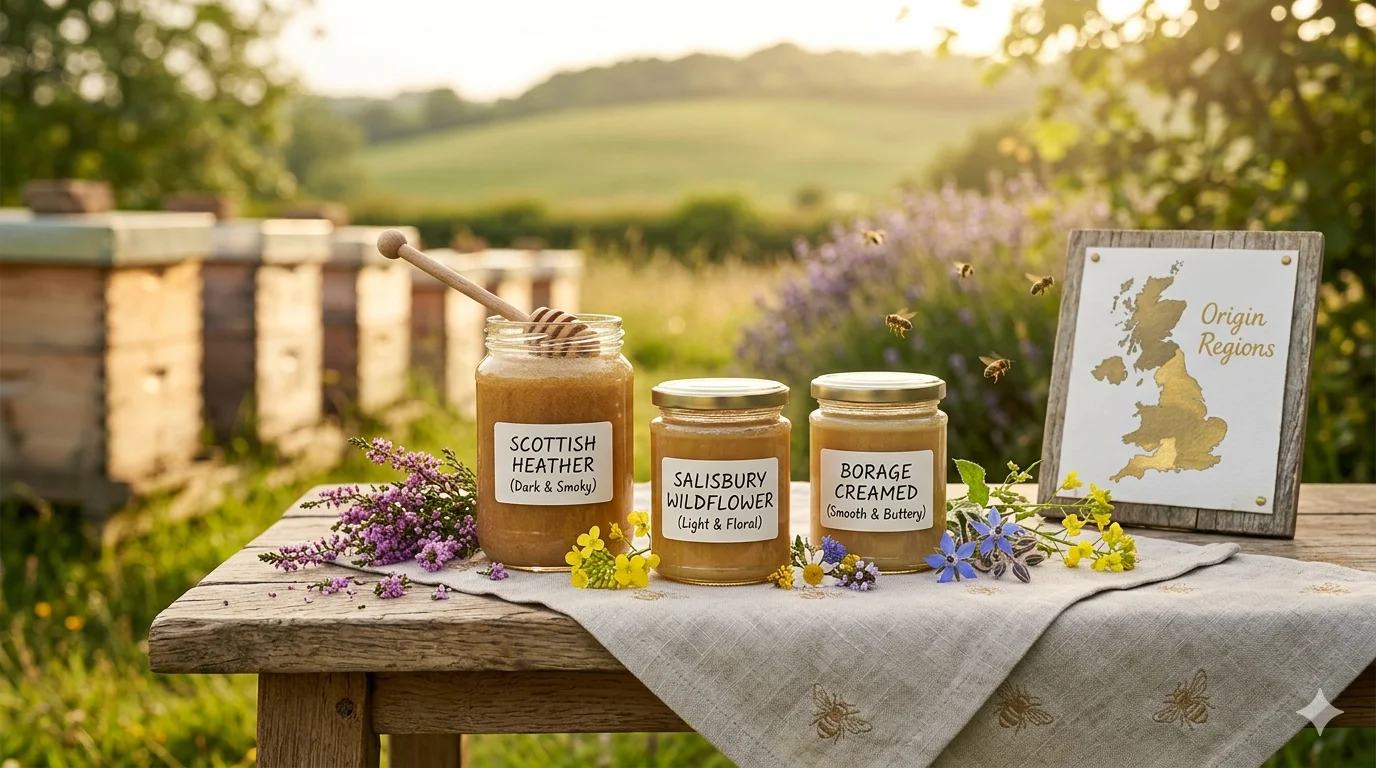
Much like wine or coffee, honey is a product of its environment. The UK offers a surprisingly diverse range of flavor profiles based on where the hives are placed.
1. Scottish Heather Honey
Often referred to as the "Manuka of the North," Heather honey from the Scottish Highlands is famous for its thick, jelly-like (thixotropic) texture and its deep, smoky flavor. Research has shown that Scottish Heather honey contains high levels of essential minerals and powerful antioxidant properties, making it a favorite for those seeking a local alternative to imported specialty honeys.
2. Salisbury Plain & Downland Wildflower
The rolling chalk grasslands of southern England produce a light, floral, and incredibly delicate honey. Because these areas are often protected, the bees forage on a vast array of wildflowers that haven't been touched by intensive pesticides, resulting in a clean, crisp taste that captures the essence of a British summer.
3. Borage and Rapeseed
Common in the East Midlands and East Anglia, these honeys are known for their high glucose content, which causes them to crystallize very quickly into a smooth, buttery texture. Creamed raw honey often starts from these bases, providing a spreadable consistency that is perfect for morning toast without the mess of traditional drips.
The Health Profile: More Than Just a Sweetener
The reason many people seek out the best raw honey UK suppliers is for the documented health benefits. Raw honey is a complex mixture of over 200 substances.
- Antibacterial Properties: Honey contains an enzyme called glucose oxidase, which produces low levels of hydrogen peroxide, a natural antiseptic. This is why raw honey has been used for centuries as a topical treatment for minor burns and stings.
- Digestive Support: As a prebiotic, raw honey helps nourish the "good" bacteria in the gut. It is often used in traditional British home remedies to soothe the digestive tract.
- Allergy Management: A common piece of folklore suggests that consuming local raw honey can help desensitize the body to local pollen. While scientific debate continues, many enthusiasts swear by a spoonful of local honey daily during the hay fever season.
How to Spot the Real Deal
When you are browsing a local farmers' market or an independent health shop in London or Edinburgh, how can you tell if the honey is truly high quality?
- Look for "Set" Honey: Raw honey will almost always crystallize over time. If a jar is cloudy, thick, or solid, it is a good sign that it hasn't been over-processed. Clear, runny honey that stays liquid for years is usually a red flag.
- The "Frothy" Top: Sometimes you will see a white, bubbly foam at the top of a jar of raw honey. This is simply trapped air bubbles and tiny particles of pollen. In the world of raw honey, this "honey foam" is considered a delicacy and a sign of zero heat treatment.
- Read the Label: Avoid jars that say "A blend of Non-EU honeys." These are mass-produced and often stripped of their unique properties. Look for single-origin, British-harvested labels that name the specific county or farm.
Sustainable Beekeeping in the UK
Choosing high-quality raw honey isn't just a win for your pantry; it’s a win for the environment. Small-scale British beekeepers prioritize the health of the hive over maximum yield. They ensure the bees have enough of their own honey to survive the damp UK winters rather than feeding them sugar water, a common practice in industrial honey production. By supporting local apiaries, you are directly contributing to the pollination of British crops and the survival of our native bee populations.
Incorporating Raw Honey into Your Lifestyle
To get the most out of your jar, avoid stirring it into boiling water. Extreme heat will neutralize the beneficial enzymes. Instead, wait for your tea or herbal infusion to cool to a drinkable temperature before adding the honey. It is also incredible as a natural face mask or simply eaten by the spoonful as a pre-workout energy boost.
Final Thoughts
The journey to finding the perfect honey is a personal one. Whether it’s the dark, intense notes of a forest honey or the light, citrusy touch of a clover field, raw honey is a testament to the UK's natural beauty. It is a slow food in a fast world, a reminder that nature, when left to its own devices, provides the most perfect wellness solutions.