From Slow Searches to Rapid Investigations: DataVare Outlook PST Split Expert Review
By Allie Thomas 24-06-2026 175
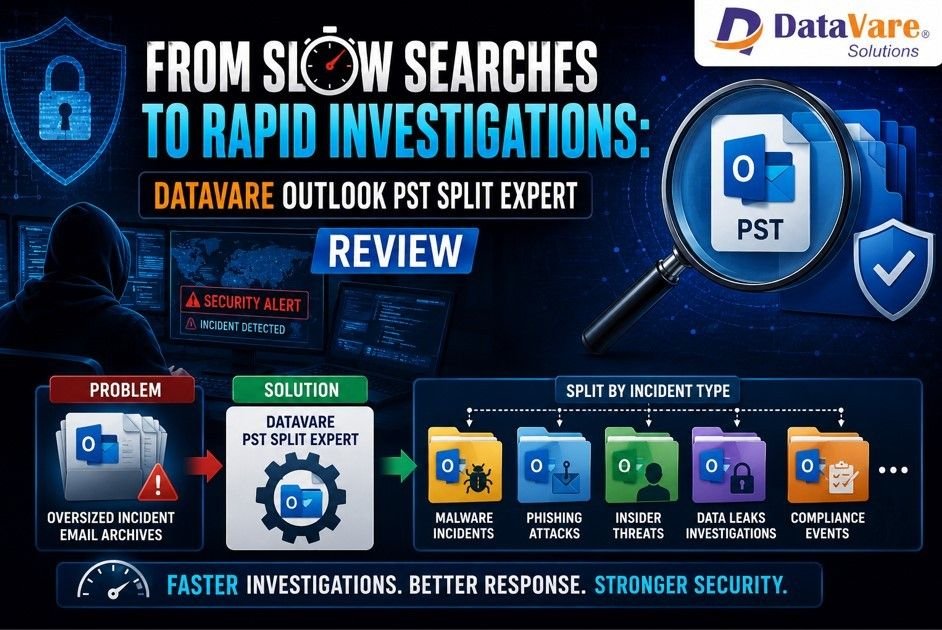
My daily duties as a Security Operations Analyst include looking into alerts, evaluating evidence, assessing occurrences and keeping precise records of security events. Because Outlook stores a large number of incident reports, threat notifications, forensic results and communication threads, email archives play an unexpectedly significant part in this process.
Thousands of emails related to malware investigations, phishing attacks, endpoint alarms, insider threats and compliance evaluations were stored in a single collection of PST archives that our incident response team used for years. What was once a practical storage solution turned become a significant barrier.
It often took more longer than necessary to search for a single incident-related chat. Every minute counts during ongoing investigations. Unfortunately, rather than facilitating efficient work, our archive structure was slowing us down.
This review explains how we overcame that difficulty and how it affected the way we conducted investigations.
When Large Email Archives Turn Into a Security Concern
Few firms consider how security data will be recovered years later, while the majority concentrate on gathering it.
We have several years' worth of incident response correspondence in our archive. Among them were:
- Reports about malware investigations
- Conversations on phishing responses
- Updates on threat intelligence
- Communications regarding compliance
- Results of forensic analysis
- Threads for internal escalation
Outlook performance steadily decreased as the archive grew.
The issues become unavoidable:
- There was a delay in the search results.
- It took longer to open PST files.
- Occasionally, Outlook stopped responding.
- It took too long for analysts to find historical proof.
- It became more difficult to recreate incident timelines.
Investigations became more difficult as the archive grew in size.
The First Manual Approach We Tested
We explored with backup recovery method prior to thinking about a specific solution.
At first, the concept appeared plausible.
When archives were too big, we tried to manually separate data and made backup copies of previous PST files. Although this brought about some short-term respite, it also created new difficulties.
Among the problems we ran with were:
- Time-consuming administration of archives
- Variations in naming customs
- Having trouble identifying some occurrence types
- Information that is stored twice
- A rise in the intricacy of investigations
The archive was still big and challenging to browse.
We were merely shifting the issue from one place to another rather than finding a solution.
Reasons for Choosing to Divide PST Files by Type of Incident
We checked our workflow and found that the main problem was the archive structure.
Naturally, most inquiries fit into particular categories.
For instance:
- Incidents involving malware
- Phishing scams
- Threats from within
- Investigations into data leaks
- Security warnings for endpoints
- Events related to compliance
It made much more sense to arrange archives based on the type of incident rather than keeping an enormous repository.
Instead of looking through years' worth of irrelevant conversations, this format would enable analysts to quickly locate the most pertinent material.
We tried DataVare Outlook PST Split Expert as a result of that insight.
The Experience of Deployment
Our goal was simple.
We intended to preserve all email content and folder structures while breaking up big PST archives into smaller files according to incident type.
Several crucial requirements were the focus of the testing process:
- Precise division
- Maintaining email metadata
- Integrity of attachment
- Retention of folder hierarchy
- Dependable output files
The procedure was successfully finished by the software.
The final files retained the original archive's organizational structure and opened normally in Outlook.
Most significantly, material inside the pertinent incident category may be found right away by analysts.
Features That Provided the Greatest Advantages
During implementation, a few capabilities were quite helpful.
Arrangement of Incident-Based Records
Navigation was significantly enhanced by the ability to divide archives based on categories of investigations.
Analysts might directly access the relevant incident repository rather than scanning a single large archive.
This greatly decreased the complexity of the search.
Maintained Email Integrity
Each archive that was kept:
- Content of emails
- Attachments
- Timestamps
- Organization of folders
- Metadata
For the purpose of compliance and investigation, maintaining the integrity of the evidence was crucial.
Quicker Search Results
Search speed was the most obvious improvement.
Finding historical incident reports that had previously needed a lot of searching became significantly simpler.
Faster investigations were the direct result of this.
Decreased Outlook Performance Problems
Outlook is less taxed by smaller archives.
Performance became substantially more responsive and steady once we reorganized our archives.
Adaptable Splitting Choices
Organizations can design archive structures that meet their operational needs thanks to the software's support for various splitting techniques.
Because of its flexibility, the tool can be used in a variety of departments and sectors.
Benefits Customers Should Understand Before Purchasing
Every software product has advantages.
During our rollout, the following benefits were very noticeable:
Advantages
- A user-friendly interface
- Large PST files are supported
- Maintains email properties
- Preserves the hierarchy of folders
- Enhances Outlook's responsiveness
- Decreases the complexity of archives
- There are several alternatives for splitting
- Fit for workflows related to compliance and investigations
- Advanced technical knowledge is not necessary
- Consistent production of output
These advantages can greatly increase efficiency for businesses handling large Outlook archives.
Restrictions Users Should Take Into Account
No software program is flawless.
Prospective purchasers ought to be aware of the restrictions.
Drawbacks
- A Windows-based environment is necessary
- Processing time is still needed for large archives
- It's crucial to plan the archive structure in advance
- The breadth of the evaluation may be limited by trial version constraints
- Additional download and upload procedures could be necessary for cloud-based archives
Although these restrictions were acceptable in our setting, deployment should take them into account.
FAQs
1. Is there a chance that emails may be lost while splitting?
All emails, attachments and information held up during our testing. But it's always advisable to save backups before processing.
2. Is it possible to successfully process huge PST files?
Yes. Large PST archives can be handled by the program, albeit file size affects processing times.
3. Does the program maintain attachments?
Yes. After splitting, attachments were still available and connected to their original messages.
4. Is it possible to arrange archives in accordance with operating needs?
Yes. Organizations can design archive structures that suit their workflow by using various splitting techniques.
5. Is technological know-how necessary?
Not always. Most administrators and analysts can use the interface without specific training because it is sufficiently simple.
Final Decision
Email archives are frequently disregarded until they start to impede vital activities. Delays in accessing past communications can have a detrimental effect on compliance, incident response and investigation efforts in cybersecurity settings.
Our experience showed that archive arrangement is equally as crucial as archive preservation. We converted an unmanageable collection into an organized repository that actively assisted investigations by classifying large PST files based on the type of occurrence.
The effort was justified solely by the increase in search efficiency. Analysts spend more time examining the evidence and less time searching for information.
This Outlook PST Split Expert is worth considering if your company has trouble with large Outlook archives and investigation delays. Determine whether a structured PST strategy may enhance your operational workflow as much as it did ours by testing it against your largest archive and closely examining the outcomes.