Cutting boards are one of the easiest categories in which to overpay, because almost every quality signal that matters is invisible in a product photo. Two boards can look identical and differ by a decade of service life.
Here are the five things worth checking, roughly in order of how much they tell you.
1. Does the listing name the species
Not "hardwood." Not "premium wood." The actual species.

ALT TEXT: Janka hardness comparison chart for common cutting board woods
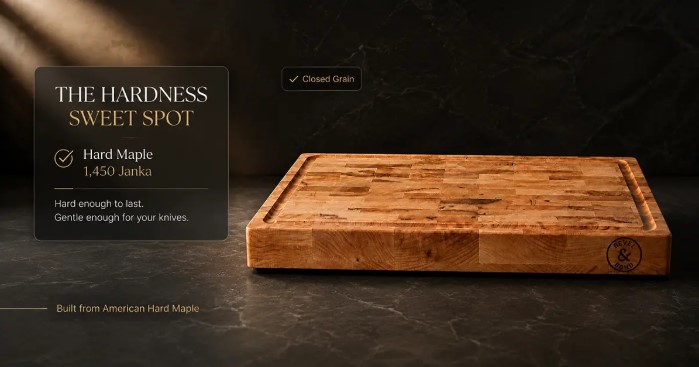
CAPTION: Janka hardness is the number worth checking. Hard maple sits around 1,450 lbf.
SOURCE: Bevel & Bond brand library (owned asset, cleared for publication)
—-----------------------------------------------------------------------------------------------------------------------
Hard maple, Acer saccharum, is the commercial standard for a reason... 1,450 lbf on the Janka hardness scale, a tight closed pore structure, and no odour or flavour transfer. For reference, black walnut sits around 1,010 and cherry around 950, which is why both mark more readily under daily prep. Walnut and cherry are softer but legitimate. Teak is durable but its silica content is rough on knife edges.
"Acacia" is the one to slow down on. It is not a single wood... it is a catch all covering dozens of species of very different density, which is why acacia boards range from excellent to disposable at similar prices. If a seller will not name the species, assume the answer would not help them.
2. Thickness, and whether it matches the construction
Under one inch is a board that will cup. Between one and 1.5 inches is fine for edge grain. End grain construction should not be under 1.5 inches, and the better examples run 1.75 to 2 inches, because the checkerboard depends on hundreds of glue joints and thickness is what gives each block enough gluing surface to hold through seasonal movement.
A thin end grain board priced like a thick one is not a bargain.
3. What glue was used

Source: https://cdn.shopify.com/s/files/1/0765/2743/6015/articles/solid-maple-cutting-board-glue-safety.webp
ALT TEXT: Cross-section of a solid maple cutting board showing food-safe glue joints
CAPTION: Glue failure is how most laminated boards actually die. Ask what adhesive was used.
SOURCE: Bevel & Bond brand library (owned asset, cleared for publication)
—---------------------------------------------------------------------------------------------------------------------------
A serious maker will tell you without hesitation. An FDA compliant waterproof adhesive, typically a Type I PVA such as Titebond III, is the standard. Vague answers here are the single most reliable red flag in the category, because glue failure is how most laminated boards actually die.
4. Weight
A board that stays put under a knife does not need a damp towel underneath it. For a 17 by 13 inch board, ten pounds or more means solid stock rather than a thin laminate. Light for its size usually means thin, hollow, or low density wood.
5. Whether anyone stands behind it
This is the one buyers skip and it is the most revealing. Most cutting board brands offer no warranty at all. A maker offering multi year coverage against manufacturing defects has put money behind their own durability claim, which is a very different thing from writing "built to last" in a bullet point.
A well specified end grain maple cutting board should be able to answer all five questions in a single product page... species, thickness, glue, weight, warranty. Smaller American makers such as Bevel & Bond tend to publish that detail because specification is the thing they are competing on.
The quick filter
If you are comparing two listings and want to decide fast: pick the one that names the species and states the thickness in a number. That one filter removes most of the bad options in the category, and it costs you nothing.