Digital transformation is no longer a technology trend. Instead, it has become a business imperative for organizations seeking resilience and growth. However, transformation efforts often fail when systems operate in isolation. Therefore, connected CRM ecosystems now sit at the center of successful digital strategies.
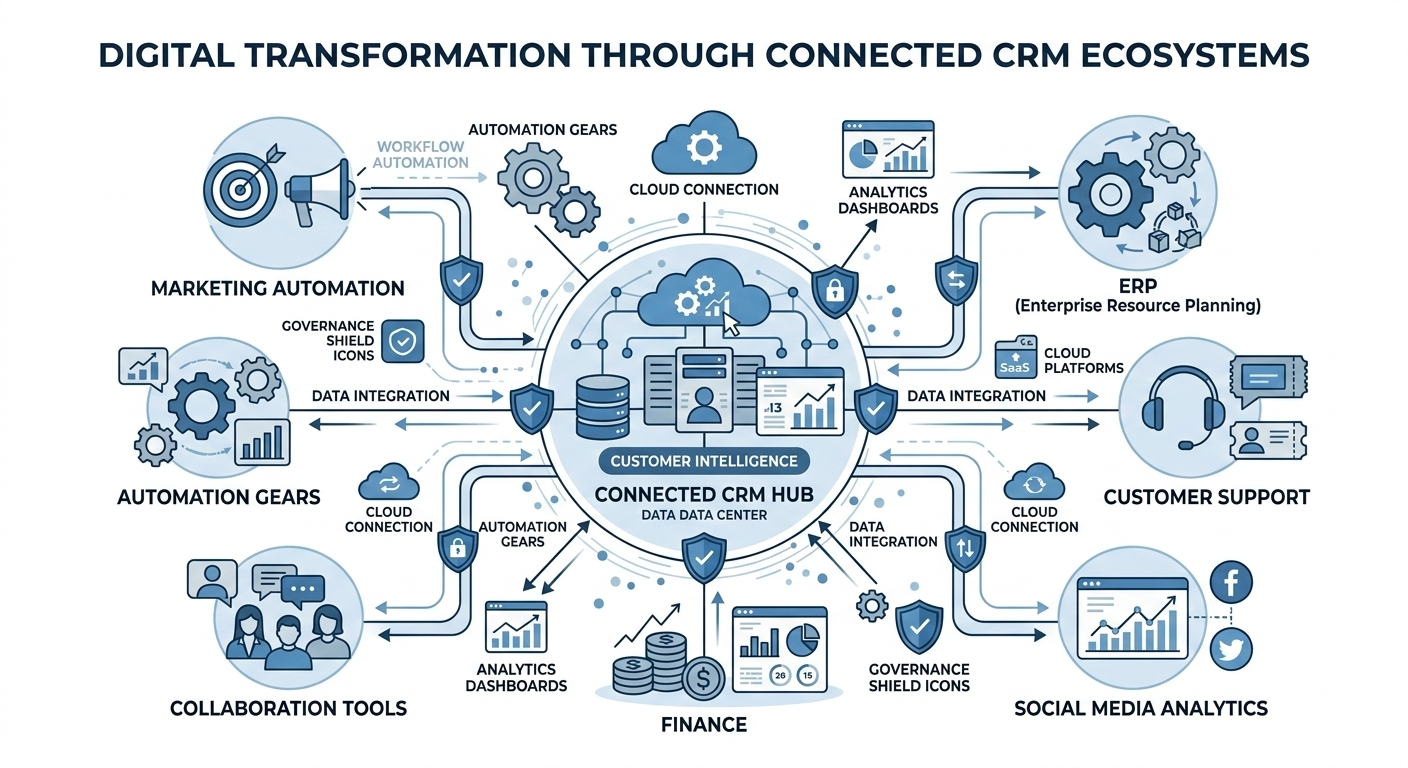
A CRM platform alone cannot deliver enterprise-wide transformation. It must integrate seamlessly with marketing automation, ERP systems, collaboration tools, analytics platforms, and customer support applications. When these systems operate cohesively, organizations gain visibility across the entire customer lifecycle. As a result, decision-making becomes faster and more data-driven.
For example, when companies implement a Brandwatch Salesforce Integration, they connect social intelligence with structured customer data. This alignment enables teams to respond proactively to market sentiment and customer behavior. However, such integration creates true value only within a broader connected ecosystem strategy. Otherwise, it becomes a tactical enhancement rather than a transformative initiative.
Understanding Connected CRM Ecosystems
A connected CRM ecosystem refers to an integrated environment where CRM acts as a central intelligence hub. Instead of functioning as a standalone database, it orchestrates data flows across departments and technologies. This ecosystem includes marketing platforms, service systems, finance tools, and external data sources.
The goal of such connectivity is continuity. Customers interact through multiple channels. Sales representatives, marketers, and support teams require unified insights. Therefore, ecosystem integration eliminates data silos and ensures consistency.
Moreover, connected ecosystems support agility. Organizations can introduce new technologies without disrupting core operations. Modular integrations allow expansion while preserving structural stability. Consequently, digital transformation becomes sustainable rather than reactive.
Why Siloed Systems Undermine Transformation
Many organizations invest heavily in new technologies. Yet, they fail to connect them strategically. As a result, departments operate in fragmented environments. Data duplication increases, and reporting discrepancies emerge.
Siloed systems also weaken customer experience. Marketing may not see support history. Sales may lack insight into digital engagement metrics. Consequently, interactions become inconsistent and reactive.
Furthermore, siloed environments limit scalability. Growth amplifies complexity. Without connectivity, organizations struggle to maintain operational discipline. Therefore, transformation requires structural alignment rather than isolated upgrades.
Core Components of a Connected CRM Ecosystem
Building a connected CRM ecosystem involves several foundational elements. Each component contributes to long-term transformation success.
1. Centralized Data Strategy
Data serves as the foundation of transformation. A connected ecosystem requires consistent data definitions and governance standards. Without this clarity, integrations produce confusion rather than insight.
Organizations must define ownership for each data domain. Customer profiles, transactional data, and engagement metrics should follow standardized structures. Additionally, validation rules must enforce data quality.
A centralized data strategy ensures analytics accuracy. When systems share a unified language, reporting becomes reliable. Consequently, leadership can make confident strategic decisions.
2. Integration Architecture Design
Integration architecture determines how systems communicate. API-based connections enable real-time synchronization. Middleware platforms manage transformations and routing logic.
However, integration design must define system authority. For example, CRM may own opportunity data, while ERP manages invoicing details. Clear boundaries prevent conflicts during synchronization.
Scalable architecture anticipates growth. New platforms should integrate without disrupting existing workflows. Therefore, modular design supports long-term flexibility.
3. Process Orchestration and Automation
Connected ecosystems extend beyond data synchronization. They orchestrate end-to-end workflows. Automated triggers move processes across systems seamlessly.
For instance, a closed deal in CRM can initiate onboarding workflows in project management tools. Support systems can receive alerts when high-value customers submit tickets. Such orchestration enhances operational efficiency.
However, automation must align with governance frameworks. Excessive complexity creates confusion. Therefore, process design should prioritize clarity and measurable impact.
4. Governance and Compliance Frameworks
Digital transformation increases regulatory exposure. More integrations mean broader data distribution. Consequently, governance becomes critical.
Role-based access controls protect sensitive information. Audit trails ensure traceability. Data retention policies support compliance requirements.
Additionally, change management processes should oversee ecosystem updates. New integrations must undergo evaluation and testing. Structured governance preserves system integrity during expansion.
5. Analytics and Intelligence Layer
A connected CRM ecosystem unlocks advanced analytics capabilities. Integrated data supports predictive modeling and behavioral analysis. Leadership gains holistic visibility into performance metrics.
For example, combining sales data with digital engagement insights reveals buying patterns. Customer health scoring identifies retention risks early. Real-time dashboards support agile decision-making.
However, analytics effectiveness depends on ecosystem stability. Clean data and consistent integration ensure accurate forecasting. Thus, intelligence layers rely on foundational alignment.
Strategic Roadmap for Ecosystem Transformation
Digital transformation through CRM ecosystems requires structured execution. Organizations should follow a phased roadmap.
First, conduct a technology audit. Identify existing systems and integration gaps. Evaluate data consistency and workflow inefficiencies.
Next, define transformation objectives. These objectives may include revenue acceleration, improved customer satisfaction, or operational cost reduction. Clear goals guide architectural decisions.
Then, prioritize integration initiatives based on impact. High-value connections should precede peripheral enhancements. Early wins demonstrate measurable progress.
Finally, implement continuous monitoring. Performance dashboards should track integration stability and process efficiency. Transformation remains ongoing rather than static.
Cultural Alignment and Change Management
Technology alone does not ensure transformation. Organizational culture plays a crucial role. Employees must embrace connected workflows and shared accountability.
Cross-functional collaboration strengthens ecosystem success. Sales, marketing, and service teams should align on shared metrics. Unified KPIs encourage collective responsibility.
Training programs reinforce adoption. Clear communication explains the purpose behind integration initiatives. Feedback channels enable iterative improvement.
Leadership sponsorship accelerates cultural alignment. When executives rely on ecosystem insights, employees follow their example. Cultural cohesion transforms technology investments into strategic assets.
Risk Mitigation in Connected Ecosystems
While connectivity delivers value, it introduces risks. System outages may cascade across integrations. Therefore, redundancy planning becomes essential.
Security vulnerabilities also increase with interconnected platforms. Multi-factor authentication and encryption mitigate exposure. Regular audits identify weaknesses proactively.
Data overload presents another challenge. Excessive information may overwhelm users. Consequently, dashboards should prioritize relevance and clarity.
Proactive governance balances innovation with control. Organizations must encourage experimentation while safeguarding stability. Risk management ensures sustainable transformation.
Real-World Illustration
Consider a global B2B enterprise expanding into new markets. Previously, its CRM operated independently from marketing and service systems. Reporting required manual consolidation.
After implementing a connected ecosystem strategy, integrations unified customer data across departments. Marketing insights informed sales outreach. Support teams accessed complete account histories.
Automation reduced manual coordination. Analytics dashboards provided real-time performance visibility. Leadership gained confidence in forecasting accuracy.
Within a year, customer satisfaction improved significantly. Revenue growth became more predictable. Operational efficiency increased without proportional headcount expansion.
This example illustrates the power of connected ecosystems. Strategic integration transforms fragmented tools into cohesive infrastructure.
Conclusion
Digital transformation thrives on connectivity. A connected CRM ecosystem transforms isolated systems into collaborative intelligence networks. Such ecosystems enable agility, scalability, and informed decision-making.
Centralized data strategy, structured integration architecture, and disciplined governance form the foundation. Process orchestration enhances operational efficiency. Advanced analytics unlock strategic insight.
However, transformation also requires cultural alignment and risk management. Technology must serve business objectives consistently.
Ultimately, organizations that embrace connected CRM ecosystems position themselves for sustainable growth. They respond to market changes with agility. They deliver cohesive customer experiences. Most importantly, they convert digital investments into measurable competitive advantage