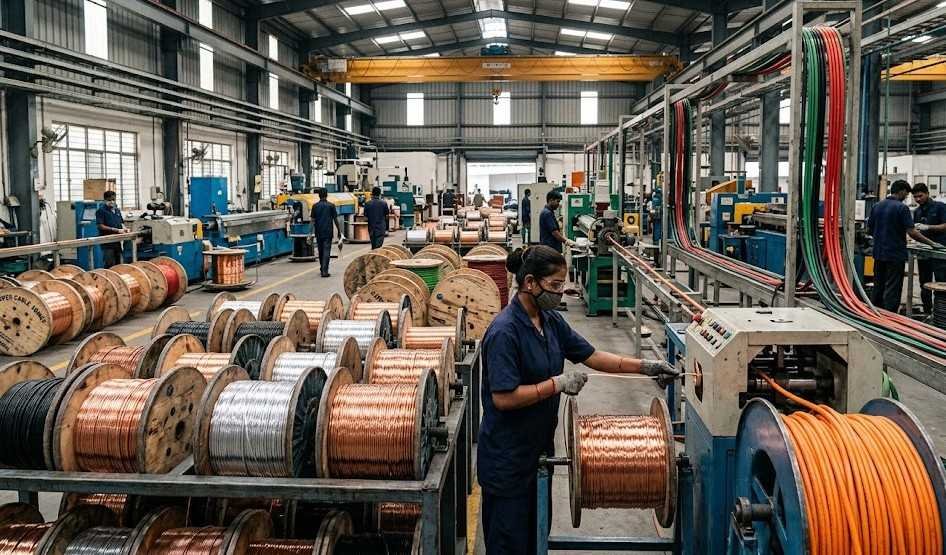
Digital transformation is changing the manufacturing industry, while Indian wire manufacturers use advanced technology to maintain their market position. Traditional production methods fail to meet current market needs, which require high-quality cables combined with safety regulations and increasing market competition. Wires manufacturers in India can achieve better operational efficiency and lower expenses while producing superior products through the use of automation, Internet of Things, and data analytics solutions. The new system improves production efficiency and enables companies to fulfill changing customer needs and international industry requirements, which supports their sustainable development in an industrial environment that constantly evolves.
Current Landscape of Wires Makers in India
The market for wires manufacturers in India is expanding rapidly due to base growth, electrification projects, and rising industrial demand. However, many manufacturers still depend on outdated systems, which restrict their ability to grow and operate efficiently. The industry needs to modernize because it faces increasing competition, unpredictable raw material costs, and stringent quality requirements. Wires manufacturers in India need advanced technologies that enable them to produce their products faster while maintaining better quality control and enhanced supply chain tracking capabilities.
- The construction, power, and telecom sectors drive increasing demand for products.
- The domestic market faces intense competition from both local companies and international firms.
- The industry relies on traditional production methods for its manufacturing operations.
- The industry requires more resources to meet its compliance and quality assurance needs.
What is Digital Transformation in Manufacturing?
Digital transformation in manufacturing involves the implementation of contemporary technologies, which include automation, IoT, ERP systems, and data analytics into manufacturing operations. The wires manufacturing sector in India must transition from traditional manufacturing methods, which use manual and semi-automated system,s toward smart manufacturing processes that depend on real-time data. The system uses real-time data to improve productivity while minimizing downtime and allowing better decision-making.
- Process optimization through smart technology implementation
- Systems for continuous monitoring and predictive maintenance
- Digital tool integration throughout all production and operational processes
Why Digital Transformation is Crucial for Wires Manufacturers in India
The existence of digital transformation now presents itself as an essential requirement that Indian wire manufacturers must adopt to achieve business growth and survival. The system enables businesses to deliver better product quality while achieving two goals of operational efficiency and market response time improvement. The digital strategy implementation process works as a solution for businesses that need to meet growing customer demands and worldwide market competition in order to achieve sustainable business operations.
- The system provides two main advantages because it improves operational efficiency while decreasing operational expenses.
- The system enhances product quality through better control of product development processes.
- The system provides businesses with the ability to meet customer needs at a faster pace.
- The system enables businesses to expand their operations while maintaining their ability to compete on a global scale.
Key Digital Transformation Strategies
Wires manufacturers in India need to implement structured digital transformation strategies which should support their business objectives and meet their industry standards for success.
5.1 Smart Manufacturing (Industry 4.0)
Smart manufacturing uses automation together with artificial intelligence and connected systems to establish intelligent production facilities for wire manufacturers operating in India.
The production lines:
- The system uses robotics to achieve precise manufacturing results
- The company achieved better operational performance through efficiency improvements, together with less system downtime.
5.2 Implementation of ERP Systems
ERP systems assist Indian wire manufacturers to merge their entire business operations onto one platform, which increases their operational visibility and system control.
The system offers three main advantages, which include:
- The system enables organizations to manage their data from one central location
- The system allows organizations to handle their inventory and procurement processes more efficiently
- The system provides organizations with better capabilities to plan their financial and operational activities.
5.3 IoT Integration in Production
The Internet of Things system enables Indian wire manufacturers to establish connections between their machines and their operational systems, which enables them to collect data and monitor their equipment performance in real time.
- The implementation of predictive maintenance systems helps organizations decrease their equipment downtime.
- The systems track the operational status of their equipment to determine its actual functioning capabilities.
- The systems track all operational activities, which enables organizations to achieve complete visibility of their business processes.
5.4 Data Analytics for Decision-Making
Data analytics enables wires manufacturers in India to make data-driven decisions by analyzing insights derived from their production and market data.
- The process of demand forecasting and planning
- The process of identifying production inefficiencies
- The process of enhancing product quality
5.5 Digital Supply Chain Management
The digital supply chain system enables Indian wire manufacturers to enhance their logistics operations while decreasing delivery times and achieving better supplier coordination.
- The system enables continuous shipment monitoring.
- The system improves the efficiency of vendor relationships
- The system decreases operational delays in processes.
6. Role of Robotics in Wire Making
Robotics plays a key role in improving productivity for wires makers in India by minimizing manual work and boosting accuracy.
Automation plays a key role in improving productivity for wires manufacturers in India by minimizing manual work and boosting accuracy.
- The production process achieves faster completion times
- The production process experiences fewer human mistakes
- The production process delivers uniform product standards throughout.
7. Enhancing Quality Control through Digital Tools
The digital tools that manufacturers use for wire production in India help them achieve superior quality results through their advanced inspection and monitoring systems.
- The system uses AI technology for defect detection
- The system performs quality checks in real time
- The system meets all requirements specified in industry standards.
8. Cybersecurity Considerations in Digital Transformation
The implementation of digital technologies by Indian wire manufacturers requires cybersecurity solutions to protect their confidential information and operational systems.
- The following three elements protect against cyber attacks.
- The organization maintains secure protocols for handling data.
- The organization protects its industrial control systems from unauthorized access threats.
9. Challenges Faced by Wires Manufacturers in India
Digital transformation presents advantages for wires manufacturers in India, yet they encounter multiple challenges that hinder their digital transformation efforts.
- The process of implementing the system requires substantial financial resources.
- Employees show strong opposition to any proposed organizational changes.
- The organization lacks sufficient technical knowledge to operate its systems.
- The current systems have compatibility problems that prevent their seamless operation.
10. Solutions to Overcome Digital Transformation Challenges
Successful digital strategy execution requires wire manufacturers in India to follow a step-by-step method that requires them to execute their plans according to a well-structured timetable.
- The organization needs to allocate resources toward two major areas, which include employee development through training programs and skills enhancement initiatives.
- The organization needs to establish partnerships with technology vendors.
- The organization should begin its operations through initial projects that follow a limited scope.
- The organization should utilize government programs and financial support to achieve its objectives.
11. Case Examples of Successful Digital Adoption
Many wire manufacturers in India have already embraced digital transformation because they want to achieve greater operational efficiency and better competitive performance.
- Businesses need to implement their operations using ERP systems, which help manage their resources more efficiently.
- Companies should use automation systems that help them boost their manufacturing output.
- Companies need to implement IoT technology, which enables them to perform predictive maintenance activities.
12. Upcoming Trends in the Indian Wire Making Industry
The future of wires manufacturers in India lies in continuous innovation and the adoption of advanced methods.
- AI-driven manufacturing processes are expanding.
- Sustainable production methods achieve energy-efficient results.
- Smart factories are being developed
- Organizations are increasingly implementing digital ecosystem solutions
Conclusion
Digital transformation helps wire manufacturers in India to enhance their operational performance, product quality, and ability to compete. The implementation of automation, IoT, and data analytics technologies enables manufacturers to address industry obstacles while meeting changing market requirements. The wire manufacturing industry needs to implement digital transformation methods in order to build international competitiveness and sustainable success.
FAQs
1. What is digital transformation in wires making?
In the area of digital strategy, new-age technologies have been connected, like IoT, automation, and data analytics, to elevate efficiency, quality, and productivity.
2. Why is digital transformation important for wires manufacturers in India?
The system enables manufacturers to maintain their market position. While decreasing expenses and enhancing product standards and satisfying current customer requirements.
3. What technologies are usually used in digital transformation?
The digital transformation method uses IoT technologies, AI systems, ERP software, automation outcomes, and data analytics tools.
4. What are the biggest challenges in digital transformation for makers?
Makers face substantial challenges because they need to spend large amounts of money, and they cannot find qualified workers and employees, who resist learning new technologies.
5. How can small wires manufacturers in India start digital transformation?
The process begins with basic automation through ERP system implementation and employee training, while companies expand their digital transformation efforts
Tags : wires manufacturers in India