Developing New, Practical and accessible Consumer electronics product design.
By Avantari 13-09-2025 43
Consumer electronics product design is vital in the accelerated technological usage of technology as far as people are concerned in the fast paced technological world of the present. Besides the functional requirements, a well-designed consumer electronics, such as smartphones, smartwearables, home automation systems, and smart appliances, enhance the user experiences and aesthetics as well as brand perception. Understanding the basics and recent trend in the design of consumer electronics products is more important than ever before as companies endeavor to manufacture products that are smarter, easier to operate, and efficient.
Some of the key areas of consumer electronics product design explored are the design process, challenges, trends, user experience, and sustainability issues, as discussed in this article. It also presents the details on how design thinking can lead to innovative solutions that are customer-satisfying and work perfectly well.
Consumer Electronics Product Design: What?
Consumer electronics product design is the process of developing, designing, and enhancing electronic products that are used by individuals in their everyday life. It encompasses branding, positioning in the market, and the actual design, user interface (UI), materials, durability and cost-effectiveness. The aim is to come up with products, which are not only problem-solving but also beautiful, easy to use, and low cost.
It is a multidisciplinary engineering design that involves electrical engineering, industrial design, software development, ergonomics, and even psychology. The consumer electronics product design process has become increasingly challenging due to the rise of such technologies as artificial intelligence (AI), the Internet of Things (IoT), and machine learning.
The two key elements of the consumer electronics product design are User Interface (UI)
User Experience (UX).
The interaction between the user and the product determines the success of the product. In designing a consumer electronics product, it is very important to have a detailed knowledge of the needs, expectations, and behaviours of the target market. As an example, wearable devices must be comfortable and lightweight, and cell phones must be easy to navigate and get to important functions.
Form factor and ergonomics
Products should also fit in a life of its users. Ergonomic devices are safe and comfortable. Whether one is holding a smartphone with one hand or spending hours in wearing headphones, the size and shape of the phone, which includes the weight, have to be modified according to the real patterns of usage.
Visual Appeal
Customers like products that are beautifully designed. The perceived value of a product is determined by the exterior design, materials, colour scheme as well as finishes. In order to make something desired, businesses often invest in expensive finishes or smooth lines.
Performance and Usability
A poorly designed product is also worth very little. Energy efficiency, sturdiness of materials, reliable connectivity and processors largely contribute to customer long-term satisfaction and product reliability.
Compliance and Safety
Consumer electronics must satisfy safety and regulatory requirements. This deals with battery safety and electromagnetic compatibility, as well as the environmental regulations such as RoHS (Restriction of Hazardous Substances).
Sustainability
The issue of sustainability is among the leading factors in product design because of the increasing environmental concerns. Designers should consider longer product life, energy-saving, recycles, environmentally friendly packs, etc.
Challenges in Consumer Electronics Product Design
Rapid Technological Advancements
The high rate of innovation requires designers to continuously adapt to the new technologies and balance usability and cost.
Maintaining Quality and Cost.
Customers also expect high-quality performance to be used at affordable prices. Designers are required to ensure that they use the maximum methods as well as materials without compromising on quality.
Hardware and Software Combinations.
In modern electronics, the collaboration of hardware engineers and software developers is to be seamless, which can often pose challenging problems in integration.
Security Issues
With the spread of smart devices, user protection and the preservation of cybersecurity have become one of the priorities in product development
International Competition.
Designers have to consider global market pricing expectations, regulation frameworks, and cultural preferences.
Consumer Electronics Product Design Trends.
AI-Powered Equipment
The integration of AI is making devices more flexible and intelligent, whether it is voice assistants, or automation in the home.
Wearables and Health Technology As wearables, sleep monitors, and other health-related products become increasingly popular, it is forcing designers to create compact, skin-safe, and data-driven products.
Eco-Friendly Materials
It is an emerging trend that product lines are incorporating recycled metals, biodegradable packaging and environmentally-friendly plastics.
Minimalist and modular designs.
Clean interfaces, reduced buttons, and modular components that can be upgraded or replaced are also better users and increase product life.
Internet of Things Connectivity.
Interconnected devices require innovative designs that consider compatibility and scalability so that the devices can work in unison in homes, workplaces, or cities.
Design Process: Research and Ideation 2-Concept to Market.
Designers start with the focus groups, surveys and analyzing competitors to identify gaps in the market and pinpoint the consumer pain points.
Making prototypes
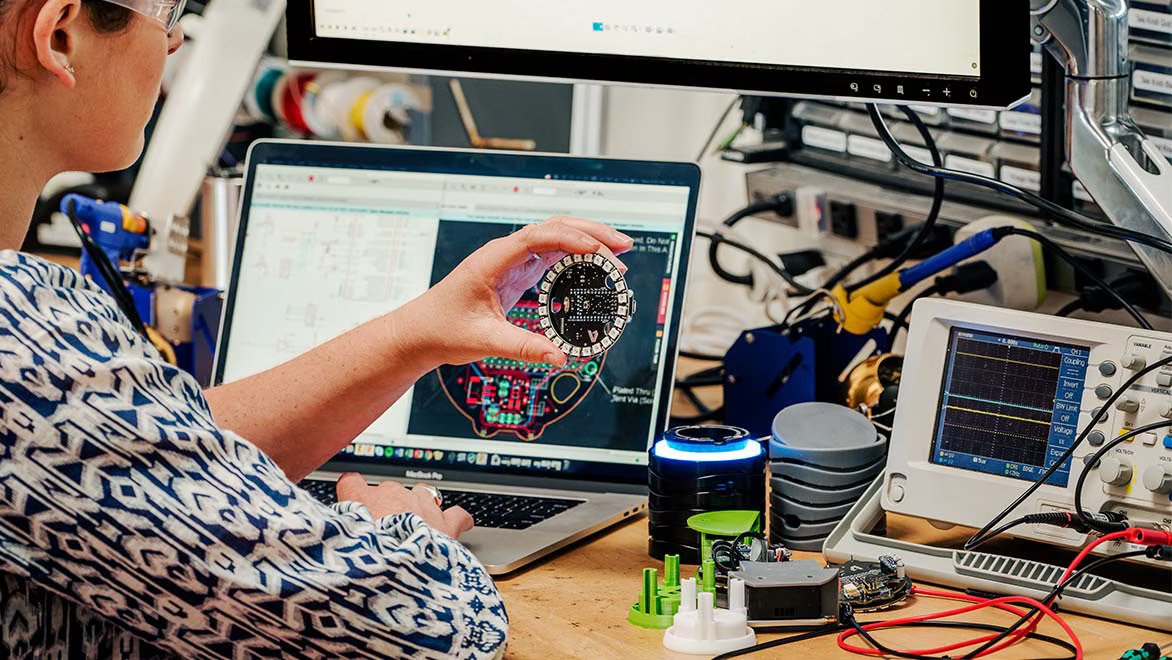
Early prototyping is done by 3D printing and CAD modelling as a result of testing form, functionality, and usability.
Testing by Users
User feedback helps in improvement of design, correction of usability and validation of the product.
During the conversion of the engineering and manufacturing designs into models that can be produced, cost, scalability and compliance are all considered.
Launch and Post-Launch support.
Consumer electronics require firmware upgrades, customer service, and continuous service even after they have been launched as a way of enhancing brand trust.
Consumer Electronics Product Design in Future.
The design of consumer electronics products will change in response to the development of technology, where AI-based personalisation, voice interfaces, advanced sensors, and sustainability efforts will all have an impact. It will be further reshaped by virtual reality (VR), augmented reality (AR), and innovation in materials such as wearables and bendable screens.
The modular designs will allow the users to upgrade or repair devices without fully getting rid of them, and personalisation with adaptive algorithms will lead to more products that are cognizant of user preferences. Industrial designers, data scientists and software developers will also collaborate more closely in the future to create cohesion and immersion.
Frequently asked questions in Product Design Consumer Electronics.
Q1. What are the skills needed to design consumer electronics products?
The designer of products should also have diverse skills including materials science, market research, industrial design, electrical engineering, and user experience (UX) design. Creativity and problem-solving skills are equally important as well as communication.
Q2. What impact will AI have on consumer electronic product designs?
AI will lead to the creation of smarter devices capable of automating, making personalized suggestions and learning the user behaviour. It will also assist designers in optimising user interfaces, energy consumption and performance.
Q3. What is the role of product design in ensuring sustainability?
Sustainability ensures that products are eco-friendly by recycling material, designing energy-efficient products and reducing waste production. It is also gradually turning out to be an important aspect of not only regulatory compliance but also customer loyalty.
Q4. What is the way to make a product well-design to enhance client satisfaction?
An effective product will ensure the comfort, provide easy controls, enhance usability, and provide reliable performance. By reducing frustration and enhancing a positive user experience, it is known to increase user satisfaction and brand trust.
Q5. What are the common product design mistakes?
Examples of typical mistakes include neglect of the user input to design, placing aesthetics over functionality, omitting of testing, and omission of environmental impacts. Hasty development cycles and financial constraints can also lead to compromise designs.
Q6. Are small industries able to adopt the design of consumer electronics product?
Indeed. With cloud collaboration tools and CAD software, as well as prototyping tools, small businesses can conduct their research, test their ideas and develop their creative designs without spending much money in case they have these tools.
In conclusion
Both the user satisfaction and technological innovation revolve around the design of consumer electronics products. Awareness of the user needs, integration of the latest technologies, and solutions that are sustainable, ergonomically and aesthetically pleasing are more significant than merely developing useful devices. By focusing on the users experience, performance, and ethical design, businesses are able to manufacture goods that do not only meet the needs of the present, but also steer the direction of consumer electronics.
Designers, engineers and innovators taking a holistic product development approach will develop more intelligent, efficient and consumer responsive devices that meet the evolving demands of consumers the world over. Technology will further enable success in consumer electronics to be pegged on cautious and user-oriented design.