Denim Tears jeans are more than a fashion statement; they are a narrative stitched into denim, carrying memory, resistance, and identity with every seam. To wear a pair of Denim Tears jeans is to step into a story that stretches far beyond personal style. It is to engage with history—not as something distant and abstract, but as something lived, felt, and carried forward.
Created under the vision of Tremaine Emory, Denim Tears emerged as a response to absence: the absence of honest historical representation in mainstream fashion and the absence of respect for the cultural roots that so often inspire it. Denim Tears jeans stand at this intersection, reclaiming denim as both a symbol of labor and a medium of truth. Denim, once worn by workers, farmers, and enslaved people, becomes a canvas for remembrance.
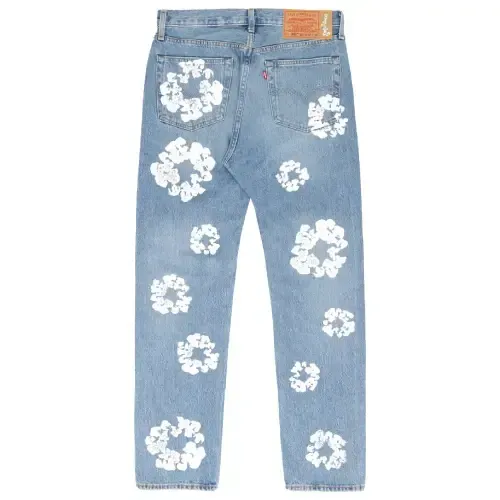
What immediately distinguishes Denim Tears jeans is their symbolism. The recurring cotton imagery, often printed or embroidered across the denim, is both striking and unsettling. Cotton is soft, light, and ordinary—but its history is heavy. It represents centuries of forced labor, suffering, and exploitation that built global wealth. By placing cotton motifs on jeans, Denim Tears forces the wearer and the viewer to confront that contradiction. The jeans become a quiet but powerful reminder that comfort and cruelty once existed side by side.
Yet these jeans are not designed to shock for shock’s sake. Their beauty lies in balance. The cuts are timeless, often relaxed and familiar, echoing classic American denim silhouettes. This familiarity draws people in before the deeper meaning reveals itself. Denim Tears understands that accessibility is power; when clothing feels wearable, its message travels further. The jeans can be styled casually, effortlessly, becoming part of everyday life—just as history is part of everyday life, whether acknowledged or not.
There is also a sense of dignity embedded in Denim Tears jeans. They do not exploit trauma or dramatize pain. Instead, they honor resilience. The designs feel thoughtful and restrained, allowing the symbolism to speak without being overwhelmed by excess. In this way, the jeans resist the fast-fashion cycle of constant novelty. They are meant to last, both physically and culturally.
Denim Tears jeans also challenge the idea that fashion must be detached from responsibility. In an industry often criticized for appropriation, the brand insists on authorship and authenticity. The stories told through these jeans belong to the culture they represent. This authenticity is what gives the garments their emotional weight. They are not inspired by history; they are in conversation with it.
Wearing Denim Tears jeans can feel like an act of participation. You are not just consuming a product—you are acknowledging a narrative. For Black wearers, the jeans may resonate as a reflection of ancestral memory, pride, and survival. For others, they may serve as an entry point into histories that were never fully taught. Either way, the jeans demand awareness. They ask the wearer to stand with the story, not above it.
Another layer of beauty in Denim Tears jeans lies in their refusal to overexplain. There are no long slogans stitched into the fabric telling you what to think. Instead, the designs trust the intelligence and curiosity of the audience. This openness allows the jeans to mean different things to different people while remaining grounded in a clear moral core.
In a world where fashion often prioritizes image over substance, Denim Tears jeans restore meaning. They prove that denim can be both functional and philosophical, stylish and sacred. They remind us that clothes are never just clothes—they are shaped by who made them, who wore them before us, and what they endured.
Ultimately, Denim Tears jeans are beautiful because they remember. They remember the hands that picked cotton, the bodies that labored, and the lives that were reduced to statistics. At the same time, they celebrate survival, creativity, and self-definition. They turn denim into testimony.