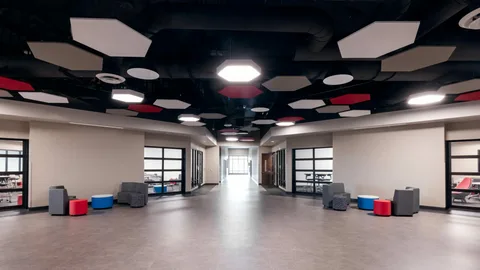
Thinking creatively to lead to innovation is not a luxury anymore, but a need in a world that is experiencing a very fast transformation. All industries are seeking people who are not only able to fix the current issues but also to foresee upcoming challenges and opportunities. This need has led to the emergence of new models of education that no longer involve classroom lectures and memorization. These learning institutions are based on values of practical learning, cross-disciplinary teamwork, and practice. They are constructed to be incubators of innovative ideas and to mold the students into visionary leaders and creators of the future.
A new type of learning environment, the Design and Innovation Academy, is one example of such a pioneering institution. It is a monument of this current-day educational philosophy. It is not only a school, but also a living ecosystem in which creativity is cultivated and innovation is a palpable product. It is an academy where young designers, entrepreneurs, and problem-solvers will be able to train and build their talents, break the rules, and eventually make a significant change in the world. Its strategy lies in the idea that the best solutions can be created in the overlap of a variety of different fields, innovative thinking, and action planning.
A New Blueprint for Education
The uniqueness of a design and innovation academy in relation to traditional universities lies in its basic learning strategy. Learning by doing is the principle on which the curriculum is constructed. Students are not passively receiving information, but rather, they are already involved in project-based work on the first day. This experiential approach is such that the learning of theory is directly processed into practice. Students can do real-world briefs, mostly through collaboration with major corporations and non-profits, which give them invaluable experience and give them a firsthand glimpse into the industries they hope to enter. It is this emphasis on concrete results that makes the portfolio of a student a very rich record of their problem-solving process, with a presentation of not only products but the thinking and process of trial and error that resulted in them.
Moreover, the learning paradigm that is promoted in this academy disintegrates the silos that prevail in the conventional academic contexts. It creates a very interdisciplinary atmosphere in which students with as different backgrounds as engineering, business, social sciences, and arts come together to cooperate. Such intellectual eugenesis is at the core of the academy. It reflects the situation of the present-day workplace, in which innovation never occurs in a vacuum. Students gain a holistic view and a skill to solve intricate, multifaceted problems using a more balanced and efficient set of tools by learning to communicate, to create with others in other disciplines.
Programs Designed for Impact
Services provided in a design and innovation academy are designed in a way that is flexible and must respond to the continuous changes in the world market. The programs do not always follow stringent and fixed routes, but can be more personalized and student-centred in their education process. At the center of the curriculum are studios and workshops centered around human-centered design, systems thinking, rapid prototyping, and strategic foresight. Students are taught how to do deep ethnography to grasp user needs, visualize to see points of interventions, and create and test prototypes, as well as to learn quickly what works and what does not.
The higher level courses may be focused on sustainable design, service design, digital product innovation, and social innovation. An example is that one student might be doing a semester on designing a sustainable packaging system at a major retailer, and another doing a semester on designing a less complicated digital banking system to older users. These are not scholarly projects; these are no holds barred dash-wars to develop workable solutions that have a difference. The professors tend to be in the practice and industry veterans who may provide the current, real world experience into the classroom that is available to them, and they tend to serve as a mentor and partner as opposed to a lecturer. This connection with the work environment renders the curriculum modern and forward-thinking.
The Ripple Effect on Students and Industries
The effects of an institution such as the Design and Innovation Academy are much more than just its physical premises. To the students, the experience is life-changing. They leave with not only a degree, but also with a portfolio, professional network, and an idea of going forward with constant learning and adaptation. They are taught to be resilient through the uncertainty and ineffectiveness of the creative process. They gain confidence in their skills to manage teams and communicate complicated concepts, and make projects happen until their final stages. These are the all-around skills that can put them in high demand among a large variety of employers, including tech startups and major corporations, as well as government agencies and NGOs.
To industries, the academy has been a good source of innovative ideas and new talent. Firms associated with the academy can access a pool of innovative thinkers who can provide new insights on the most outstanding challenges that they encounter. These partnerships may result in the creation of new products, streamlining of the available services, and exploring new markets that have never been attempted before. The academy, in essence, is a laboratory of research and development, based on forcing industries to be creative and adaptable. The academy is contributing towards creating a more creative, resilient, and human-centred economy of the future by graduating graduates prepared to lead change. It is a place where ideas are not only taught, but they are also made to come alive.