The Reactor That Trades Conversion for Control
Ask two process engineers to pick a reactor for the same reaction and you will often get two different answers, because the choice is rarely about chemistry alone. It is about heat, control, and what happens on the third shift when nobody senior is on the floor.
The continuous stirred tank reactor sits at one end of that trade-off. It gives up conversion efficiency compared with a plug flow arrangement, and in exchange it gives you the steadiest temperature control and the simplest operation of any continuous system. For a large class of industrial reactions, that trade is worth making. This is my attempt to explain why, and how to tell when it applies to your process.
How a CSTR Actually Behaves
The defining assumption is perfect mixing. Feed enters continuously, product leaves continuously, and the agitator keeps the vessel contents uniform in composition and temperature throughout. Every point in the tank looks like every other point.
That assumption has one consequence that surprises people the first time they meet it. Because the tank is uniform, the outlet stream has exactly the same composition as the bulk contents. The reaction is therefore running at the outlet concentration everywhere in the vessel, not at the higher inlet concentration. Since reaction rate generally rises with concentration, the whole reactor operates at the lowest rate in the system.
That is the efficiency penalty in a single sentence. For a positive-order reaction at a given conversion, a CSTR needs more volume than a batch reactor or a plug flow reactor doing the same duty.
Feed molecules also do not spend equal time inside. Some short-circuit toward the outlet almost immediately, others linger far longer than average. That broad residence time distribution matters when your product can degrade or over-react on extended exposure, and it is a design consideration rather than a fault.
The Design Equation
The mole balance for a CSTR at steady state reduces to something refreshingly simple, because the accumulation term disappears and the uniform composition means the rate is a single value rather than something you integrate across a gradient.
Volume equals the molar feed rate of the limiting reactant multiplied by the fractional conversion, divided by the rate of reaction evaluated at outlet conditions. No integration. That algebraic simplicity is one reason the CSTR shows up so early in reaction engineering courses and why sizing calculations are quick to sanity-check by hand.
Space time, the reactor volume divided by volumetric feed rate, is the parameter you tune. Raise it and conversion rises. Cut it and throughput rises while conversion falls. The design job is finding the point where the two meet your specification.
Tanks in Series and Recovering the Lost Conversion
There is a practical answer to the conversion penalty: put several CSTRs in series.
Each tank operates at a progressively lower concentration, and the cascade approximates the concentration gradient a plug flow reactor achieves naturally. Three or four tanks in series gets you most of the way toward plug flow performance while keeping the mixing, heat transfer, and control advantages of stirred tanks at every stage.
Total volume across the cascade is usually well below the volume a single CSTR would need for the same conversion. You also gain the ability to run each stage at a different temperature, which is genuinely useful for reactions where selectivity and rate want different conditions.
Where CSTRs Earn Their Keep
Liquid phase reactions dominate the application list. Neutralization, esterification, saponification, nitration, sulfonation, and hydrolysis all suit continuous stirred operation. Polymerization runs in CSTRs where controlling the exotherm matters more than squeezing out the last percentage of conversion. Fermentation and bioprocess work uses the same configuration, often called a chemostat in that context.
Wastewater treatment leans on it heavily, since activated sludge basins are effectively large stirred tanks with continuous feed.
The common thread across all of these is heat. Strongly exothermic reactions are dangerous in configurations where a hot spot can develop and run away. A well-mixed tank has no hot spot by definition, and the jacket area is available continuously for heat removal rather than intermittently. Anyone specifying a continuous stirred tank reactor for exothermic duty is usually buying that thermal stability first and treating volume efficiency as secondary.
Mixing, Jackets, and Why Glass Construction Suits This Duty
The agitator is doing more work than it appears. It has to homogenize composition, keep any solids suspended, disperse a second phase if the reaction is two-phase, and move liquid across the heat transfer surface fast enough that the jacket actually does its job. A poorly specified impeller undermines every assumption the design equation rests on.
Baffles matter more than people expect. Without them, an unbaffled tank develops a rotating vortex where the liquid turns with the impeller rather than being turned over by it, which destroys the mixing the whole design depends on.
The jacket handles heating and cooling through steam, chilled water, or a thermic fluid circuit, depending on the temperature range.
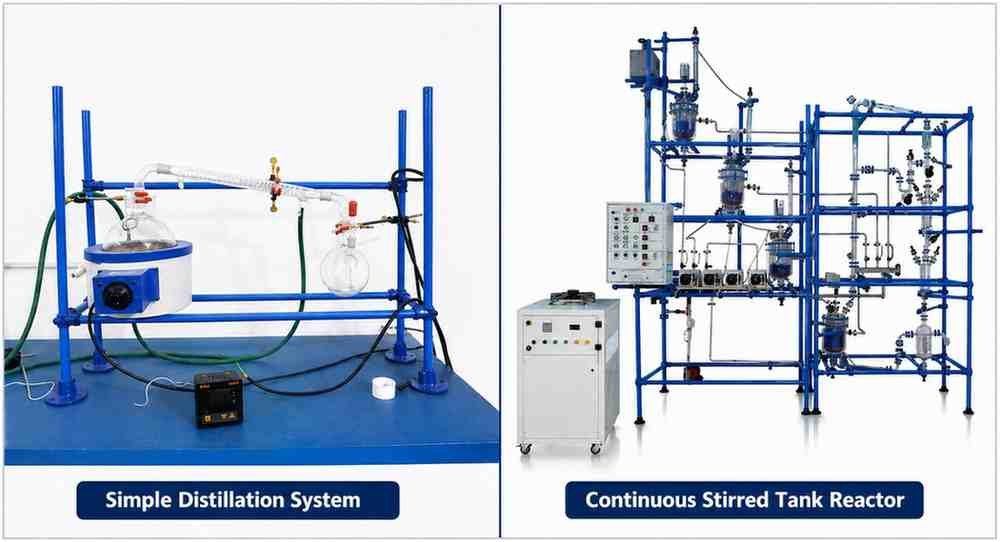
Borosilicate glass 3.3 construction brings advantages that are specific to reactor duty. Corrosion resistance covers nearly all acids and organic media, which matters when your reaction mass is aggressive and a metallurgy change would cost a fortune. Low thermal expansion handles the jacket temperature swings. Glass does not contribute metal ions to the reaction mass, which protects catalyst systems that are poisoned by trace metals and protects product purity where trace metal limits are specified.
And the operator can see the reaction. Mixing pattern, phase separation, color change, solids suspension, and foaming are all directly visible. In an opaque vessel every one of those is an inference drawn from instrumentation.
Startup, Steady State, and Control
A CSTR does not reach steady state instantly. Conditions approach their final values asymptotically, and a common rule of thumb is that three to five residence times pass before the outlet composition settles. During that window the product does not meet specification, so startup material usually goes to recycle or to a holding tank rather than to finished storage. Plan for it in the operating procedure rather than discovering it in commissioning.
Once at steady state, control is straightforward, which is the real operational payoff. Temperature is controlled through the jacket, level through the outlet, and composition through feed ratio and space time. Those loops are stable and well understood, and none of them requires the operator to anticipate a moving target the way a batch profile does.
Frequently Asked Questions
When should I choose a CSTR over a batch reactor?
When production volume is high enough to justify continuous operation and the product mix is stable. Batch still wins for small volumes, frequent product changeovers, and reactions needing long hold times.
Why does a CSTR need more volume than a plug flow reactor?
Because the entire vessel operates at the low outlet concentration, so the reaction rate is at its minimum throughout. A PFR runs across the full concentration gradient and averages a higher rate.
How many tanks in series are worth using?
Three to four captures most of the benefit for typical kinetics. Beyond that, added conversion per extra vessel falls off while capital and footprint keep rising.
Can a CSTR handle solid-containing reaction mixtures?
Yes, provided the impeller is specified to keep solids suspended and the outlet is arranged to avoid settling and blockage. Both need attention at the design stage.
Is glass suitable for pressurized reactions?
Glass reactors have pressure limits well below metal vessels and are normally specified for atmospheric or modest vacuum service. For elevated pressure, glass-lined steel is the usual route.