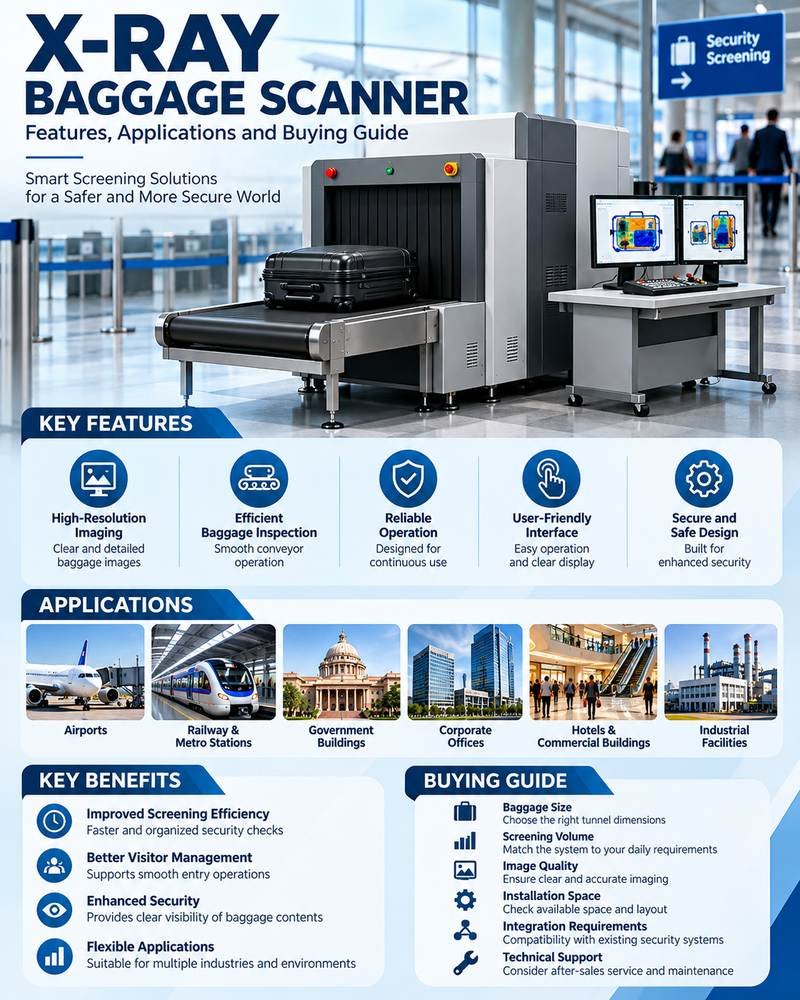
Security screening has become an important part of modern transportation, commercial buildings, government facilities, and other high-security environments. An X-Ray Baggage Scanner provides security teams with an efficient way to inspect luggage, bags, parcels, and other items without opening them manually.
What Is an X-Ray Baggage Scanner?
An X-Ray Baggage Scanner is a security inspection system that uses X-ray technology to generate images of objects inside baggage. Operators can examine the displayed images and identify items that may require further inspection.
These systems are commonly used where large numbers of bags need to be screened efficiently while maintaining an organized security process.
How Does an X-Ray Baggage Scanner Work?
The baggage is placed on the scanner's conveyor system and passes through an X-ray inspection tunnel. The system generates an image of the contents, which is displayed on an operator monitor.
Security personnel can review the image and determine whether additional inspection is required. This approach helps facilities manage screening operations more efficiently than relying entirely on manual baggage checks.
Key Features
When selecting an X-Ray Baggage Scanner, organizations should consider features such as:
- High-quality X-ray imaging
- Clear image display
- Efficient conveyor operation
- Reliable continuous performance
- User-friendly operator controls
- Appropriate tunnel dimensions
- Safety-focused design
- Easy integration with existing security procedures
The right configuration depends on the type and volume of baggage being screened and the environment where the equipment will be installed.
Applications of X-Ray Baggage Scanners
X-ray baggage screening systems can be used across a variety of locations, including:
Airports
Airports handle large volumes of passenger luggage and require organized security screening systems to support efficient passenger movement.
Railway and Metro Stations
Railway and metro facilities can use baggage scanners to inspect bags at controlled entry points and improve security operations.
Government Buildings
Government offices and sensitive facilities can deploy scanning equipment as part of their visitor and security screening processes.
Corporate Offices
Large corporate campuses may use baggage screening at reception areas, controlled entrances, and high-security zones.
Hotels and Commercial Buildings
Hotels, shopping malls, and other commercial properties can use X-ray screening systems to strengthen security at selected entry points.
Industrial Facilities
Factories, warehouses, and industrial sites may require baggage inspection to support their overall access-control and security procedures.
Benefits of X-Ray Baggage Screening
An effective Baggage Scanner can provide several operational benefits:
Improved Screening Efficiency:
Security personnel can inspect baggage through an X-ray image without opening every item.
Faster Entry Management:
Efficient screening can help reduce unnecessary delays at controlled access points.
Better Visibility:
X-ray imaging provides operators with a view of baggage contents that may not be possible through external inspection alone.
Flexible Applications:
Different scanner configurations can be selected according to baggage size, throughput requirements, and installation conditions.
Enhanced Security Operations:
Baggage screening can become an important component of a broader security and access-control strategy.
What to Consider Before Buying?
Before purchasing an X-ray baggage screening system, organizations should evaluate several factors.
1. Baggage Size
Consider the maximum dimensions and types of bags that will pass through the scanner.
2. Screening Volume
Facilities with high visitor or passenger volumes should select equipment capable of supporting their expected operational requirements.
3. Image Quality
Clear and useful imaging is important for effective operator inspection.
4. Installation Space
Measure the available installation area, including conveyor access and operator workspace.
5. Integration Requirements
Consider whether the scanner needs to work alongside other security technologies and existing screening procedures.
6. Technical Support
After-sales service, installation assistance, maintenance, and operator support are important for long-term equipment performance.
Choosing a Baggage Scanner Manufacturer
Selecting an experienced Baggage Scanner Manufacturer can simplify equipment selection, installation, training, and ongoing technical support.
Organizations should evaluate the manufacturer's product specifications, customization capabilities, installation support, maintenance services, warranty terms, and experience with similar security applications.
Houston Systems provides security and access-control solutions for organizations requiring dependable screening and security infrastructure. The appropriate baggage scanning configuration can be selected according to the facility's operational requirements.
Conclusion
An X-Ray Baggage Scanner can play an important role in modern security screening by helping operators inspect luggage and parcels efficiently. From airports and railway stations to corporate offices, hotels, government facilities, and industrial sites, these systems can support organized and reliable security operations.
Before choosing a system, businesses should consider baggage dimensions, screening volume, image quality, installation requirements, integration needs, and after-sales support. Selecting the right Baggage Scanner Manufacturer can help ensure that the equipment matches the facility's long-term security requirements.