Why Salesforce Development Services Are Essential for Managing Complex Business Workflows
By DreamSoft4u Private Limited 05-02-2026 430
Modern organizations operate in an environment where customer data, sales processes, service operations, and analytics are deeply interconnected. As businesses grow, workflows become more layered, approvals multiply, and integrations expand across platforms. In such scenarios, basic CRM configurations often fail to deliver the flexibility and control required for long-term efficiency.
This is where Salesforce development services play a critical role. Instead of forcing teams to adapt their processes to CRM limitations, these services allow Salesforce to be tailored around real operational workflows—ensuring scalability, automation, and performance at every stage of growth.
What Are Salesforce Development Services?
Salesforce development services involve customizing, extending, and optimizing the Salesforce platform to align with specific business workflows. These services go beyond standard setup and configuration to include custom development, automation, integrations, and scalable architecture design.
They typically include:
Custom Salesforce application development
Workflow and process automation
CRM data modeling and customization
Third-party system integrations
Performance optimization and security enhancements
Why Business Workflows Are Becoming Increasingly Complex
Business workflows today are no longer linear. Instead, they are dynamic systems that involve multiple teams, tools, and decision points.
Common contributors to workflow complexity include:
Cross-department collaboration between sales, service, operations, and finance
Multi-level approval processes
Real-time reporting and analytics requirements
Integration with ERP, marketing automation, payment systems, and data warehouses
Compliance, audit trails, and role-based access control
As these requirements grow, organizations often realize that out-of-the-box CRM features are not sufficient to manage such complexity efficiently.
Limitations of Standard Salesforce Configuration
Salesforce offers powerful native features, but default configurations are designed for general use cases. When workflows become unique or industry-specific, limitations start to appear.
Key challenges include:
Restricted automation logic for advanced business rules
Limited flexibility in user interfaces and page layouts
Reporting constraints for custom metrics
Performance issues when scaling large data volumes
Difficulty integrating deeply with external systems
Without customization, teams often resort to manual workarounds, disconnected tools, or inefficient processes—reducing overall ROI from the CRM platform.
How Salesforce Development Services Address Workflow Complexity
Salesforce development services transform Salesforce from a generic CRM into a fully customized business platform. By leveraging custom development and platform extensibility, organizations can design workflows that reflect how they actually operate.
Core capabilities include:
Custom objects, fields, and relationships
Advanced automation using Salesforce Flow and Apex
Custom Lightning components for improved usability
Tailored dashboards and reports
Scalable data models for long-term growth
These capabilities ensure workflows are automated, consistent, and aligned with operational goals.
The Role of Custom Salesforce Development in Workflow Optimization
Custom Salesforce development enables businesses to:
Replace manual processes with automation
Reduce errors through validation rules and logic
Improve productivity with intuitive user experiences
Adapt quickly to changing operational requirements
By implementing custom Salesforce development, organizations gain full control over how data flows across departments, how approvals are handled, and how insights are generated.
Salesforce Application Development Services and System Integration
Modern workflows rarely exist in isolation. CRM systems must communicate seamlessly with other enterprise platforms.
Salesforce application development services support:
ERP and accounting system integrations
Marketing automation tool connectivity
Customer support platforms
Payment gateways and invoicing systems
Legacy system modernization
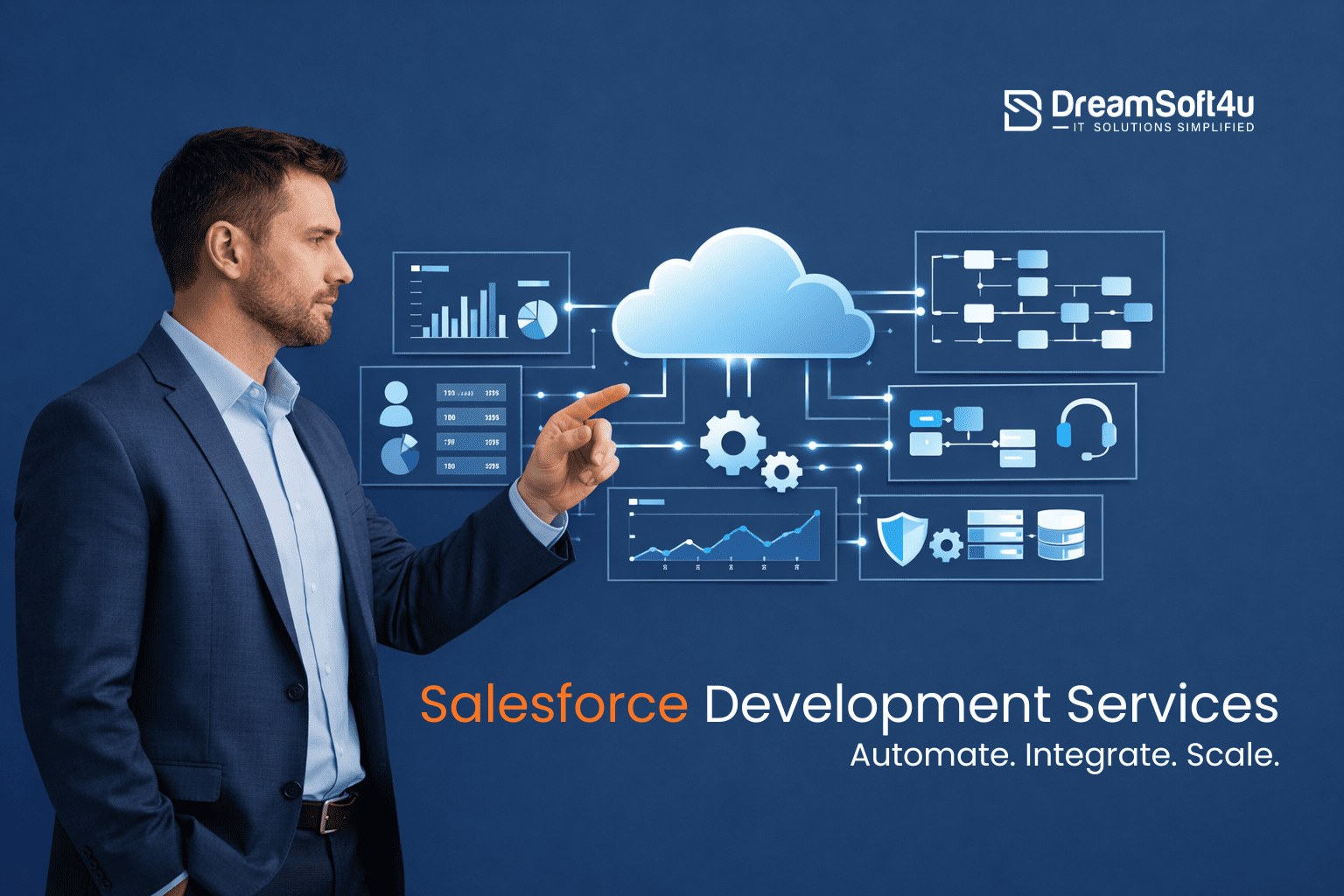
Through APIs, middleware, and event-driven architecture, Salesforce becomes a central operational hub rather than a standalone system.
Salesforce Development Services Across the Development Lifecycle
A structured Salesforce development lifecycle ensures that custom solutions are scalable, secure, and aligned with business goals.
Typical lifecycle stages include:
Requirement Analysis – Understanding workflows, pain points, and objectives
Solution Architecture – Designing scalable and secure CRM structures
Custom Development – Building automation, integrations, and UI components
Testing & Quality Assurance – Ensuring performance, security, and reliability
Deployment & Optimization – Rolling out solutions and refining based on usage
Following this lifecycle minimizes risk and ensures long-term maintainability.
Why Partnering With the Right Salesforce Development Company Matters
The success of Salesforce customization depends not only on the platform but also on the capability behind its implementation. A reliable Salesforce development company brings technical depth, process understanding, and long-term vision to the table.
Companies like DreamSoft4u deliver Salesforce development services with a focus on scalable architecture, secure integrations, and workflow optimization—ensuring Salesforce evolves alongside organizational growth.
Not all implementations are equal. The success of Salesforce customization heavily depends on the capability of the implementation partner.
A reliable Salesforce development company offers:
Certified Salesforce developers and architects
Proven capability in handling complex business workflows
Best practices for scalability and performance
Secure development aligned with compliance standards
Ongoing support and optimization services
Choosing the right partner reduces implementation risk and accelerates time-to-value.
Real-World Use Cases for Salesforce Development Services
1. Sales Process Automation
Automated lead routing and assignment
Custom approval flows for discounts and contracts
Pipeline forecasting with advanced analytics
2. Service Operations Optimization
Intelligent case routing
SLA tracking and escalation workflows
Unified customer interaction history
3. Reporting and Analytics
Custom dashboards for leadership
Real-time performance tracking
Data-driven decision support
4. Enterprise Integrations
ERP synchronization
Billing and invoicing automation
Third-party application connectivity
Benefits of Salesforce Development Services for Growing Organizations
Organizations that invest in Salesforce development services experience:
Higher operational efficiency
Reduced dependency on manual processes
Improved data accuracy and visibility
Better scalability as business requirements evolve
Increased return on CRM investment
Instead of adapting workflows to software limitations, Salesforce adapts to the business.
Salesforce Development Services and Future-Ready Architecture
As organizations adopt AI-driven insights, predictive analytics, and automation, Salesforce customization becomes even more valuable.
Custom development prepares the platform for:
AI-powered workflows
Intelligent recommendations
Advanced analytics and forecasting
Continuous innovation without re-platforming
This future-ready approach ensures Salesforce remains a long-term strategic asset.
Frequently Asked Questions
What are Salesforce development services used for?
Salesforce development services are used to customize CRM workflows, automate processes, integrate third-party systems, and build scalable Salesforce applications tailored to business needs.
How are Salesforce development services different from configuration?
Configuration uses standard features, while development involves custom code, automation logic, integrations, and advanced customization for complex workflows.
When should organizations invest in Salesforce development services?
Organizations should invest when standard CRM features no longer support workflow complexity, scalability requirements, or integration needs.
Do Salesforce development services support scalability?
Yes. Custom development ensures Salesforce can scale with data volume, users, and evolving business processes.
Conclusion
This is where Salesforce development services play a critical role. Instead of forcing teams to adapt their processes to CRM limitations, these services allow Salesforce to be tailored around real operational workflows—ensuring scalability, automation, and performance at every stage of growth.
Skilled Salesforce partners like DreamSoft4u focus on aligning CRM capabilities with real-world business processes, helping organizations unlock the full potential of Salesforce through strategic customization and integration.
Tags : Salesforce development services Salesforce development company Salesforce application development services Salesforce app development Salesforce application development custom Salesforce development Salesforce CRM development services Salesforce development lifecycle Salesforce Consulting Partner