Railway construction and road construction share a lot of surface-level similarities - both involve earthworks, embankments, and drainage planning. But engineers who've worked on both will tell you the failure modes are genuinely different, and treating railway embankment design as a variation on road design is a mistake that shows up years later in track geometry problems.
India's railway network has been expanding aggressively, with dedicated freight corridors, high-speed rail projects, and doubling of existing lines all running in parallel. That expansion has put a spotlight on embankment engineering practices that, in some cases, hadn't been seriously revisited in decades.
The Load Difference Nobody Talks About Enough
Road embankments deal with distributed, relatively light traffic loads spread across a wide surface. Railway embankments deal with concentrated, cyclical, and much heavier loading through the rail-sleeper-ballast system, repeated thousands of times per day on busy corridors.
This difference matters more than it might seem. Repeated heavy loading causes progressive settlement in ways that lighter, more distributed road traffic doesn't replicate. An embankment that would perform adequately under road traffic loads can develop measurable settlement issues under railway loading within a much shorter timeframe if the subgrade wasn't engineered with that specific loading pattern in mind.
Track geometry tolerances are also far tighter than road surface tolerances. A road can absorb a few centimeters of settlement without much operational impact. The same settlement under a rail line affects train speed limits, ride quality, and in more serious cases, safety margins, which is why railway embankment specifications tend to be more conservative than comparable road specifications.
Why Settlement Shows Up as a Maintenance Nightmare
Uneven settlement along a rail line doesn't fail catastrophically most of the time. Instead, it creates a slow, ongoing maintenance burden - track sections that need more frequent tamping and realignment, speed restrictions imposed on sections with geometry issues, and a steady drain on maintenance budgets that could have been avoided with better initial ground engineering.
Railway maintenance teams often develop detailed knowledge of exactly which stretches of a line need repeat attention, because settlement patterns tend to be consistent once they start. A stretch built over poorly compacted fill or unstable native soil will keep needing correction long after construction is technically complete, sometimes for the entire operational life of that section.
This pattern has pushed railway engineering departments to invest more heavily in geotechnical investigation during the design phase for new lines and doublings, rather than accepting the ongoing maintenance cost as simply a normal part of railway operations.
Water Management Around Rail Formations
Water is arguably the single biggest threat to railway embankment stability. Poor drainage around a rail formation saturates the subgrade, reduces its bearing capacity, and accelerates the same kind of progressive settlement that heavy cyclical loading causes on its own - the two problems compound each other.
Traditional railway drainage relies heavily on side drains and cross-drainage structures like culverts, but these can struggle to keep pace on longer embankment stretches, particularly through low-lying terrain where natural gradient doesn't assist water movement away from the formation.
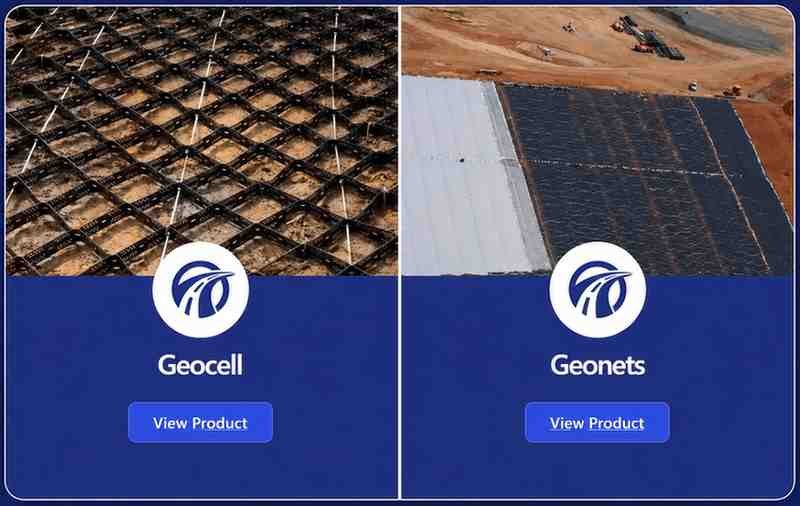
This has led more railway projects to incorporate subsurface drainage solutions directly into embankment design rather than relying purely on surface drainage. Formation designs for weaker subgrade sections increasingly specify geonets as part of the drainage blanket beneath ballast layers, giving water infiltrating from above a defined path away from the formation rather than allowing it to saturate the subgrade directly beneath the track.
Confinement Approaches for Weak Formation Soil
Where railway alignments pass through weak or expansive soil that can't be easily replaced due to cost or logistical constraints, confinement-based ground improvement has become a more common specification, similar to trends seen in road construction over the past decade but adapted for railway loading requirements.
Some formation designs for weak-soil stretches have started incorporating geocell road construction principles adapted for railway formations, using cellular confinement to distribute the concentrated cyclical loads from rail traffic more evenly across weaker subgrade layers, reducing the depth of soil replacement that would otherwise be required on difficult alignments.
Why New Dedicated Freight Corridors Take Ground Engineering More Seriously
India's dedicated freight corridor projects have generally applied more rigorous geotechnical standards than older conventional lines, partly because these corridors are designed for heavier axle loads and partly because the scale of investment justifies more thorough upfront investigation.
Engineers working on these newer corridors have had the opportunity to apply lessons learned from decades of maintenance data on the existing network, identifying which ground conditions historically caused the most settlement-related maintenance and designing more conservatively for similar conditions on new alignments.
This represents a shift from a design philosophy that treated ground engineering as a cost center to be minimized, toward one that treats it as a long-term investment that reduces total lifecycle cost through lower maintenance requirements.
The Long-Term View Railway Engineering Requires
Railway infrastructure is generally expected to perform for many decades, often exceeding the design life of road infrastructure built at the same time. This longer time horizon changes the economics of upfront ground investment in ways that aren't always intuitive to people used to shorter-lifecycle construction projects.
A railway embankment that costs more to build properly, but requires minimal settlement-related maintenance over fifty years, will almost always outperform economically compared to one built more cheaply but requiring repeated track realignment throughout its operational life. That calculation increasingly informs how railway engineering departments approach new construction and major upgrades.
What This Means for India's Rail Expansion
As India continues expanding both passenger and freight rail capacity, the embankment and formation engineering decisions made now will determine maintenance costs and operational reliability for generations of trains that haven't been built yet. Getting ground engineering right the first time remains far more cost-effective than the alternative of managing chronic settlement issues on a line that's already carrying traffic.
The engineering community working on India's rail expansion increasingly recognizes this, even as the pressure to deliver projects quickly continues to test how much upfront investment in ground preparation actually gets built into new corridors.
Tags : geocell road construction geonets