Introduction
IBM Lotus Notes is presently the most popular medium used by many businesses and individual users for emails, contacts, calendars, and other essential data. Lotus Notes has served as a great platform for a long time, but now many users have opted for better and more flexible email systems, such as Outlook, Thunderbird, Apple Mail, etc. Now, one major issue occurs during this migration-how to migrate the data from NSF files safely. This is when an NSF Converter comes into play. It allows users to migrate their data smoothly without loss or complexity.
What Are NSF Files?
An acronym for Notes Storage Facility. It is the main database file format for IBM Lotus Notes. All user data is stored in NSF files such as emails, attachments, contacts, calendars, tasks, and journals. The only way to open and access these files is by using Lotus Notes, this makes data access difficult if the application is no longer used or supported. Because NSF files are platform dependent, users often run into problems when attempting to open them in other email applications.
Reasons for Migration from Lotus Notes
Some reasons for which users and companies are choosing to migrate from Lotus Notes are
- Increased costs of maintenance: Dedicated servers with trained administrators are required to run Lotus Notes.
- Complex interface: While many of the users are not able to use it as easily as modern email platforms.
- No compatibility: NSF files cannot be opened in the very widely used email clients like Outlook.
- Moving to the cloud: Businesses are now moving towards Office 365 and Gmail.
- End of support concerns: As time passes, upgrades and support for older systems become increasingly limited.
These are reasons that made migration from Lotus Notes more common than ever before.
Modes of Migrating NSF and Limitations
There are a number of methods that users opt for in an attempt to convert NSF files, but each method has its own limitations.
Manually
It's possible to migrate data using Lotus Notes features or to set up IMAP configurations for migrating emails.
Cons:
- Time consuming
- Requires technical knowledge
- Very prone to data loss
- Not for large databases
Use Free or Open Source Tools
There are some free tools that are said to migrate NSF files.
Limitations:
- Size of files is limited
- No guarantee of accuracy of data
- No consumer support
- Fails to work on NSFs that have been corrupted
Professional Software
This is the most trusted method that users can migrate using a dedicated tool.
Limitations:
- Paid solution (but worth it for safety and accuracy)
Among these options, professional softwares clearly stand out as the safest and fastest approach.
Importance of an Lotus Notes Converter
Safe Data Migration Assured
The Converter migrates emails and data from Lotus Notes with zero data loss or corruption risk.
Access to NSF Files
NSF files can only be opened from Lotus Notes. It lets the user access data using other popular email clients and formats.
Time and Stress Saving
Manual methods of migration take up a lot of time and are cumbersome. The softwares makes this step easy through automation.
Preservation of Data Integrity
Data integrity in migration means that the original folder structure, email formats, metadata, and attachments are all retained.
Supports Large Databases
Dealing with large and multiple NSF files with a tool is easy as compared to manual methods.
Decreases Technical Complexity
The user does not require advanced technical knowledge to migrate NSF files using the help of a professional converter.
Compatible with Modern Platforms
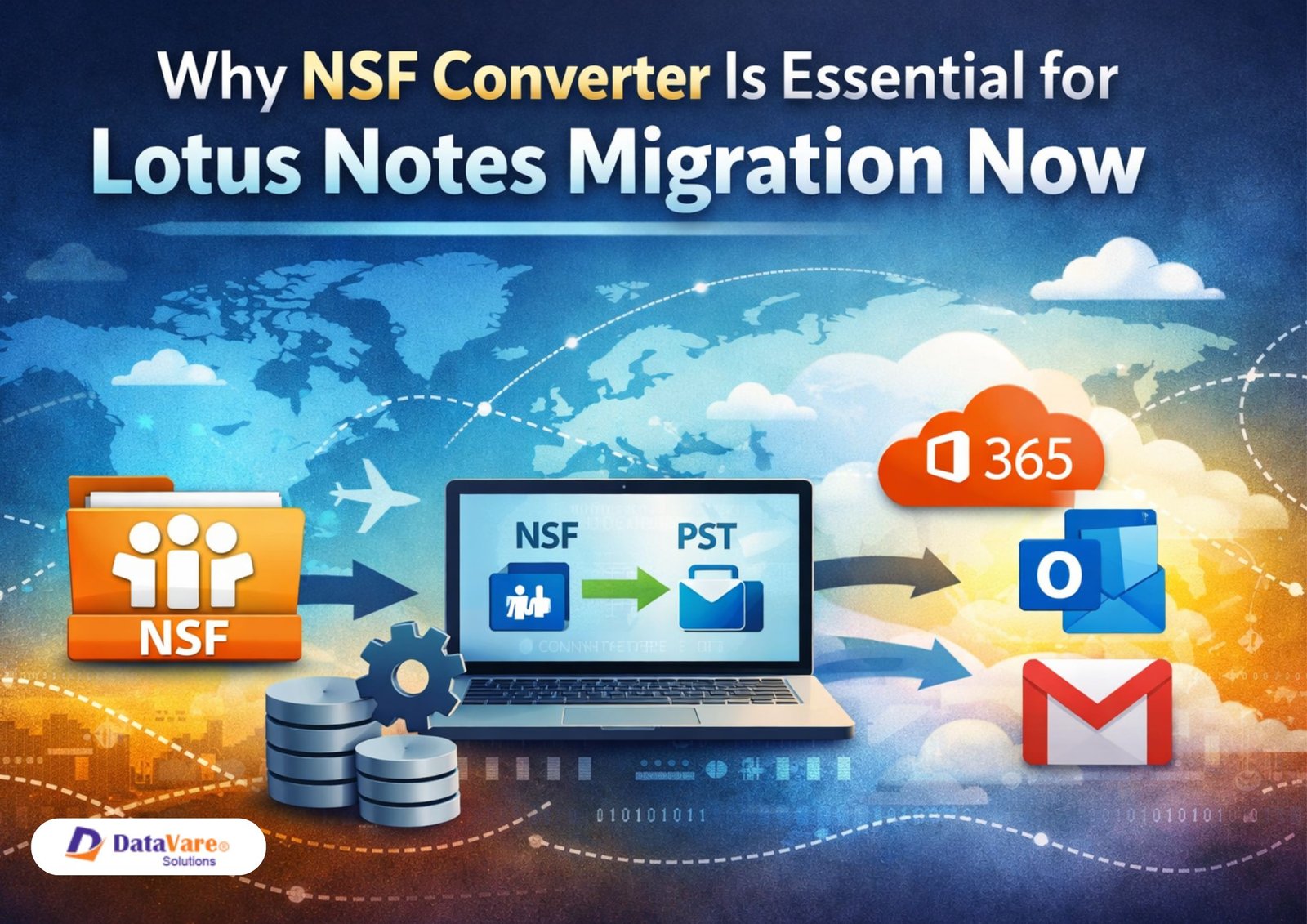
A tool assists in migration to modern platforms like Outlook, Office 365, Gmail, and other email clients.
Minimizes Error Probability
Automated migration minimizes the risk of human errors arising in manual processes.
Cost-Effective in the Longer Run
Though a paid tool, it saves time, resources, and potential expenses of data recovery later.
Best Recommended Solution
DataVare NSF Converter is a trusted provider for safe and efficient migration from Lotus Notes. This software is built for technical and non-technical users. The accurate migration of NSF files is made into many formats like PST, EML, MSG, MBOX, and many more.
Key benefits:
- Simple and user-friendly interface
- Retains original folder structure
- Supports bulk NSF conversions
- Preserves email metadata while keeping attachments intact
- Compatible with all major versions of Windows
- It guarantees a smooth and hassle-free migration process for an individual or business.
Conclusion:
With advancements in technology, it will one day become necessary to migrate away from obsolete technologies like Lotus Notes. However, this does not mean leaving aside the hassles of accessing and migrating NSF files. Manual and free methods are replete with risks and constraints. This is why today there is a need to engage a professional software. A trusted solution allows users to migrate their data safely, quickly, and efficiently, making the whole process completely stress-free.
FAQs
Q1. Is the converted data compatible with Outlook?
Yes, the NSF file can be converted into PST and other formats compatible with Outlook.
Q2. Is manual NSF conversion safe?
Manual methods are not much reliable, with a risk of data loss being high and hence not recommended for large or critical data.
Q3. Does the software support bulk conversion?
Yes, it allows users to convert multiple files into one NSF format at once.
Q4. After conversion, will my email attachments be secure?
Yes, It keeps attachments associated with emails intact.
Q5. Is the software also suitable for non-technical users?
Absolutely. It has a streamlined interface that anyone can utilize without technical expertise.