Why Large Forklift Rental Is the Smart Choice for Short-Term Projects
By Superlift Machinery 28-07-2026 40
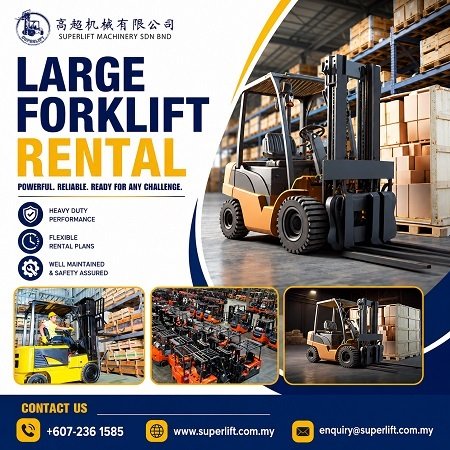
Large forklift rental is the smart choice for short-term projects because it eliminates capital expenditure, reduces maintenance burdens, and gives project managers access to the exact lifting capacity they need — only for as long as they need it. For temporary operations involving heavy loads, renting scales with project demands without locking resources into depreciating assets.
If you're managing a project that involves moving heavy machinery, staging construction materials, or loading oversized cargo — and it's only going to last a few weeks or months — buying a large forklift makes almost no financial sense. The upfront cost alone can run well into six figures. Maintenance, storage, operator certification compliance, and eventual resale headaches add further strain to a project budget that's already under pressure.
This is exactly where large forklift rental solves a real operational problem. You get the machine. You use it. You return it. No depreciation, no idle asset sitting on your books.
What Counts as a "Large Forklift" and When Do You Actually Need One?
Standard warehouse forklifts typically handle loads between 1.5 to 5 tonnes. Large or big forklifts — often called heavy-duty or high-capacity forklifts — go well beyond that range, handling loads from 10 tonnes up to 45 tonnes or more in industrial configurations.
You'd typically need heavy lifting equipment of this scale for:
- Heavy construction projects requiring steel beams, precast concrete, or large mechanical plant
- Port and marine operations for container movement or vessel loading
- Manufacturing facilities during equipment installation or plant relocation
- Oil and gas projects involving heavy component staging and positioning
- Warehouse or distribution centre setup during fit-out phases
The keyword here is "phase." Most of these scenarios are time-bound. The forklift's role is critical but temporary — which makes ownership a poor return on investment.
The True Cost Comparison: Renting vs. Buying for Short-Term Use
Let's be direct. Buying a large forklift for a three-month project is almost always the wrong call. Here's why the numbers rarely work in ownership's favour for short-term scenarios:
| Cost Factor | Ownership | Rental
|
|---|---|---|
| Upfront Capital | High (RM 200,000–RM 800,000+) | None |
| Maintenance & Repairs | Owner's responsibility | Typically covered by rental provider |
| Storage When Idle | Owner's cost | Returned to provider |
| Depreciation | Immediate and ongoing | Not applicable |
| Operator Compliance | Full responsibility | Often advisory support available |
| Resale Complexity | High — specialist market | Not applicable |
For a project lasting under 12 months, the cost structure of big forklift rental consistently outperforms ownership. The break-even point on a purchased heavy forklift — accounting for depreciation, servicing, and financing costs — is rarely reached in short-duration deployments.
Flexibility: The Operational Advantage That Often Gets Overlooked
Scale Up or Down Without Penalty
Project scopes change. Deliveries get delayed. Phase timelines shift. When you own a machine, those changes cost you in idle time and fixed overhead. With temporary forklift rental, you simply adjust the rental period or swap to a different capacity machine if the scope evolves.
Need a 15-tonne unit for the first month and a 25-tonne machine for the second phase? That's a straightforward conversation with your rental provider — not a capital procurement decision requiring board approval.
Right Machine for the Right Job
Large forklift models vary significantly — reach trucks, rough terrain forklifts, telehandlers, counterbalance heavy lifters, and container handlers all serve different environments. Renting gives project managers access to the correct machine for their specific site conditions, whether that's a compacted outdoor construction yard or a port-side loading area with uneven ground.
Ownership typically means you deploy what you have. Rental means you deploy what you need.
Why Forklift Hire in Malaysia Makes Particular Sense for Project-Based Work
In Malaysia, large infrastructure and industrial projects have surged across sectors including construction, logistics, and petrochemical processing. The Malaysian Investment Development Authority (MIDA) has consistently reported significant capital investments in manufacturing and industrial zones in states such as Selangor, Johor, and Penang — all of which drive demand for temporary heavy lifting equipment on project sites.
For project managers operating in Malaysia, forklift hire offers additional advantages specific to the local context:
- Compliance with DOSH (Department of Occupational Safety and Health) regulations: Reputable forklift hire providers in Malaysia ensure their equipment meets DOSH standards, reducing the compliance burden on project teams.
- Avoiding import and customs complexity: Sourcing heavy equipment locally through rental eliminates any cross-border procurement friction for international project contractors.
- Faster deployment: Local rental providers can mobilise equipment to sites across Malaysia significantly faster than a purchase and delivery cycle from an overseas manufacturer.
- Support and breakdown cover: A reliable local provider offers on-the-ground technical support — critical when downtime on a project site has direct cost implications.
What Project Managers Should Evaluate Before Signing a Rental Agreement
Define Your Load Requirements Precisely
The most common mistake in equipment procurement is underspecifying lifting capacity. Always account for the maximum expected load — not the average. Include dynamic loads, attachment weights, and any gradient or terrain factors that affect effective rated capacity.
Confirm Rental Terms and Service Coverage
Not all rental agreements are structured equally. Before committing, project managers should clarify:
- Whether scheduled maintenance is included or billed separately
- Response time guarantees for breakdowns
- Fuel and consumable responsibilities
- Flexibility clauses for rental period extension or early return
- Insurance requirements and liability coverage
Assess Site Conditions Against Equipment Specs
Ground bearing pressure, overhead clearances, aisle widths, and surface type all determine which machine is safe and effective on your site. Share a site plan with your rental provider before finalising equipment selection. An experienced provider will flag potential issues before the machine arrives — not after.
Common Misconceptions About Renting Heavy Forklifts
"Rental is always more expensive long-term." This is true for long-term, continuous use — but irrelevant for project-based deployments under 12 months. Over short periods, rental costs are predictable, contained, and free of the hidden costs that ownership carries.
"You lose control over equipment quality." Reputable providers maintain their fleets rigorously — often to a higher standard than owner-operated equipment — because their business depends on uptime and reliability.
"It's complicated to arrange." Modern equipment rental in Malaysia has become increasingly streamlined. Established providers handle delivery, collection, compliance documentation, and operator guidance as part of a managed service.
Making the Decision: When Rental Is Clearly the Right Call
To summarise the decision framework simply: if your heavy lifting requirement is temporary, variable in scope, or tied to a project milestone rather than an ongoing operational need — rental wins. Every time.
The calculation becomes even clearer when you factor in the speed of deployment, the elimination of asset management overhead, and the ability to match machine specification exactly to project requirements rather than working around what you happen to own.
For project managers handling tight timelines and tighter budgets, working with an experienced and well-equipped local provider is essential. Superlift Machinery offers a comprehensive range of heavy lifting equipment and forklift hire solutions across Malaysia, built specifically to support project-based operations that demand reliability, flexibility, and the right machine for the job.
Frequently Asked Questions
What is the typical rental period for a large forklift on a short-term project?
Large forklift rental periods for short-term projects typically range from one week to twelve months. Most project-based rentals fall in the one to six month range. Rental providers in Malaysia generally offer flexible terms, allowing project managers to extend or shorten the rental period based on actual project progress without significant financial penalties.
What load capacity is considered a "large" or "big" forklift?
A large or big forklift generally refers to equipment with a lifting capacity of 10 tonnes or more. Heavy-duty models can reach 25 to 45 tonnes and above for specialist industrial applications. The right capacity depends on your maximum load weight, load centre, and site conditions. Always specify your peak load — not your average — when requesting a rental quote.
Is temporary forklift rental compliant with Malaysian workplace safety regulations?
Yes, when sourced from a reputable provider. In Malaysia, heavy lifting equipment must comply with DOSH (Department of Occupational Safety and Health) standards under the Factories and Machinery Act. Established rental providers ensure their fleet meets current certification and inspection requirements, reducing the compliance burden on project teams and minimising regulatory risk on-site.
What are the main advantages of forklift hire in Malaysia for international project contractors?
For international contractors operating in Malaysia, local forklift hire eliminates import logistics, customs delays, and cross-border procurement complexity. It also provides faster on-site deployment, access to locally compliant equipment, and on-the-ground technical support. This makes temporary forklift rental significantly more practical and cost-efficient than sourcing or transporting equipment internationally for a fixed-duration project.
What should I check before finalising a large forklift rental agreement?
Before signing a rental agreement, confirm whether maintenance and breakdown support are included, clarify fuel and consumable responsibilities, verify insurance and liability terms, and check for flexibility clauses around rental period changes. Also ensure the specified machine matches your site conditions — including ground surface, load requirements, and clearance dimensions — to avoid costly equipment swaps mid-project.
Can I switch to a different forklift model mid-project if requirements change?
Yes, in most cases. One of the key advantages of renting heavy lifting equipment rather than purchasing is operational flexibility. Reputable rental providers can accommodate machine swaps if your project scope or load requirements change, subject to availability and contract terms. This adaptability is particularly valuable in large construction or industrial projects where phased requirements often shift unexpectedly.